
Mugwort
Artemisia vulgaris L. · Asteraceae · aerial parts (leaf and flowering top); Chinese medicine uses the leaf of A. argyi
Also known as common mugwort, felon herb, St. John's plant, cronewort, Beifuss (German), armoise (French); Nagadamani in Ayurvedic texts; Ai Ye in Chinese medicine (the leaf of the related Artemisia argyi, source of moxa)
- Warm
- Bitter
- Pungent
- Drying
- Bitter digestive
- Emmenagogue
- Nervine
- Oneirogen (dream-enhancing)
- Hemostatic (charred leaf, Chinese medicine)
- Anthelmintic (traditional)
Educational content, not medical advice. Nothing on this page is a substitute for care from a qualified healthcare provider. Do not stop or change a prescribed medication based on anything you read here. Mugwort acts on the uterus, belongs to a plant family that causes allergies, and contains thujone in some chemotypes, so talk with your doctor or pharmacist before using it beyond a cup of tea, and do not use it in pregnancy.
About Mugwort
Mugwort is the flowering top of Artemisia vulgaris, a tall perennial in the daisy family, Asteraceae, which it shares with echinacea and ragweed. The genus Artemisia holds more than 500 species and takes its name from Artemis, the Greek goddess associated with childbirth. Medieval Europe called this plant mater herbarum, the mother of herbs.1
Identification
- Grows 3 to 6 feet tall on angular stems that are often purple-tinged and become woody with age.1
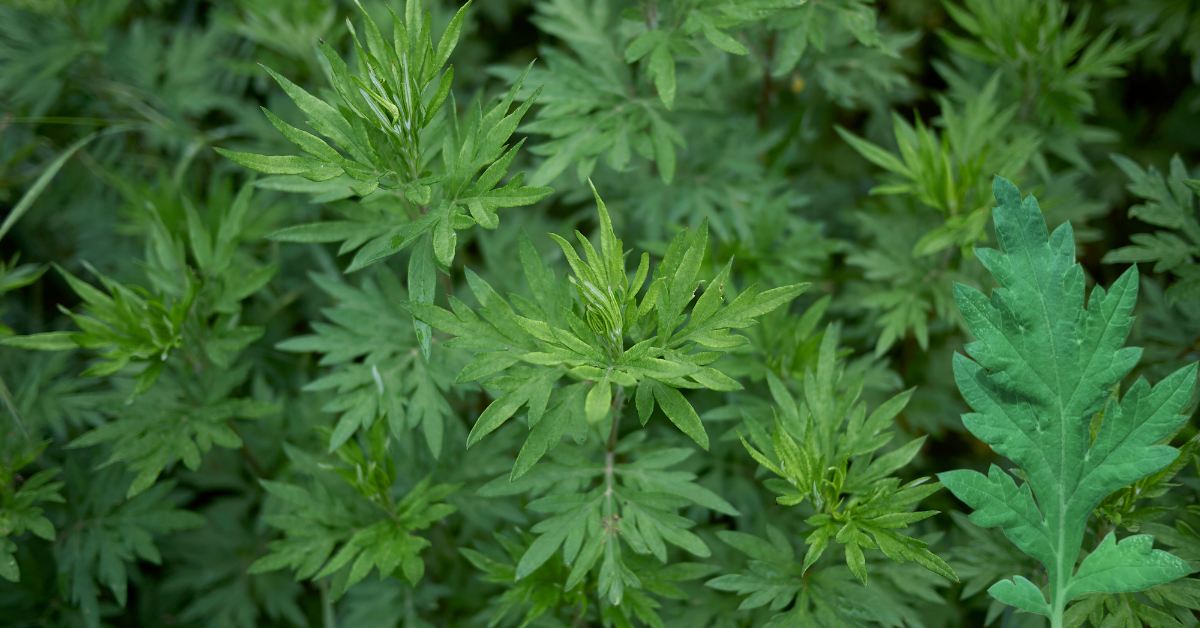
- Leaves are deeply cut, dark green on top and white with dense wool underneath. That silver underside is the field mark that separates mugwort from most look-alikes.1,2
- Flowers are small, dull yellow to reddish brown, and packed into branched spikes from July into September. They are wind-pollinated, which is why mugwort pollen is a major late-summer allergen in Europe and parts of Asia.1,3
- The crushed leaf smells sharp and sage-like. The taste is bitter and spicy.1
- It spreads by root fragments and is classed as an invasive weed in much of North America. It came to the continent with European settlers around the 16th century.1
Where it grows
Native to Europe and Asia, now found on every continent except Antarctica, on roadsides, riverbanks, field edges, and waste ground.1 Here in Montana the plant you are more likely to meet is a native cousin, Artemisia ludoviciana, called western mugwort or white sagebrush, which King's American Dispensatory records the Paiute using for nosebleed and to ease labor.4 Big sagebrush, A. tridentata, is also an Artemisia. True sage is a different genus, Salvia, and the two are not interchangeable.
The other mugworts
Several species travel under the mugwort name, and the medicine changes with the species.
- A. argyi, Chinese mugwort, is the pharmacopoeial source of Ai Ye and of moxa. Its chemistry overlaps closely with A. vulgaris, which is why Western writers often treat them as one plant.5
- A. douglasiana, California mugwort, was once classed as a variety of A. vulgaris and is the species in the Chumash record below.1,6
- A. absinthium, wormwood, is far more bitter and far higher in thujone. Do not substitute it for mugwort.7
- A. annua, sweet wormwood, is the source of the malaria drug artemisinin. Most "Artemisia" research online refers to this species or to the isolated drug, not to mugwort.7
Who has used it
- Greek and Roman medicine. Dioscorides, Pliny, and Galen all described it in the first and second centuries, mainly for the womb and the urinary tract.1
- European folk and monastic medicine. Used for cold digestion, worms, delayed menses, fever, and tired legs, and hung on the door at midsummer against misfortune.1,2
- Chinese medicine. Ai Ye appears in the classical formula Jiao Ai Tang and is the material burned in moxibustion.5
- Unani and Ayurvedic practice. Named in several compound preparations for the liver and for painful periods.1
- Indigenous North America. The Chumash of coastal California used A. douglasiana for menstrual cramps, menopause, and sleep; the Paiute used A. ludoviciana in labor.4,6
Traditional Use
The traditions below describe how practitioners have used mugwort. These are historical and cultural records, not instructions. None of this is medical advice.
Energetics
Every tradition reads mugwort as warm and dry, with a bitter and aromatic taste. Western herbalists use it where digestion is cold and sluggish, where menstruation is scanty or painful from cold, and where the nervous system needs a mild lift. The same warmth makes it a poor fit for hot, dry, irritable constitutions. Chinese medicine classes Ai Ye as bitter, acrid, and warm, entering the liver, spleen, and kidney channels, and cautions against it where heat comes from yin deficiency.2,5,8
Western herbalism
Culpeper assigned mugwort to Venus and to women's complaints. Grieve, writing in 1931, put its effect on the nervous system ahead of its diuretic and sweat-promoting actions, and gave a covered infusion for fevers and colds, taken warm, or cold as a bitter tonic.2 The British Herbal Pharmacopoeia lists poor appetite, nervous indigestion, and intestinal worms as its indications.9 David Hoffmann describes it as a bitter and carminative that supports digestion on two fronts at once, with a mild nervine action he attributes to the volatile oil, and calls it specific for painful periods and for absent periods without a structural cause.8 Nineteenth-century Thomsonian practice in England used a strong mugwort decoction as a steam sitz bath for period pain.10
The Eclectic physicians of the 1800s paid it less attention than its cousin wormwood. King's 1854 dispensatory says A. vulgaris "has been reputed beneficial in epilepsy, hysteria, and amenorrhea," and the 1898 edition adds that the root was the German remedy for those conditions. The 1918 United States Dispensatory repeats the German epilepsy and chorea use.4,11,12 None of them list a dose for mugwort itself, and none of the seizure uses have been tested.
A separate thread runs through European and North American folk use: mugwort under the pillow, in tea before bed, or smoked, to bring vivid and memorable dreams. The 2024 narrative review on dream induction records that reputation and notes that no trial has tested it.13 My Dream Boost tea draws on that tradition.
Chinese medicine: Ai Ye
Bensky's Chinese Herbal Medicine: Materia Medica gives Ai Ye three actions: it warms the womb and stops bleeding, it disperses cold and alleviates pain, and it eliminates dampness and stops itching. The bleeding it addresses is the cold, deficient type, such as prolonged menstrual flow or spotting in early pregnancy, and for that use the leaf is charred first. For cold-type cramps it is used plain or vinegar-processed. Decocted and applied as a wash, it is used for damp, itchy skin conditions. Ai Ye is also the herb aged and rolled into moxa, the wool burned over acupuncture points.5 Chinese sources record the fresh leaf as gentler and less warming than the dried, and the dry-fried leaf as hot.5
Two points from this tradition reappear in the safety section. First, Ai Ye is used within Chinese practice for threatened miscarriage, while Western texts contraindicate mugwort in pregnancy. Second, the same leaf both stops bleeding and, in Western use, brings on a delayed period. The Chinese answer is that the charred leaf restrains and the raw leaf moves; the Western answer is that mugwort regulates a cold, stalled cycle rather than forcing flow. Neither answer has been tested in people.
Unani and Ayurvedic practice
Ekiert's review lists several Unani preparations that include mugwort for liver congestion, enlarged spleen, and chronic fever, and a decoction taken for painful menstruation. Ayurvedic sources give a single dose of the dried herb or liquid extract at 0.5 to 2 g.1 Mugwort does not appear in Sebastian Pole's Ayurvedic Medicine, so I have no primary Ayurvedic monograph to cite for dosha effects.
The Chumash of California
James Adams and Cecilia Garcia, writing in 2006, describe Artemisia douglasiana as a Chumash remedy for painful periods, menopause, and sleep, and the related A. californica as a liniment for pain.6,14 These are ethnobotanical records rather than trials, and Adams practices the tradition he writes about, which the research section notes.
Constituents and What They Do
Mugwort's chemistry varies more from place to place than almost any herb on this site. Ekiert's review found that plants from India and Morocco carry essential oil dominated by thujone, while German plants run on sabinene and cineole with little thujone at all. The figures below come from that review and describe the range, not a single plant.1 Where a constituent is said to do something, the evidence is laboratory or animal work unless stated otherwise.
| Constituent | Amount | What studies show |
|---|---|---|
| Essential oil (1,8-cineole, camphor, borneol, sabinene, caryophyllene, and in some chemotypes thujone) | Highly variable; thujone from 0 to over 20 percent of the oil depending on origin | Carries the aroma and the carminative (gas-relieving) quality. Inhibited bacteria and Candida in the test tube. Thujone is the safety-limiting compound; see Safety.1,15 |
| Sesquiterpene lactones (vulgarin, psilostachyin, yomogin) | Vulgarin about 0.15 percent of dry weight | Provide the bitterness that stimulates digestive secretions. Yomogin blocked histamine H1 receptors and relaxed intestinal and airway smooth muscle in guinea pig tissue.1 Artemisinin has been detected in some samples at 0 to 2.3 percent, which is too inconsistent to make mugwort a source of it.1 |
| Flavonoids (quercetin, luteolin, apigenin, eriodictyol, jaceosidin) | Milligrams per kilogram; eriodictyol and luteolin highest at about 40 mg/kg | Inhibited mouse brain monoamine oxidase in the test tube, the enzyme that breaks down serotonin and dopamine. Eriodictyol and apigenin activated the human estrogen receptor in a yeast assay at about 5 percent the strength of estradiol.1 |
| Coumarins (esculin, umbelliferone, scopoletin) | Not quantified | Scopoletin and esculetin also inhibited monoamine oxidase in the same mouse enzyme study. Plain coumarins of this type are not blood thinners.1 |
| Caffeoylquinic acids (chlorogenic acid relatives) | Up to about 1.1 percent of dry weight for the main one | Account for most of the antioxidant activity measured in water extracts. The European Pharmacopoeia standardizes homeopathic mugwort tincture on these compounds.1 |
| Tannins | Present, not quantified | Add astringency and are the likely basis of the traditional hemostatic and wound uses.1 |
| Prunasin (a cyanogenic glycoside) | Trace | Reported in the plant. No case of harm from it has been documented at herbal doses.1 |
| Pollen proteins (Art v 1, Art v 3, Art v 4) | In pollen, not in leaf preparations | Art v 1 is the major mugwort pollen allergen and the sensitizer behind mugwort-celery-spice syndrome. Relevant to anyone with late-summer hay fever.3,16 |
What the Research Shows
Taken together, the human evidence on mugwort concerns one preparation, moxibustion, in which the leaf of A. argyi is burned near the skin rather than swallowed. Those trials support a modest effect on turning breech babies and on period pain, with the limits noted below. No randomized trial has tested mugwort tea, tincture, or capsules in people for any condition. The digestive, antispasmodic, estrogenic, and monoamine oxidase findings all come from animals, isolated tissue, or the test tube. Antiviral and anticancer claims attached to the genus rest on laboratory work, mostly with other species or with isolated artemisinin, and do not transfer to mugwort. Ekiert's 2020 review is the most complete summary and is the source for the laboratory studies below.1,7
Moxibustion for breech presentation
- Design: systematic review of 13 randomized or quasi-randomized trials, 2,181 pregnant women with a breech baby, comparing moxibustion at the acupuncture point BL67 on the little toe, with or without usual care, against usual care alone or sham moxibustion.
- Findings: moderate-certainty evidence that moxibustion plus usual care probably reduces the number of babies still non-head-down at birth. Evidence on the need for a manual turning procedure was uncertain. One trial suggested less oxytocin use in labor.17
- Dose: typically one or two sessions a day of 15 to 20 minutes over one to two weeks from about 33 weeks of pregnancy; protocols varied.
- Limitations: participants cannot be blinded to a burning stick, most trials were small, results were more consistent in Asian populations, and at least one well-run European trial found no effect. One review author was an investigator on an included pilot study; the other two authors handled that study's assessment. This is a pregnancy intervention that belongs with a midwife or obstetrician, not a home experiment.
Moxibustion for period pain
- Design: pragmatic randomized trial in China; 152 women with primary dysmenorrhea (period pain without a diagnosed pelvic cause) were assigned to moxibustion at abdominal and leg acupuncture points or to a conventional pain medication, over three menstrual cycles. 133 completed the trial.
- Findings: pain scores fell from about 6.4 to 2.5 out of 10 in both groups, with no meaningful difference between moxibustion and the drug at the end of treatment.18
- Dose: moxa stick held near the skin for 30 minutes per session, in the days before and during menstruation.
- Limitations: no placebo or sham group, so the trial cannot separate the moxa from expectation or from the natural swing in period pain month to month. Open-label. Both arms improving equally is consistent with either treatment working or with neither doing much beyond attention. No industry funding reported.
Antispasmodic and airway-relaxing effects
- Design: crude extract applied to strips of rabbit intestine and guinea pig windpipe in a bath, plus a mouse diarrhea model. A separate Philippine team isolated yomogin from a chloroform extract and tested it on guinea pig ileum.
- Findings: the extract relaxed both gut and airway muscle through a combined anticholinergic and calcium-channel-blocking action, at concentrations from 0.03 to 10 mg/mL. Yomogin blocked histamine H1 receptors in the ileum.1
- Dose: tissue-bath concentrations; no human dose can be derived from them.
- Limitations: isolated organ strips and mice. These results explain the traditional carminative and antispasmodic reputation at the level of mechanism only. No human trial exists.
Monoamine oxidase inhibition and the dream reputation
- Design: a South Korean team isolated eight flavonoids and coumarins from an 80 percent ethanol extract of whole mugwort and tested each against monoamine oxidase taken from mouse brain. The 2024 review surveyed substances proposed to induce lucid dreams.
- Findings: all eight compounds inhibited the enzyme, quercetin most strongly at an IC50 of 1 micromole. The review lists mugwort among traditional dream herbs, suggests its MAO inhibition and possible acetylcholinesterase activity as a mechanism worth studying, and states that no trial has tested it.1,13
- Dose: none applicable.
- Limitations: enzyme in a dish, with compounds at concentrations a cup of tea would not reach in the brain. The dream effect remains a tradition with a plausible mechanism and zero clinical data.
Estrogen receptor activity and anti-implantation effects
- Design: a polar extract and individual flavonoids were tested in yeast engineered with the human estrogen receptor. Separately, an Indian team gave leaf extract to female rats and measured pregnancy outcomes.
- Findings: the extract showed about 5 percent of the estrogenic activity of estradiol; eriodictyol and apigenin were the active flavonoids. In rats, the leaf extract showed strong anti-implantation and estrogenic activity.1
- Dose: rat doses; not reported in the review.
- Limitations: yeast and rats. The relevance is to safety in pregnancy, where this animal finding lines up with the traditional emmenagogue use, not to any therapeutic claim.
Chumash women's health and the mugwort liniment
- Design: two ethnobotanical papers by a pharmacology professor and a Chumash healer, recording traditional uses and, in the 2005 paper, a series of pain patients treated with a liniment made from the plant.
- Findings: A. douglasiana tea is recorded for period cramps, menopause, and sleep. The liniment is reported to relieve pain within a minute or so of application; the authors attribute this to monoterpenes in the volatile oil acting on skin pain receptors.6,14
- Dose: topical, applied daily; tea quantities not specified.
- Limitations: no control group, no blinding, self-reported outcomes, and the senior author practices and teaches the healing tradition he describes, which is a conflict of interest even without money involved. Valuable as a record of use, not as proof of effect.
Is moxa smoke safe to breathe?
- Design: smoke from burning moxa was analyzed for the compounds regulated in cigarette smoke: tar, carbon monoxide, polycyclic aromatic hydrocarbons, aromatic amines, formaldehyde, and others.
- Findings: at concentrations well above normal clinic exposure, only a few aromatic amines exceeded permitted limits, and only when results were extrapolated to long-term daily use. The authors judged ordinary moxa use unlikely to pose a health risk.1
- Dose: not applicable.
- Limitations: chemistry of the smoke, not health outcomes in people. Anyone with asthma should still treat it as smoke.
Dosing Perspectives
Not medical advice. The doses below are educational. They show how different herbalists and traditions have approached mugwort so you can see where they agree and disagree. They are not a recommendation for you. Talk with your healthcare provider or a clinical herbalist before using mugwort beyond an occasional cup of tea.
| Source | Preparation | Dose, as stated | Route |
|---|---|---|---|
| Maud Grieve, A Modern Herbal (1931) | Infusion of the herb, made in a covered vessel | 1 oz herb to 1 pint boiling water; half-teaspoonful doses while warm for fever and colds; cold, in similar doses, three times daily as a tonic | Internal |
| Richard Hool (1918) | Infusion | Half-teacup doses for fever and colds | Internal |
| British Herbal Pharmacopoeia (1983) | Dried herb by infusion; liquid extract 1:1 in 25 percent alcohol | 0.5 to 2 g dried herb, or 0.5 to 2 ml liquid extract, three times daily | Internal |
| David Hoffmann, Medical Herbalism (2003) (affiliate link) | Infusion; tincture 1:5 in 25 percent alcohol | Infusion of 1 to 2 teaspoons dried herb per cup, steeped 10 to 15 minutes, three times daily; tincture 1 to 4 ml three times daily | Internal |
| Bensky, Chinese Herbal Medicine: Materia Medica, Ai Ye (A. argyi leaf) | Decoction; charred leaf for bleeding; decoction as an external wash; aged leaf as moxa | 3 to 9 g decocted | Internal; external |
| Ayurvedic sources, as reported by Ekiert et al. (2020) | Dried herb or liquid extract | 0.5 to 2 g per single dose | Internal |
| German folk practice, as reported by Ekiert et al. (2020) | Infusion | One teaspoon (about 1.2 g) dried herb per cup, covered, steeped about 5 minutes | Internal |
| German Commission E (1988) | Herb | No dose given. Unapproved monograph: traditional uses listed, effectiveness "not confirmed" | Not recommended |
The Western sources agree closely: about half a gram to two grams of dried herb per dose, or a few milliliters of tincture, taken up to three times a day. Grieve's half-teaspoon doses of a strong infusion sit at the low end, which fits her emphasis on the nervous system rather than the gut. Chinese practice runs higher, at 3 to 9 g decocted, because the leaf is one part of a multi-herb formula and the decoction is boiled rather than steeped. Commission E is the outlier in refusing to endorse any dose. The gap between the traditions is smaller than it looks once you account for the preparation: a 9 g decoction boiled for 20 minutes has lost much of its volatile oil, while a 2 g covered infusion has kept it.1,2,5,8,9,19
Preparations by What You Want to Extract
Not every constituent in a plant dissolves in every solvent, so the preparation decides what ends up in the cup. If the extraction methods are new to you, start with my article on decoctions versus infusions.
Solubility of the constituents
- Essential oil: dissolves in alcohol and fat, only partly in water, and leaves with steam. This is where the carminative and nervine actions live, and also where the thujone lives.
- Sesquiterpene lactones (the bitters): dissolve in alcohol and moderately in hot water. A tea tastes bitter because enough of them come through.
- Flavonoids and caffeoylquinic acids: dissolve well in hot water and in alcohol-water mixtures. The homeopathic tincture standard is set on these compounds.1
- Coumarins: dissolve in alcohol; partly in hot water.
- Tannins: dissolve in water, more with longer steeping.
Preparations that fit the chemistry
- Covered infusion. One teaspoon of dried herb per cup, boiling water, lid on, 10 minutes. The lid keeps the volatile oil in the cup. This is the traditional bitter-digestive and bedtime form. Expect it to taste bitter; sweetening it defeats part of the point, since bitterness on the tongue is what triggers digestive secretions.
- Tincture. 1:5 in 45 percent alcohol pulls the bitters, flavonoids, coumarins, and most of the oil together. Hoffmann's 25 percent also works but leaves more of the oil behind. Dosed in drops or single milliliters. Napiers in Edinburgh, one of the oldest herbal dispensaries in Britain, sells a 1:3 at 45 percent.8,20
- Decoction, Chinese style. 3 to 9 g of leaf simmered with other herbs. The boil drives off oil but extracts the tannins and phenolic acids fully, which suits the hemostatic and warming uses in that tradition.5
- External wash or sitz bath. A strong decoction cooled to skin temperature, used for damp, itchy skin in Chinese practice and, as a warm sitz bath, for period pain and hemorrhoids in the European record.1,5,10
- Infused oil and liniment. Dried leaf steeped in a carrier oil pulls the volatile oil and carries it into the skin. This is the form behind the Chumash liniment.14
- Moxa. Aged, fluffed leaf of A. argyi rolled into sticks or cones and burned near the skin. Heat is the medicine here. Moxibustion belongs with a trained practitioner, and for breech presentation with your maternity provider.5,17
- Dream pillow. Dried leaf in a small cloth bag under the pillow. Aroma only. No thujone exposure to speak of, and the only preparation on this list with no safety notes attached.
Preparations to skip
- Essential oil taken internally. Distillation concentrates the thujone by a factor of hundreds. This is the one form of mugwort that has caused documented harm in its relatives, and there is no tradition of drinking it.15
- Root as a bitter. Ekiert notes the root lacks the bitter compounds, so a root tea does nothing for digestion. The root was the old German epilepsy remedy, a use with no evidence behind it.1
- Smoking. Traditional, and it does deliver the volatile oil. It also delivers combustion products to the lungs. The dream pillow and the tea cover the same ground without the smoke.
- Glycerite. Glycerin holds the volatile oil poorly and extracts the bitters weakly. You get flavor without much medicine.
Safety and Cautions
Not medical advice. Herbs contain active compounds that can interact with medications and health conditions. Mugwort has a long record of use as a food seasoning and a bitter tea, and a much thinner safety record at medicinal doses. Germany's Commission E declined to approve it in 1988, and a 20th-century German assessment concluded its allergenic potential made it better suited to the kitchen than the medicine cabinet.1,19 The cautions below apply to anyone using it beyond an occasional cup. Talk with your healthcare provider or pharmacist first if any of them apply to you.
Francis Brinker's Herbal Contraindications and Drug Interactions grades each caution by its evidence: empirical (from human use or clinical observation) or speculative (from animal or test-tube data), with the study setting noted. His mugwort entry lists two contraindications and no drug interactions. His grades are carried through below.21
Pregnancy: where the traditions disagree
- Western position. Mugwort is a classical emmenagogue, a herb that brings on menstruation, and European folk records include its use to induce labor or miscarriage. The British Herbal Pharmacopoeia and Hoffmann both contraindicate it in pregnancy.1,8,9 Brinker's first contraindication is "avoid pregnancy," graded empirical for the emmenagogue and abortifacient effects, with the uterine stimulant action shown in vitro or in animals and attributed to thujone.21 The rat study showing anti-implantation activity, described in the research section, points the same direction.1
- Chinese position. Ai Ye, the charred leaf of A. argyi, is used inside formulas for threatened miscarriage with cold-pattern spotting, under a trained practitioner and within a diagnosed pattern.5
- Moxibustion. External use over the little toe in the last weeks of pregnancy has been tested in more than 2,000 women without a safety signal in the trials, and always under maternity care.17
- What this means in practice. Do not take mugwort internally while pregnant or trying to conceive. The Chinese use is a practitioner-supervised exception with a different species and preparation, not a home remedy. Nursing has no safety data, so the same rule applies.
Allergy: the best-documented risk
- Brinker's contraindication. "Do not use if there is allergic hypersensitivity to the plant." He cites a human case report in which an erythema-multiforme-like eruption, a spreading rash with target-shaped blisters, developed after both external and internal medicinal use of mugwort, and a human case report plus a human clinical study showing cross-sensitivity with chamomile pollen.21
- Pollen. Mugwort pollen is one of the main causes of late-summer hay fever in Europe and northern China. Its major allergen, Art v 1, cross-reacts with ragweed and other daisy-family pollens.3,16
- Mugwort-celery-spice syndrome. A minority of people sensitized to mugwort pollen react to celery, carrot, fennel, anise, coriander, black pepper, paprika, and related foods. A 2024 study from Germany's Paul-Ehrlich-Institut identified the celery protein Api g 7 as the cross-reacting partner of Art v 1 and linked it to severe, sometimes life-threatening celery reactions.16 If you have mugwort hay fever and have ever reacted to celery or spices, treat mugwort preparations as a possible trigger.
- Contact dermatitis. Handling the fresh plant causes skin reactions in some people, a pattern seen across the Asteraceae.1
- Family allergy. Anyone with known allergy to ragweed, chamomile, echinacea, or other daisy-family plants should avoid mugwort. Brinker's chamomile evidence makes that family rule a documented one rather than a precaution.21
Thujone
Thujone is a nervous-system toxin found in wormwood, sage, and some mugwort. The sources disagree on how much mugwort carries. Brinker calls thujone its "major volatile constituent."21 Ekiert's review, which compared plants from nine countries, found the thujone share of the essential oil ranging from zero in German and Brazilian samples to over 20 percent in some Lithuanian, Indian, and Moroccan samples.1 Both can be right: it depends on where the plant grew. The European Medicines Agency's public statement on thujone-containing herbal medicines sets a daily ceiling of 6 mg per person for a maximum of 2 weeks.15 Three practical consequences follow. A cup of tea from dried leaf carries a small fraction of the plant's oil and, from a low-thujone source, little or no thujone. The distilled essential oil concentrates it and should never be taken by mouth. Long daily use at tincture doses is the gray zone, which is why every source that gives a duration keeps it short. See the sage monograph for the fuller thujone discussion.
Medications
Brinker lists no drug interactions for mugwort.21 The points below are theoretical and drawn from laboratory findings.
- MAO-inhibitor antidepressants and serotonin-active drugs, theoretical. Mugwort flavonoids and coumarins inhibited monoamine oxidase in mouse brain tissue in a dish.1 No human interaction has been reported, and tea concentrations are far below the test-tube levels. Worth a mention to your prescriber if you take an MAOI or a drug with a narrow margin, and low confidence either way.
- Hormone-sensitive conditions and hormonal medications, theoretical. The estrogen-receptor activity measured in yeast was about 5 percent of estradiol.1 Anyone with a hormone-sensitive cancer, or on hormonal therapy, should ask before using mugwort beyond food amounts.
- Blood thinners. No direct evidence either way. Chinese practice uses the charred leaf to stop bleeding, and the plant's coumarins are the plain type that do not thin blood. Culinary and tea use is not a concern; medicinal doses alongside warfarin are an unknown, and unknowns belong in a conversation with the prescriber.
- Nutrient absorption. The British Herbal Pharmacopoeia notes that high doses may interfere with nutrient absorption, without citing data.9
Constitutional cautions
- Heat from yin deficiency. Chinese sources contraindicate Ai Ye where heat signs come from depleted fluids, and caution in blood-heat bleeding.5
- Hot, dry, irritable constitutions. Western energetics point the same way. A person who runs hot, sleeps poorly from restlessness, and has a dry, inflamed gut is a poor match for a warming, drying bitter.
- Seizure disorders. Mugwort was a folk seizure remedy, and thujone is a known seizure trigger at high doses. Those two facts do not cancel out. Anyone with epilepsy should avoid mugwort at medicinal doses and avoid the essential oil entirely.4,15
Moxa and smoke
- Burns. The main adverse event in moxibustion trials is a minor skin burn from holding the stick too close.17
- Smoke. Chemical analysis found moxa smoke unlikely to pose a risk at normal exposure, but it is still smoke. Ventilate, and skip it with asthma or in a room with an infant.1
Children
No dosing data exist for children, and the allergy and thujone concerns apply with more force in small bodies. A dream pillow is fine. Internal use is not.
Sourcing and identification
Because chemotypes differ so much, buy dried mugwort from a supplier that names the species and country of origin. If you gather your own, confirm the white-felted leaf underside and the sage-like smell, and learn wormwood, A. absinthium, well enough to rule it out; it is far higher in thujone. Do not harvest from roadsides, where Artemisia concentrates road pollutants, and avoid the flowering tops during pollen season if you have hay fever.
Frequently Asked Questions
What is mugwort used for?
Traditionally, as a bitter for cold, sluggish digestion; as a warming herb for painful or delayed periods; as a mild nervine; and, in Chinese medicine, as the charred leaf that stops cold-type bleeding and the aged leaf that becomes moxa. Folk use adds vivid dreams. Human trials exist only for moxibustion, which supports a modest effect on turning breech babies and on period pain.
Is mugwort safe to drink as a tea?
For most non-pregnant adults without a daisy-family allergy, an occasional cup of covered infusion from a reputable source is within every traditional dose range on this page. The people who should skip it are anyone pregnant or trying to conceive, anyone with mugwort, chamomile, or ragweed allergy, and anyone with a seizure disorder. Daily use for weeks at a time is where the thujone question arises, so keep courses short.
Does mugwort cause vivid dreams?
That is the folk reputation across Europe and North America, and a 2024 review of dream-inducing substances lists mugwort with a plausible mechanism through monoamine oxidase inhibition. No trial has tested it. A dried-leaf pillow is the lowest-risk way to find out for yourself.
Is mugwort the same as wormwood?
No. Both are Artemisia species, but wormwood (A. absinthium) is far more bitter and carries much more thujone. Sweet wormwood (A. annua) is a third plant, the source of the malaria drug artemisinin. Mugwort contains little or no artemisinin.
What is moxa?
Moxa is the dried, aged leaf of Chinese mugwort, Artemisia argyi, fluffed into wool and rolled into sticks or cones. Burned near the skin over acupuncture points, it delivers penetrating heat. Its best-studied use is encouraging a breech baby to turn, under maternity care.
Can I take mugwort while pregnant?
No. Western sources contraindicate it as a uterine stimulant, Brinker grades that caution empirical, and animal work shows anti-implantation activity. Chinese medicine uses a charred preparation of a related species inside supervised formulas for threatened miscarriage, which is a practitioner decision, not a home remedy.
Why do I react to celery if I'm allergic to mugwort pollen?
The major mugwort pollen allergen, Art v 1, closely resembles a protein in celery, and the immune system treats them as the same. Carrot, fennel, coriander, and several spices carry related proteins. This is called mugwort-celery-spice syndrome, and it can produce severe reactions, so it deserves an allergist's attention.
Can mugwort cause a rash?
Yes, in sensitized people. Handling the fresh plant causes contact dermatitis in some, and Brinker cites a case in which medicinal use, both on the skin and by mouth, produced a blistering erythema-multiforme-like eruption. Anyone with a chamomile or ragweed allergy is at higher risk.
Does mugwort grow in Montana?
Common mugwort, A. vulgaris, has naturalized in patches, but the Artemisia you will see everywhere here is western mugwort, A. ludoviciana, along with big sagebrush. Western mugwort has its own Indigenous medicinal record and is not a drop-in substitute for the European plant.
Sources
- Ekiert H, Pajor J, Klin P, Rzepiela A, Ślesak H, Szopa A. Significance of Artemisia vulgaris L. (common mugwort) in the history of medicine and its possible contemporary applications substantiated by phytochemical and pharmacological studies. Molecules. 2020;25(19):4415. DOI: 10.3390/molecules25194415. Open access; no conflicts declared. Source for botany, chemotype variation, historical use, the Commission E and pharmacopoeia status, and the laboratory studies summarized on this page.
- Grieve M. Mugwort. A Modern Herbal, 1931. Public domain, hosted at botanical.com.
- Cosi V, Gadermaier G. The role of defensins as pollen and food allergens. Current Allergy and Asthma Reports. 2023;23:277-285. DOI: 10.1007/s11882-023-01080-3. Review of Art v 1 and its cross-reactivity.
- Felter HW, Lloyd JU. Absinthium (U.S.P.), with notes on related Artemisia species including A. vulgaris and A. ludoviciana. King's American Dispensatory, 1898. Public domain, hosted at Henriette's Herbal.
- Bensky D, Clavey S, Stöger E. Chinese Herbal Medicine: Materia Medica, 3rd edition. Eastland Press, 2004. Artemisiae argyi Folium (ai ye) entry.
- Adams JD, Garcia C. Women's health among the Chumash. Evidence-Based Complementary and Alternative Medicine. 2006;3(1):125-131. PMC1375244. Ethnobotanical record; the senior author practices the tradition described.
- Trifan A, et al. Artemisia spp.: an update on its chemical composition, pharmacological and toxicological profiles. Oxidative Medicine and Cellular Longevity. 2022;2022:5628601. PMC9467740. Genus-level review; source for the species distinctions and the laboratory-only status of antiviral claims. .
- Hoffmann D. Medical Herbalism: The Science and Practice of Herbal Medicine. Healing Arts Press, 2003 (affiliate link). Mugwort entry.
- British Herbal Medicine Association. British Herbal Pharmacopoeia, 1983. Artemisia vulgaris entry.
- Tobyn G, Denham A, Whitelegg M. Artemisia vulgaris, mugwort. In: The Western Herbal Tradition: 2000 Years of Medicinal Plant Knowledge. Churchill Livingstone, 2011. Excerpt at ScienceDirect Topics. Source for the Hool and Stevens dosing and the Thomsonian sitz bath.
- King J. Artemisia absinthium, with the note on A. vulgaris. The American Eclectic Dispensatory, 1854. Public domain, hosted at Henriette's Herbal.
- Remington JP, Wood HC, eds. Absinthium, N.F. IV, with the note on A. vulgaris. The Dispensatory of the United States of America, 1918. Public domain, hosted at Henriette's Herbal.
- Oldoni AA, Bacchi AD, Mendes FR, Tiba PA, Mota-Rolim S. Neuropsychopharmacological induction of (lucid) dreams: a narrative review. Brain Sciences. 2024;14(5):426. DOI: 10.3390/brainsci14050426. Narrative review; no trials of mugwort identified.
- Adams JD, Garcia C. The advantages of traditional Chumash healing. Evidence-Based Complementary and Alternative Medicine. 2005;2(1):19-23. PMC1062165. Case reports without controls; the senior author practices the tradition described.
- European Medicines Agency, Committee on Herbal Medicinal Products. Public statement on the use of herbal medicinal products containing thujone, revision 1. EMA/HMPC/732886/2010 Rev.1, 2012. EMA thujone statement (PDF). .
- Paul-Ehrlich-Institut. New insights on celery allergies and associated risks. Press release, 22 May 2024, summarizing Ballmer-Weber BK, et al. New light on an old syndrome: role of Api g 7 in mugwort pollen related celery allergy. Journal of Allergy and Clinical Immunology. 2024;154:679-689. German federal institute; no industry funding.
- Coyle ME, Smith C, Peat B. Cephalic version by moxibustion for breech presentation. Cochrane Database of Systematic Reviews. 2023;(5):CD003928. DOI: 10.1002/14651858.CD003928.pub4. One review author was an investigator on an included pilot trial; assessed independently by the other two.
- Yang M, et al. Moxibustion for pain relief in patients with primary dysmenorrhea: a randomized controlled trial. PLOS ONE. 2017;12(2):e0170952. DOI: 10.1371/journal.pone.0170952. Drug-controlled, no placebo arm. .
- German Commission E. Mugwort (Artemisiae vulgaris herba), unapproved herb monograph, 1988. In: Blumenthal M, ed. The Complete German Commission E Monographs. American Botanical Council, 1998. ABC Commission E, Mugwort. ABC is a nonprofit funded in part by industry membership. .
- Napiers the Herbalists, Edinburgh. Mugwort tincture, Artemisia vulgaris, 1:3 in 45 percent. Retail product page; cited only for the tincture strength and the dispensary's stated adult dose. Commercial source, low confidence for anything beyond that.
- Brinker F. Herbal Contraindications and Drug Interactions, 4th edition. Eclectic Medical Publications, 2010. Mugwort entry, p. 248. Brinker grades each entry as empirical or speculative and notes the study setting (human, animal, in vitro); those grades are quoted as given.
This monograph is updated as new research and sources become available.

Ivy Ham
I'm Ivy Ham, a clinical herbalist dedicated to blending traditional healing wisdom with modern science, and revealing how nature's remedies can enhance everyday wellness. Through my blog, I share insights on herbal solutions, nutrition, and holistic practices to guide you toward a more balanced, vibrant life.
Certified clinical herbalist · Missoula, Montana · Read more about Ivy