
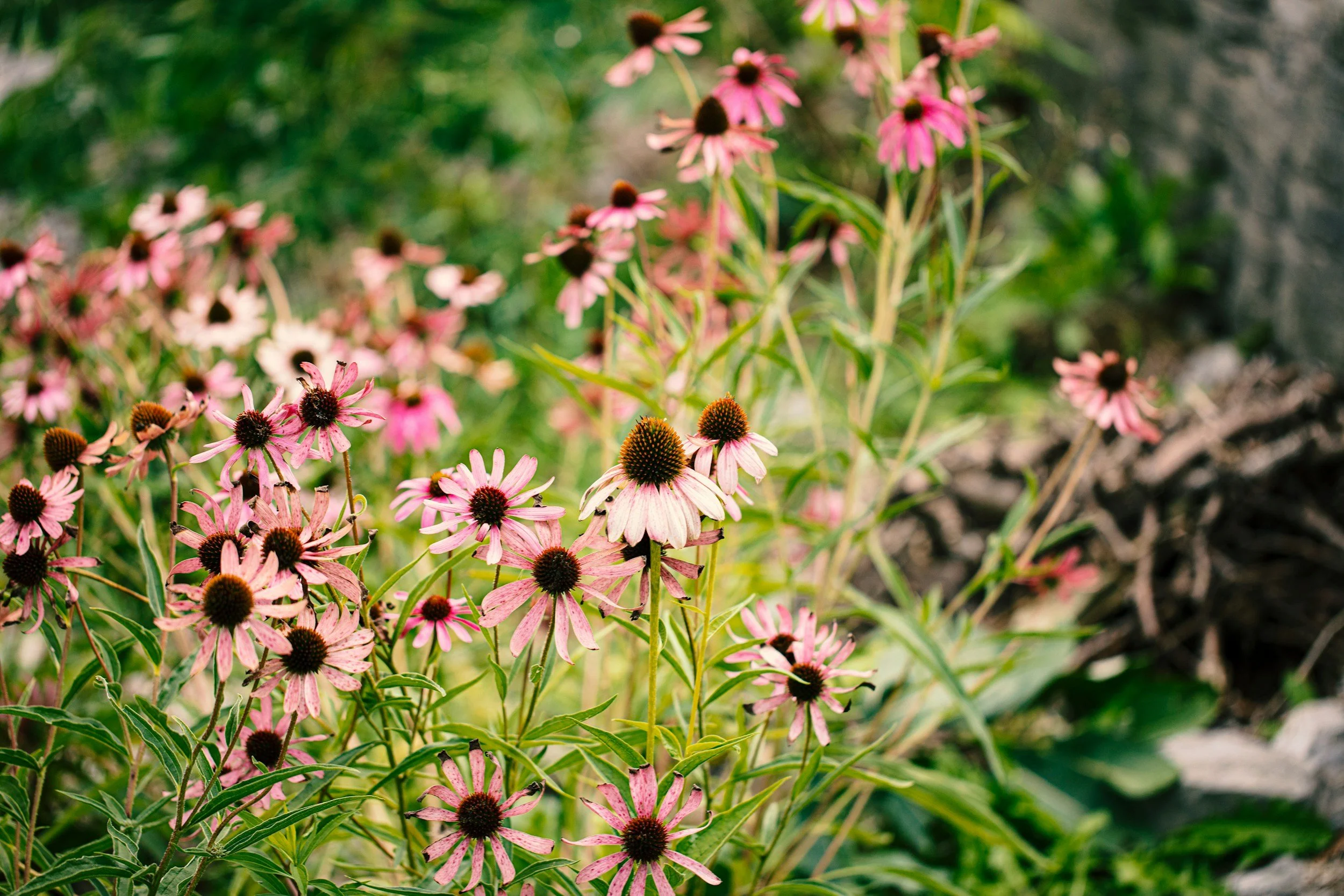
Echinacea
Echinacea angustifolia, Echinacea purpurea, Echinacea pallida · Asteraceae · root (all three); fresh aerial parts (purpurea)
Also known as purple coneflower, narrow-leaved coneflower, pale purple coneflower, Black Sampson, Kansas snakeroot
- Cool
- Pungent
- Bitter
- Immune modulator
- Lymphatic
- Alterative
- Sialagogue
- Vulnerary
Educational content, not medical advice. Nothing on this page is a substitute for care from a qualified healthcare provider. Do not stop or change a prescribed medication based on anything you read here. Echinacea can cause serious allergic reactions in sensitive people and carries regulatory cautions for autoimmune conditions, so talk with your doctor or pharmacist before using it if either applies to you.
About Echinacea
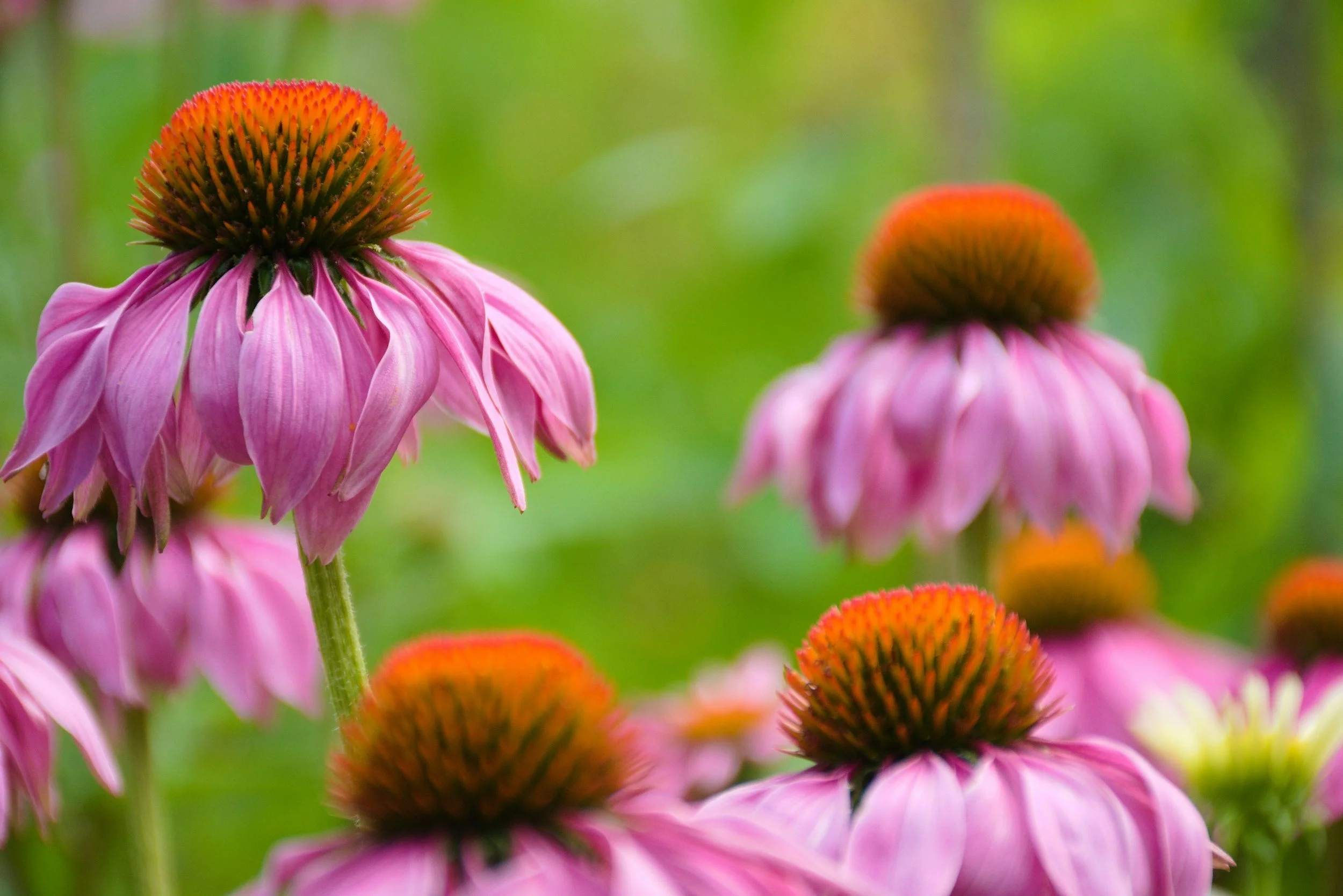
Echinacea is a genus of nine perennial wildflowers native to the prairies and open woods of central and eastern North America, all in the daisy family, Asteraceae.19 The name comes from the Greek echinos, hedgehog, for the spiny cone at the center of the flower. Three species are used in herbal medicine, and they differ in chemistry, in tradition, and in which trials were run on them. Most writing about echinacea never says which one it means.
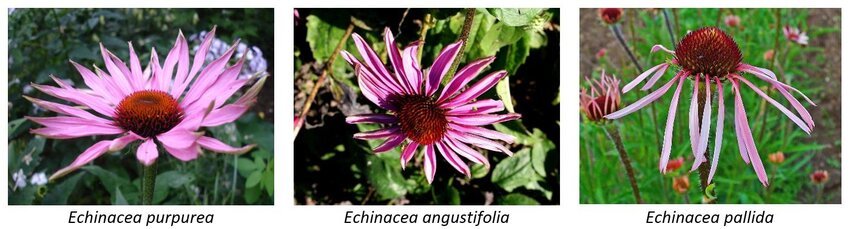
- Echinacea angustifolia, the narrow-leaved coneflower, grows on the dry plains from Texas into Canada. This is the species the Plains nations used and the one the Eclectic physicians of the late 1800s built their practice on. Both used the root.1,4
- Echinacea purpurea, the purple coneflower, is the broad-leaved garden species with a wider range through the eastern and central United States. It grows easily from seed, which angustifolia does not, and that single fact explains its commercial dominance.4
- Echinacea pallida, the pale purple coneflower, sits between the two geographically and receives the least attention. Germany's Commission E approved its root, so it carries a regulatory monograph that angustifolia root does not.6
How purpurea became the research plant
In 1938 the German physician and manufacturer Gerhard Madaus obtained seed from America that he believed was Echinacea angustifolia. It was Echinacea purpurea.4 Angustifolia would not cultivate reliably in Germany, purpurea would, and the product line that followed (Echinacin, a fresh-pressed juice of the aerial parts) became the basis of most European echinacea research through the twentieth century. When you read an older European study labeled angustifolia, assume purpurea unless the root chemistry proves otherwise.
| E. angustifolia | E. purpurea | E. pallida | |
|---|---|---|---|
| Common name | Narrow-leaved coneflower | Purple coneflower | Pale purple coneflower |
| Part used | Root | Root and fresh aerial parts | Root |
| Tradition | Plains nations, Eclectics, US National Formulary to 1946 | German research and commerce since 1938 | Commission E and EMA monographs |
| Cichoric acid | Low | High | Low |
| Echinacoside | Present | Absent | Present |
| Tongue-tingling alkylamides | High in root | Present in root | Low |
| Cultivation | Slow, difficult from seed | Easy from seed | Moderate |
| Conservation | At-risk; buy cultivated only | Secure in cultivation | Regionally pressured |
Sustainability
Wild Echinacea angustifolia has been dug hard for over a century, and the whole genus appears on the United Plant Savers Species At-Risk list. Wild stands recover slowly because the root is the medicine and harvest kills the plant. United Plant Savers also notes that other species are routinely dug, mislabeled, and sold as angustifolia.19 Buy cultivated root from suppliers who state the species and growing source. Cultivated angustifolia exists. Purpurea from cultivation is abundant and carries no conservation burden, which is a sound reason to use it even where a tradition prefers angustifolia.
Traditional Use
The traditions below describe how practitioners have used echinacea. These are historical and cultural records, not instructions. None of this is medical advice.
Energetics
In the energetic language used by Western herbalists, echinacea is cool, pungent, and bitter. It clears heat and toxins, moves stagnant lymph, and has affinities for the lungs, liver, and stomach.20 King's records the physical signature of the root: a persistent tingling on the tongue and a marked increase in saliva.1 The pattern it suits is hot, septic, and inflamed: infection with fever, foul discharge, boils, swollen glands, and wounds that trend toward putrefaction. The same energetics mark who it suits less well. A person who runs cold, pale, and low in vitality is a poor match for a cooling, dispersing herb.
The Plains nations
Christopher Hobbs' history of the plant documents Echinacea angustifolia root as one of the most widely used medicines of the Great Plains, applied to snakebite, insect stings, toothache, sore throat, burns, and infections of many kinds. The root was chewed, poulticed, and decocted.4 A Nebraska patent-medicine seller, H.C.F. Meyer, brought the plant to the Eclectic pharmacist John Uri Lloyd in the 1880s, and Lloyd's firm turned it into the most prescribed remedy in Eclectic practice.4
The Eclectics
King's American Dispensatory (1898) classifies echinacea as an alterative (a remedy believed to gradually restore normal function), antiseptic, and sialagogue, and records its use in:1
- septicemia, which they called blood poisoning, and typhoid states
- boils, carbuncles, abscesses, and foul or gangrenous discharges
- bites of snakes, spiders, and insects, and rabid-animal bites as a supportive measure
- diphtheria, tonsillitis, and other throat infections
- eczema and other chronic skin conditions with sticky exudation, in "liberal doses... for a prolonged period"
- leucorrhoea with offensive discharge, and vulvitis in children
Felter's Eclectic Materia Medica (1922) adds that echinacea "has been held to increase phagocytosis," a claim the laboratory later confirmed, and that "no reliable cases of fatal poisoning in human beings have been recorded from its use."2 Ellingwood (1919) records twenty drops of fluid extract every two hours in a case of septic kidney failure, "the echinacea alone being continued."3 Ellingwood also notes the identity confusion that persists today: the eastern purpurea "is often used for the same purposes, but is universally disappointing" compared with the western angustifolia.3 The Eclectics set no limit on duration and used the root for months in chronic septic conditions. Their echinacea was angustifolia root in high-alcohol tincture, and its 65 percent ethanol fluid extract stayed in the US National Formulary until 1946.4
European regulatory monographs
Germany's Commission E approved E. purpurea fresh aerial herb as supportive therapy for colds and chronic infections of the respiratory and lower urinary tract, and externally for poorly healing wounds, and approved E. pallida root as supportive therapy for influenza-like infections.5,6 The European Medicines Agency lists purpurea juice as well-established for short-term prevention and treatment of the common cold, and angustifolia root as a traditional supportive remedy for colds.8,9
Modern clinical use
Contemporary herbalists use echinacea for colds and respiratory infections, skin infections, poison oak and poison ivy, lymphatic congestion, and topically on wounds and bites. Karta Purkh Singh Khalsa's working protocol pairs it with eleuthero and astragalus, two deep immune tonics, and follows each dose with ten minutes of light exercise to move lymph.20 In Dental Herbalism, Leslie Alexander and Linda Straub-Bruce document echinacea for dental abscesses, oral infections with pus, sinus pain of dental origin, swelling, toothache, and the fevers that accompany acute dental infection, continuing the toothache use recorded on the Plains.21 A dental abscess still requires a dentist. The herb is support, and drainage is the treatment.
Constituents and What They Do
Three groups of compounds carry the immune activity, and they sit in different parts of the plant and dissolve in different solvents. That is why species, plant part, and preparation decide what a product does.
| Constituent | Where it sits | What studies show |
|---|---|---|
| Alkylamides (isobutylamides) | Roots of angustifolia and purpurea; low in pallida root. Fat-soluble, extracted by alcohol. | The compounds behind the tongue tingle. Two of them bind the cannabinoid CB2 receptor on immune cells more strongly than the body's own cannabinoids, at about 60 nM, and modulate TNF-alpha and interleukin signaling in human blood in a dish.15 This is the current mechanistic explanation for the "immune modulator" label. Cell-level evidence only. |
| Caffeic acid derivatives | Cichoric acid: high in purpurea. Echinacoside: angustifolia and pallida, absent from purpurea. Water-soluble. | Show phagocytosis-stimulating activity in laboratory work. Echinacoside is the industry marker for angustifolia and pallida, and per Khalsa that marker is close to meaningless as a potency measure, since echinacoside contributes little to the immune effect.20 Both compounds degrade by enzyme action during processing unless the enzymes are inactivated.13 |
| Polysaccharides | Aerial parts and expressed juice; some in root. Water-soluble, not alcohol-soluble. | Activate macrophages (white blood cells that engulf debris) in laboratory work. Most relevant in juice, decoction, and tea, and largely absent from high-proof tinctures.10 |
| Ketoalkenes and ketoalkynes | Pallida root, in place of the alkylamides. | Give pallida root its own chemical profile and explain why it does not tingle. Laboratory antimicrobial activity reported; no human outcome data on these compounds alone. |
What the Research Shows
Echinacea research is harder to read than most because trials used different species, plant parts, and extraction methods, then got pooled as if they tested one thing. Taken together: prevention trials point the same direction, toward a small reduction in colds, without any single trial reaching significance. Treatment trials are inconsistent, and the one large trial that used a high early dose of root extract found only a non-significant half-day trend. Direct rhinovirus challenge with a low dose of angustifolia root found nothing. Safety data from thousands of trial participants are reassuring apart from allergy. The immune-cell mechanism is well supported in the laboratory.
Cochrane review: prevention and treatment of colds
- Design: 24 double-blind trials, 4,631 people, 33 comparisons of an echinacea product against placebo. Nine prevention trials and 14 treatment trials, plus one doing both.
- Findings: no individual prevention trial reached significance, but results were so consistent that the authors pooled them and found a 10 to 20 percent relative reduction in cold episodes. Treatment trials showed at most a small effect on duration and severity, and the authors did not judge it clinically meaningful. Dropouts from adverse events were the same as placebo.10
- Dose: varied by trial.
- Limitations: the products differed in species, part, and process, so the pooled prevention number is exploratory. Eight trials were rated high risk of bias. Co-author Bruce Barrett's own trial is included, and co-author Rudolf Bauer has a long research history with echinacea manufacturers. Cochrane itself takes no industry funding.
Meta-analysis with broader inclusion rules
- Design: 14 trials pooled by a University of Connecticut pharmacy group, including trials of echinacea combined with vitamin C or other supplements and three trials using direct rhinovirus inoculation.
- Findings: odds of developing a cold fell by 58 percent and cold duration fell by 1.4 days.11
- Dose: varied by trial.
- Limitations: the inclusion rules are the reason this review looks better than Cochrane. Four of the 14 trials tested echinacea plus another supplement, five used Madaus products, and heterogeneity between trials was high. The 58 percent figure is an odds ratio, which reads larger than the risk reduction it represents.
High early dose of root extract for a new cold
- Design: 719 people aged 12 to 80 in Wisconsin with a cold under 36 hours old, assigned to no pills, blinded placebo, blinded echinacea, or open-label echinacea. Tablets contained 675 mg purpurea root and 600 mg angustifolia root equivalents; eight tablets on day one, four daily for four more days.
- Findings: the blinded echinacea group trended toward about 10 percent lower overall severity and a half-day shorter cold than blinded placebo, and the difference did not reach significance. No side effects beyond placebo.12
- Dose: 10.2 g dried root equivalent on day one, then 5.1 g daily.
- Limitations: this is the closest any large trial has come to the traditional high-dose-at-onset protocol, using root rather than aerial parts, and the result was a trend rather than an effect. Co-author Kerry Bone co-founded MediHerb, which made the tablets. Funding came from the US National Center for Complementary and Alternative Medicine.
Angustifolia root against experimental rhinovirus
- Design: 437 volunteers, 399 analyzed, given one of three root extracts (supercritical CO2, 60 percent ethanol, or 20 percent ethanol) or placebo, either for seven days before or starting at the moment of nasal rhinovirus inoculation, then sequestered five days.
- Findings: no significant effect on infection rate, symptoms, nasal secretions, white cell counts in nasal washings, or virus levels.13
- Dose: 1.5 ml three times daily, equivalent to about 900 mg of root per day.
- Limitations: the dose was a fraction of what King's, Ellingwood, or Barrett used, and the exposure was a single high dose of one virus strain squirted into the nose, which no ordinary cold matches. The trial is strong evidence that 900 mg a day of angustifolia root does not stop lab-induced rhinovirus, and weak evidence about anything else. NCCAM funded.
Four months of daily purpurea extract for prevention
- Design: 755 healthy adults in Cardiff took 0.9 ml three times daily or placebo for four months, kept symptom diaries, and gave nasal samples during colds.
- Findings: 149 cold episodes and 672 episode-days with echinacea against 188 episodes and 850 episode-days with placebo, fewer recurrent infections, and less painkiller use. Adverse events were equal to placebo.14
- Dose: 2.7 ml daily.
- Limitations: A. Vogel Bioforce, which makes Echinaforce, funded the trial and two of its employees are co-authors. The product is mostly aerial parts, so it says little about root. This is the best safety dataset for months of continuous use and the strongest single prevention result, and both come with the funding caveat.
Alkylamides and the cannabinoid CB2 receptor
- Design: binding assays, receptor screening against 49 other receptors, and cytokine measurements in human whole blood, at ETH Zurich.
- Findings: two echinacea alkylamides bound CB2 (the cannabinoid receptor on immune cells) at about 60 nM, tighter than the body's own anandamide, and were selective for CB2 over CB1. At 50 nM they raised IL-6 and modulated TNF-alpha in whole blood.15
- Dose: not applicable; cell work.
- Limitations: a mechanism, not an outcome. The earlier 2004 paper this builds on had two Bioforce employees as co-authors; this one lists academic and Novartis affiliations.
Echinacea in pregnancy
- Design: 206 women who used echinacea in pregnancy, 112 of them in the first trimester, compared with 206 matched women exposed to agents known not to cause birth defects, followed through delivery by the Motherisk program in Toronto.
- Findings: no significant difference in major or minor malformations, delivery method, gestational age, birth weight, or fetal distress.16
- Dose: various products, most often for 5 to 7 days.
- Limitations: 206 exposures can rule out a large increase in malformations and cannot rule out a small one. Products, species, and doses were self-reported and mixed. This remains the only human dataset, and the EMA relies on it while still recommending against use in pregnancy without a doctor's advice.
Dosing Perspectives
Not medical advice. The doses below are educational. They show how different herbalists, traditions, and regulators have approached echinacea so you can see where they agree and disagree. They are not a recommendation for you. Work with your healthcare provider before using any herb, especially if you have an autoimmune condition, a history of allergy, or take medication.
| Source | Preparation | Dose (as stated) | Use |
|---|---|---|---|
| King's American Dispensatory (1898) | Specific echinacea (angustifolia root, high-alcohol tincture) | 1 to 5 drops; "larger doses (even 60 drops) may be employed, but small doses are generally most efficient if frequently repeated." In a mixture of 1 to 2 fluidrachms in 4 fluidounces of water, a teaspoonful every half hour or hour in acute cases, every 3 or 4 hours in chronic | Internal; also applied externally |
| Felter, Eclectic Materia Medica (1922) | Specific medicine echinacea | 1 to 5 drops, up to 60; same mixture and frequency as King's | Internal and external |
| Ellingwood, American Materia Medica (1919) | Fluid extract of the root; Specific Medicine Echinacea | Fluid extract 1/4 to 1/2 fluid dram; specific medicine 5 to 40 "or even sixty" drops; in a septic case, 20 drops of fluid extract every two hours | Internal |
| German Commission E (1992) | E. purpurea fresh aerial herb, expressed juice | 6 to 9 ml daily; not beyond 8 weeks without medical advice | Internal; externally as semi-solid preparations with at least 15 percent juice |
| German Commission E (1992) | E. pallida root tincture, 1:5 in 50 percent ethanol | Equivalent to 900 mg dried root daily; not beyond 8 weeks | Internal |
| European Medicines Agency (2014) | E. purpurea fresh herb expressed juice, 1.5 to 2.5:1 | Single dose 1.5 to 4.5 ml; daily 6 to 9 ml; not more than 10 days; start at first signs; adolescents and adults only | Internal; ointment with 10 to 20 g juice per 100 g for small superficial wounds, up to one week |
| European Medicines Agency (2012) | E. angustifolia root: tea, powder, tincture, liquid extract | Tea: 1 g in 150 ml boiling water, infused at least 10 minutes, 3 times daily (or decocted 10 minutes). Powder: 500 mg up to 3 times daily. Tincture 1:5 in 45 percent ethanol: 1 to 2 ml 3 times daily. Liquid extract 1:1 in 45 percent ethanol: 0.25 to 1 ml 3 times daily. Adolescents and adults | Internal |
| Karta Purkh Singh Khalsa, Herbal Defense | Root tincture, acute infection | Large frequent doses, up to 5 ml every 2 hours at onset | Internal |
| Barrett trial (2010) | Root extract tablets, purpurea and angustifolia | 10.2 g dried root equivalent on day one, then 5.1 g daily for four days | Internal |
Two things stand out. The Eclectics, who used more echinacea than anyone before or since, preferred small doses given often, and reached for the 60-drop dose only in severe septic cases. Modern herbalists like Khalsa and the Barrett trial went the other way, with gram-level daily amounts. The regulators sit in the middle and add time limits: 8 weeks from Commission E, 10 days from the EMA for purpurea juice.5,8 Every named source agrees on one point: begin at the first sign of symptoms.
Preparations by What You Want to Extract
Not every constituent in a plant dissolves in every solvent, so the preparation decides what ends up in the cup. If the extraction methods are new to you, start with my article on decoctions versus infusions.
Solubility of the constituents
- Alkylamides: fat-soluble. They come out in alcohol and need a strong tincture; the Eclectic specific medicine was high-proof, the EMA angustifolia monograph uses 45 percent ethanol, and Echinaforce uses 65 percent.1,9,14 Water pulls them only partly.
- Caffeic acid derivatives: water-soluble and alcohol-soluble, and they break down by enzyme action in fresh or slowly dried material. Fast drying or prompt tincturing preserves them.13
- Polysaccharides: water-soluble and left behind by high-proof alcohol. Decoction, tea, and expressed juice carry them; a 65 percent tincture does not.
Preparations that fit the chemistry
- Root tincture. The Eclectic preparation and the one every named herbalist on this page reaches for first. A good angustifolia or purpurea root tincture tingles on the tongue within seconds and increases saliva. If it does not, the material was weak, old, or the wrong species and part. Pallida root does not tingle at any strength.
- Root decoction. Simmer 1 to 2 teaspoons of dried root per cup for 10 to 15 minutes, per the EMA angustifolia monograph.9 Water pulls the polysaccharides and caffeic acids well and the alkylamides partly, so decoction and tincture are complements rather than substitutes. Some practitioners take both in an acute infection.
- Fresh-pressed juice. The German purpurea preparation behind Echinacin and most of the European trial data. It is an aerial-part medicine rich in polysaccharides and cichoric acid, made from fresh flowering plants, and is the preparation the Commission E and EMA purpurea monographs describe.5,8
- Topical. Diluted tincture or strong decoction as a wash or compress on bites, stings, boils, poison oak and poison ivy, and infected wounds, alongside internal use. The EMA lists purpurea juice ointment at 10 to 20 percent for small superficial wounds.8
- Combinations. Khalsa pairs echinacea with eleuthero and astragalus.20 For a cold with cold signs, garlic is a warming partner that offsets echinacea's cooling energetics.
Preparations to skip
- Glycerin extracts as the main preparation. Glycerin extracts the alkylamides poorly. King's used glycerin as a vehicle mixed with the alcohol tincture, not as the solvent.1
- Low-dose capsules of powdered aerial parts. Dried leaf and stem hold little of the root alkylamides, and the caffeic acids degrade in slow drying. Most of the negative treatment trials used preparations in this category.
- Products that do not name the species and plant part. With echinacea, an unnamed product tells you nothing about what is in it.
Safety and Cautions
Not medical advice. Herbs contain active compounds that can interact with medications and health conditions. Echinacea has an unusually clean toxicity record: no overdose has ever been reported to the EMA, and adverse events in trials of thousands of people run at placebo levels.8,10,14 The cautions that matter are allergy and population-specific. Where a caution is marked (empirical) or (speculative) below, the grade is Francis Brinker's from Herbal Contraindications and Drug Interactions: empirical means someone observed it happen, speculative means it is an inference from laboratory or theoretical work.22 Talk with your healthcare provider or pharmacist before using echinacea if any of these apply to you.
Allergy (empirical)
Echinacea is in the daisy family, and the EMA and Brinker both contraindicate it in anyone hypersensitive to Asteraceae plants such as ragweed, chrysanthemum, marigold, and daisy.8,9,22 Brinker reports that reactions are mainly contact dermatitis, with anaphylaxis after internal use in a human case report, and that of 26 adverse reactions reported across six brands of tablets, tea, and tincture, all 26 suggested allergy and half were in atopic patients: four anaphylaxis, twelve acute asthma attacks, ten hives or angioedema. Of 100 other atopic patients, only three had ever used echinacea, yet 20 percent reacted to skin-prick testing with echinacea extracts.22 The EMA adds Stevens-Johnson syndrome and bronchospasm to the list and flags atopic people (those with eczema, hay fever, or asthma) as being at particular risk of severe reactions.8 Brinker's counterpoint: only 2 of 1,032 patients tested at six patch-test clinics reacted to an ointment made with 10 percent echinacea tincture, so topical sensitization is rare.22 If you are atopic and have never taken echinacea, this is the caution to take seriously.
The autoimmune question (speculative)
Commission E lists progressive systemic diseases such as tuberculosis, leukosis, collagenosis, multiple sclerosis, AIDS, and HIV infection as contraindications, and the EMA adds autoimmune disease, immunodeficiency, immunosuppression, and diseases of the white blood cell system as conditions where use is "not recommended."5,8 That caution now appears on nearly every label, usually stated as settled fact. The evidence behind it:
- Brinker grades every one of these cautions speculative. The reasoning is laboratory work: arabinogalactan polymers from the roots stimulate spleen cells and cytokine production in a dish, and they resemble arabinogalactans in the cell wall of the tuberculosis bacterium. For purpurea aerial parts he writes that the caution applies "in principle."22
- Four human case reports appear in Brinker: thrombotic thrombocytopenic purpura in a 32-year-old man after a week of pallida extract, sudden Sjögren's syndrome after two weeks of echinacea and other herbs, a pemphigus vulgaris flare within a week of starting an unnamed echinacea product, and autoimmune hepatitis in a 45-year-old man after a month of 1.5 g daily of unnamed root tablets, which resolved when he stopped. Brinker's verdict on all four: no product was characterized or identified and no causal evidence was provided, "so the causal association in these cases remains speculative."22
- His counter-evidence: ten weeks of purpurea juice extract in 60 patients "totally without adverse effects," twelve weeks of an aqueous purpurea extract four times daily in 23 subjects with no change in white cell counts, and a rat study in which high-alcohol root extract of all three species failed to raise antibody levels at all.22
- The American Botanical Council's expanded Commission E notes that most of the systemic-disease contraindications were written for injectable echinacea and "have been misinterpreted to mean that echinacea use can exacerbate such conditions; however, there is no clinical evidence to support this concern."7
- Karta Purkh Singh Khalsa reports that across decades of practice, including patients with lupus and other autoimmune diseases, he has not observed echinacea trigger a flare, reasoning that an autoimmune disease is a misdirected immune system rather than an overactive one.20
- Against all of this, the EMA states that "association with autoimmune diseases cannot be excluded."8
Every position is on this page because the question is unresolved. Anyone with an autoimmune condition, HIV, tuberculosis, a blood cancer, or an organ transplant should decide with their prescriber, not from a product label or from this page.
How long can you take it? (speculative)
Three duration rules circulate. Commission E says not beyond 8 weeks without medical advice, the EMA says not beyond 10 days for purpurea juice, and Brinker lists "avoid prolonged use therapeutically for more than 6-8 weeks" as speculative, then cites the ten-week and twelve-week human studies above as evidence against it.5,8,22 All three are precautionary limits set for lack of long-term data, not findings that the herb stops working. A separate claim, that echinacea loses effect after 10 days, traces to a single 1989 German phagocytosis study. Paul Bergner's Medical Herbalism journal documented that the study dosed for five days only and the English-language summaries mistranslated the graph; the decline in immune measures came after the herb was stopped, not during use. Kerry Bone brought the error to light, and he co-founded MediHerb, an echinacea manufacturer, which is worth knowing when weighing his position.17 Against the whole debate stands the Eclectic record: they used echinacea for months in chronic conditions and King's records "liberal doses... for a prolonged period" in chronic skin disease.1 One published case report links a low white blood cell count to long-term daily use; it is one case, with no rechallenge.18 Short courses with breaks remain a defensible default for self-care, and anyone using echinacea for more than a few weeks should be doing so with a practitioner.
Medications
- Immunosuppressive drugs (speculative). Brinker lists cyclosporine and corticosteroids as drugs echinacea "may offset or minimize," and advises transplant patients to keep any use short-term. The support is rat antibody data, and the same rat model failed to show an effect at 250 mg/kg of root extract.22 Two human studies in his adjunct list cut the other way: purpurea extract at 150 mg twice daily for nine months alongside dexamethasone or prednisone let uveitis patients stay off steroids for an average of 209 and 146 days versus 121 and 87 on steroids alone, and purpurea juice with econazole cut recurrent candida infections from 60.5 percent to about 16 percent over six months.22 Decide with your prescriber.
- Drugs cleared by liver enzymes. The EMA monographs report no interactions.8,9 Brinker fills in the detail: angustifolia root tincture is a strong CYP3A4 inhibitor in a dish, and the inhibition tracks alkamide content across species and preparations. In people, 400 mg of purpurea root four times daily for 8 days increased clearance of intravenous midazolam and reduced its bioavailability, yet did not change oral midazolam, and 1.6 g of whole purpurea plant daily for 28 days had no clinically relevant effect on caffeine or tolbutamide. His reading is that gut and liver effects may run in opposite directions.22 If you take a drug with a narrow dosing window, ask your pharmacist.
- Liver-toxic drugs (speculation). A caution against combining echinacea with anabolic steroids, amiodarone, methotrexate, or ketoconazole circulates on the theory that echinacea harms the liver. Brinker grades it speculation and explains why: echinacea's two pyrrolizidine alkaloids lack the chemical ring that makes that alkaloid family toxic, they occur at 0.006 percent of dry root weight, and seven Australian hepatitis reports attributed to echinacea were never confirmed.22
Pregnancy, nursing, and children
- Pregnancy. The only human data, 206 exposed pregnancies including 112 in the first trimester, showed no increase in malformations or other adverse outcomes.16 The EMA cites those "several hundreds of exposed pregnancies" as reassuring and still does not recommend use in pregnancy without a doctor's advice, for lack of more data.8 Brinker lists no pregnancy contraindication for any echinacea species.22 No source records harm. No source clears it either.
- Nursing. No data. The EMA does not recommend use during lactation without medical advice and says echinacea products should not be applied to the breast.8
- Children under 12. The EMA does not recommend purpurea juice or angustifolia root under 12 for lack of adequate data.8,9 In the one pediatric trial Brinker cites, 200 children aged 2 to 11 on dried purpurea juice had a 7.1 percent rash rate against 2.7 percent on placebo.22 Children are also the age group most likely to have undiagnosed atopy, which raises the allergy stakes.
Energetic caution
Practitioners who apply energetic categories caution against echinacea in people with chronic coldness, pallor, and low vitality, the pattern sometimes called deficient yang, since a cooling, dispersing herb can drive that state deeper.20 This is a pattern-based caution rather than a toxicological one, and it is the one most safety lists leave out.
Frequently Asked Questions
What is echinacea good for?
Traditionally, infections of many kinds: colds and respiratory infections, skin infections, boils, bites and stings, swollen glands, wounds, and dental infections. The proposed mechanism is activation of white blood cells and movement of lymph rather than direct killing of pathogens. Research support is strongest for a modest reduction in the number of colds.
Does echinacea work?
For prevention, the pooled trials point toward 10 to 20 percent fewer colds, with no single trial reaching significance on its own. For treatment of a cold already underway, results are mixed; the largest high-dose root trial found a non-significant half-day trend. Products differ so much in species, part, and preparation that "echinacea" in one trial is often not the same medicine as in another.
Who should not take echinacea?
Anyone allergic to plants in the daisy family, and atopic people should check with a doctor first because severe reactions have been reported. European regulators also do not recommend it in autoimmune disease, immunodeficiency, or on immunosuppressive drugs; Brinker grades every one of those cautions speculative, and the question remains unresolved. Children under 12, pregnant, and nursing people are advised to use it only with medical guidance.
Is echinacea safe during pregnancy?
One study of 206 women who used it in pregnancy found no increase in birth defects or other problems. That is reassuring and it is the only human dataset, so regulators still recommend against use in pregnancy without a doctor's advice.
Does echinacea interact with medications?
The European monographs report no interactions. Laboratory work shows the root can inhibit the liver enzyme CYP3A4, and one human study found a change in how an intravenous sedative was cleared without any change to the same drug taken by mouth. Theoretical cautions exist for immunosuppressants. Ask a pharmacist if you take a drug with a narrow dosing window.
Which species of echinacea is best?
Angustifolia root is the traditional choice of the Plains nations and the Eclectics and carries the most tongue-tingling alkylamides. Purpurea is the species behind most European research, is easy to grow, and carries no conservation burden. Pallida root has a Commission E monograph and a different chemistry. Whichever you choose, buy cultivated root from a supplier who names the species.
How do you pronounce echinacea?
Ek-ih-NAY-shuh. The first syllable is "ek," from the Greek word for hedgehog.
Sources
- Felter HW, Lloyd JU. Echinacea. King's American Dispensatory, 1898. Public domain, hosted at Henriette's Herbal.
- Felter HW. Echinacea. The Eclectic Materia Medica, Pharmacology and Therapeutics, 1922. Public domain, hosted at Henriette's Herbal.
- Ellingwood F. Echinacea. The American Materia Medica, Therapeutics and Pharmacognosy, 1919. Public domain, hosted at Henriette's Herbal.
- Hobbs C. Echinacea: From Native American Panacea to Modern Phytopharmaceutical. Hobbs is a fourth-generation herbalist and botanist; the article is a history and sells nothing.
- German Commission E monograph, Echinaceae purpureae herba, 1992. In: Blumenthal M, ed. The Complete German Commission E Monographs. American Botanical Council, 1998. ABC Expanded Commission E, Echinacea purpurea herb.
- German Commission E monograph, Echinaceae pallidae radix, 1992. ABC Expanded Commission E, Echinacea pallida root.
- American Botanical Council. Expanded Commission E, Echinacea purpurea root (unapproved monograph). Source of the note that the systemic-disease contraindications derive from injectable preparations. ABC is a nonprofit funded in part by industry membership.
- European Medicines Agency, Committee on Herbal Medicinal Products. European Union herbal monograph on Echinacea purpurea (L.) Moench, herba recens. EMA/HMPC/48704/2014, adopted 24 November 2014.
- European Medicines Agency, Committee on Herbal Medicinal Products. Community herbal monograph on Echinacea angustifolia DC., radix. EMA/HMPC/688216/2008, adopted 27 March 2012.
- Karsch-Völk M, Barrett B, Kiefer D, Bauer R, Ardjomand-Woelkart K, Linde K. Echinacea for preventing and treating the common cold. Cochrane Database of Systematic Reviews. 2014;(2):CD000530. DOI: 10.1002/14651858.CD000530.pub3.
- Shah SA, Sander S, White CM, Rinaldi M, Coleman CI. Evaluation of echinacea for the prevention and treatment of the common cold: a meta-analysis. The Lancet Infectious Diseases. 2007;7(7):473-480. DOI: 10.1016/S1473-3099(07)70160-3.
- Barrett B, Brown R, Rakel D, Mundt M, Bone K, Barlow S, Ewers T. Echinacea for treating the common cold: a randomized trial. Annals of Internal Medicine. 2010;153(12):769-777. DOI: 10.7326/0003-4819-153-12-201012210-00003. NCCAM funded; co-author Bone co-founded MediHerb, which supplied the product.
- Turner RB, Bauer R, Woelkart K, Hulsey TC, Gangemi JD. An evaluation of Echinacea angustifolia in experimental rhinovirus infections. New England Journal of Medicine. 2005;353(4):341-348. DOI: 10.1056/NEJMoa044441. NCCAM funded.
- Jawad M, Schoop R, Suter A, Klein P, Eccles R. Safety and efficacy profile of Echinacea purpurea to prevent common cold episodes: a randomized, double-blind, placebo-controlled trial. Evidence-Based Complementary and Alternative Medicine. 2012;2012:841315. DOI: 10.1155/2012/841315. Funded by A. Vogel Bioforce AG; co-authors Schoop and Suter are Bioforce employees.
- Raduner S, Majewska A, Chen JZ, et al. Alkylamides from Echinacea are a new class of cannabinomimetics: cannabinoid type 2 receptor-dependent and -independent immunomodulatory effects. Journal of Biological Chemistry. 2006;281(20):14192-14206. DOI: 10.1074/jbc.M601074200. Builds on Gertsch et al., FEBS Letters 2004, which had two Bioforce co-authors.
- Gallo M, Sarkar M, Au W, et al. Pregnancy outcome following gestational exposure to echinacea: a prospective controlled study. Archives of Internal Medicine. 2000;160(20):3141-3143. Abstract at ResearchGate.
- Bergner P, ed. Echinacea: the 10-day myth. Medical Herbalism: A Journal for the Clinical Practitioner. Documents the mistranslation of Jurcic K, et al., Zeitschrift für Phytotherapie 1989;10:67-70, with credit to Kerry Bone (MediHerb co-founder).
- Kemp DE, Franco KN. Possible leukopenia associated with long-term use of echinacea. Journal of the American Board of Family Practice. 2002;15(5):417-419. Single case report.
- United Plant Savers. Echinacea (Echinacea spp.), Species At-Risk list.
- Khalsa KPS, Landis R. Herbal Defense: Positioning Yourself to Triumph Over Illness and Aging. Warner Books, 1997.
- Alexander L, Straub-Bruce L. Dental Herbalism: Natural Therapies for the Mouth. Healing Arts Press, 2014.
- Brinker F. Echinacea angustifolia; Echinacea pallida; Echinacea purpurea; Echinacea purpurea root. In: Herbal Contraindications and Drug Interactions, 4th edition. Eclectic Medical Publications, 2010, pp. 129-139. Brinker is a naturopathic physician; the book cites primary studies for every entry and grades each caution empirical or speculative.
This monograph is updated as new research and sources become available.

Ivy Ham
I'm Ivy Ham, a clinical herbalist dedicated to blending traditional healing wisdom with modern science, and revealing how nature's remedies can enhance everyday wellness. Through my blog, I share insights on herbal solutions, nutrition, and holistic practices to guide you toward a more balanced, vibrant life.
Certified clinical herbalist · Missoula, Montana · Read more about Ivy