Sea Moss and Carrageenan: The Same Seaweed, Two Reputations
Sea moss gel and sea moss capsules are sold as mineral-rich supplements. Carrageenan is a food additive with a long list of critics. Both come from the same group of red seaweeds, and in the case of Irish moss, from the same plant. This article explains the connection, what researchers use carrageenan for, what published studies say about how it behaves in the digestive tract, and where else the minerals in sea moss can be found.
Key takeaways
- Irish moss (Chondrus crispus) was the original commercial source of carrageenan and is still used for it today.
- Most carrageenan is now extracted from Kappaphycus and Eucheuma, the same tropical seaweeds sold as "gold" or "Jamaican" sea moss.
- Since 1962, researchers have injected carrageenan into lab animals to produce swelling, then tested anti-inflammatory drugs against it.
- Carrageenan absorbs many times its weight in water. Animal studies since 1969 have linked oral carrageenan to colon ulceration in several species.
- Regulators consider food-grade carrageenan acceptable at current intakes, but the European review in 2018 labeled its safety limit temporary and asked for more data.
- Whole sea moss carries variable iodine and concentrates heavy metals from the water it grew in. Independent lab testing has confirmed lead, cadmium, and arsenic in a retail sea moss gel.
- The minerals people take sea moss for are available from foods and tested supplements that do not carry these exposures.
This article is for educational purposes and is not medical advice. It does not diagnose, treat, or prevent any condition. Talk with a qualified healthcare provider before starting or stopping any supplement, especially if you are pregnant, breastfeeding, have a thyroid condition, or have a digestive disorder.
What sea moss is
Evidence: strong. Botanical identity and commercial sourcing are documented by the seaweed industry itself.
"Sea moss" is a marketing term that covers several species. In the North Atlantic it refers to Irish moss, Chondrus crispus, a small red alga that grows on rocks along the coasts of Ireland, France, Canada, and New England.[1] Dried, it looks like a tangle of purple or gold fronds. Soaked and blended, it swells into a thick gel.
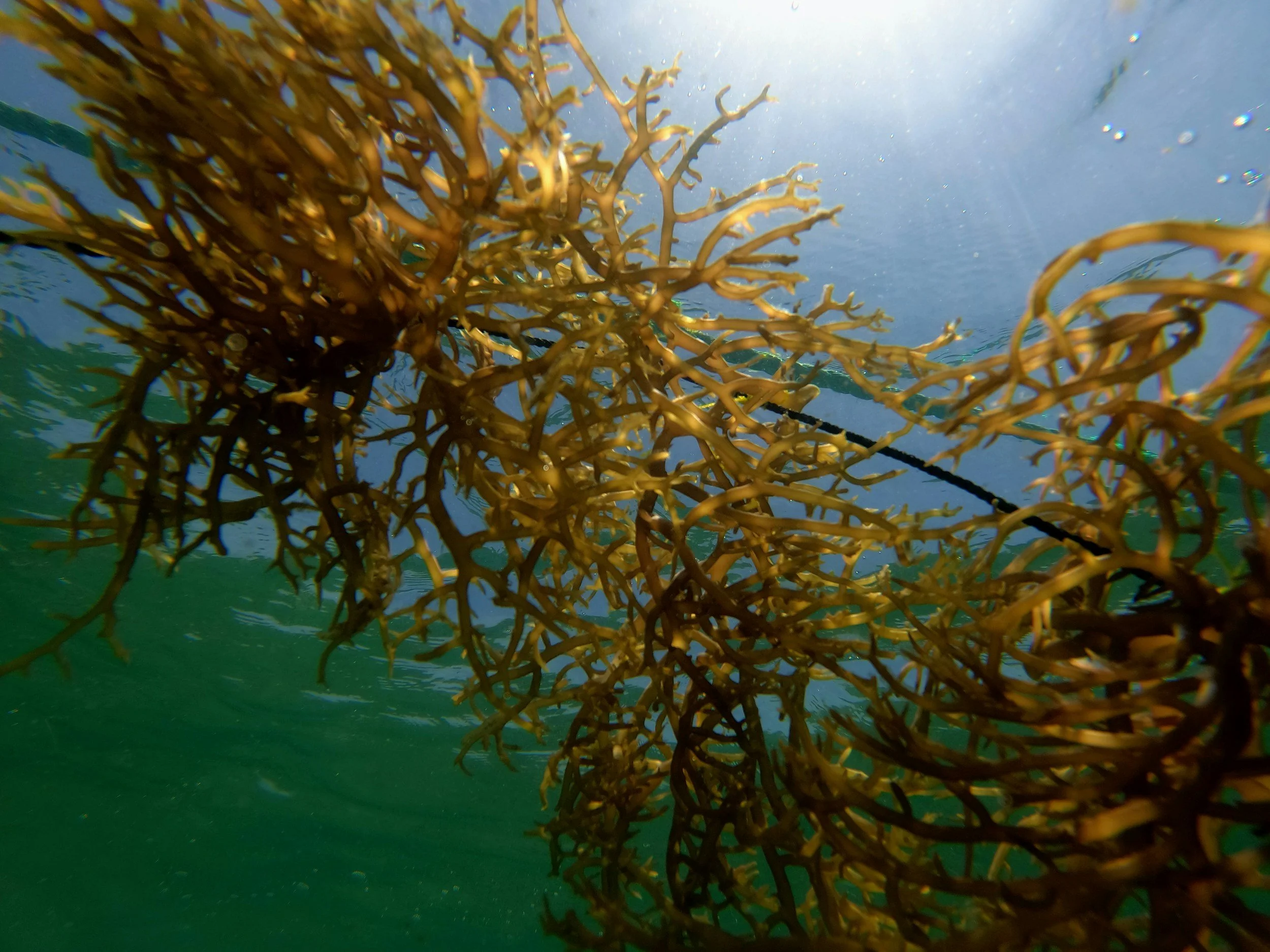
Most sea moss sold in the United States is a different plant. The gold and purple varieties marketed as Jamaican or St. Lucian sea moss are usually Kappaphycus alvarezii (sold in the trade as "cottonii") or Gracilaria species, both farmed in warm water.[2] These have different chemistry from Irish moss, and the difference comes up again below.
All of these seaweeds are sold for the same reasons. They contain minerals absorbed from seawater, including iodine, calcium, magnesium, and iron, and they thicken anything they are added to. That thickening ability is the property the food industry extracts and sells separately.
Carrageenan comes from the same seaweeds
Evidence: strong. Sourcing is documented in the FAO's industry guide and in peer-reviewed reviews of carrageenan production.
Carrageenan is the name given to the sulfated polysaccharides that make up the cell walls of certain red seaweeds. The word comes from Carrageen, a town on the Irish coast where Irish moss was harvested, and the extract was first described by a British pharmacist in 1862.[3]
According to the Food and Agriculture Organization's guide to the seaweed industry, Chondrus crispus was the original source of commercial carrageenan, collected wild from France, Ireland, Portugal, Spain, and eastern Canada. When demand outgrew the wild supply in the 1970s, producers turned to farmed Eucheuma and Kappaphycus in the Philippines.[1] Today those two genera supply more than 90 percent of the world's carrageenan, and wild Irish moss is still used for specialty grades.[4]
So the answer to "is sea moss the same plant as carrageenan" is yes for Irish moss, and yes for the Kappaphycus that fills most sea moss jars. Gracilaria is the exception. It is farmed for agar, a different gelling polysaccharide.[1] If your sea moss label does not name a species, you have no way to know which one you bought.
The additive on an ingredient list has been separated from the rest of the plant. Manufacturers boil the seaweed in alkali, filter it, and precipitate the polysaccharide. The result is a purified powder that accounts for roughly half the dry weight of the original seaweed.[1] When you blend sea moss into a gel, you are consuming that same polysaccharide with the rest of the plant still attached.
Why researchers use carrageenan to cause inflammation
Evidence: strong. The carrageenan paw edema model has been a standard pharmacology assay since 1962 and is cited in thousands of papers and drug patents.
In 1962, three scientists at the Merck Institute for Therapeutic Research published a method for testing anti-inflammatory drugs. They injected a 1 percent solution of carrageenan, described in the paper as "an extract of Chondrus," into the hind paw of rats. Swelling peaked within about three hours. Aspirin, phenylbutazone, and hydrocortisone all reduced the swelling in proportion to their dose.[5] The study was conducted and funded by Merck, a pharmaceutical manufacturer.
This became the carrageenan-induced paw edema assay, still used by contract research labs and drug companies to screen anti-inflammatory compounds.[6] Carrageenan was chosen because it produces inflammation predictably. It triggers prostaglandin release and draws fluid and white blood cells into the tissue. Related models inject carrageenan into the pleural cavity or into a pouch of air under the skin to study the same response.
Injecting a substance under the skin is different from swallowing it, and the paw model alone does not prove anything about dietary sea moss. It does explain where carrageenan's reputation comes from. When a lab needs to create inflammation for an experiment, carrageenan is the standard choice.
What carrageenan does in the digestive tract
Evidence: moderate for animals, limited for humans. Animal colitis models are well established. Human trial data is small and contested.
It absorbs water
Carrageenan is a hydrocolloid. In water it swells, then gels, which is why it thickens ice cream and gives sea moss gel its texture. Irish moss can absorb 20 to 100 times its own weight in water when boiled.[1] The European Food Safety Authority's 2018 review concluded that carrageenan is not absorbed intact and passes through the gut.[7] A bulky, water-binding polysaccharide moving through the colon can loosen stools and cause bloating in people sensitive to it. Individual tolerance varies, and no test predicts who will react.
Animal colitis studies
In 1969, two researchers at the University of Liverpool reported that guinea pigs, rabbits, rats, and mice given carrageenan from Chondrus crispus and Eucheuma spinosum developed changes in the colon lining that resembled human ulcerative colitis.[8] Feeding a 5 percent solution of degraded carrageenan to guinea pigs produced ulcers in the cecum, colon, and rectum in every animal within 30 days.[9] Degraded carrageenan, now called poligeenan, is broken into smaller fragments by acid and heat and is not permitted in food. The guinea pig ulceration model became a research tool in its own right, used to study inflammatory bowel disease the same way the paw model is used to study joint swelling.[10]
A 2001 review in Environmental Health Perspectives by Joanne Tobacman of the University of Iowa collected these experiments and argued that both degraded and undegraded (food-grade) carrageenan were associated with intestinal ulceration and tumor promotion in animals.[11] The review also noted that the International Agency for Research on Cancer classified degraded carrageenan as a possible human carcinogen in 1982. Tobacman's work is the foundation of most consumer concern about carrageenan, and she has continued publishing on it for two decades.
The regulatory position
The EFSA panel reviewed the same literature in 2018 and reached a more cautious conclusion. In rat studies, food-grade carrageenan produced no adverse effects at the highest doses tested, and the panel found no evidence of genotoxicity. It kept the acceptable daily intake at 75 milligrams per kilogram of body weight. It also called that limit temporary and asked industry to supply better data within five years, in part because commercial carrageenan can contain a fraction of low-molecular-weight material closer to the degraded form.[7]
The one human trial
The only randomized human trial comes from Tobacman's group at the University of Illinois at Chicago. Twelve patients with ulcerative colitis in remission followed a carrageenan-free diet and were randomized to capsules containing either carrageenan or placebo. Relapses occurred only in the carrageenan group.[12] Twelve people is a small number, and the study should be read as a pilot. A 2019 critique in the same journal, written by authors with consulting ties to carrageenan manufacturers (see the paper's disclosure statement), argued the trial's design could not support its conclusion.[13] The original authors published a reply defending the design.[14]
Carrageenan inflames tissue when injected and ulcerates the colon of some animal species when fed in degraded form. Whether the food-grade form harms a healthy human gut at typical intakes is unresolved. The people who report problems with it tend to already have intestinal permeability or an inflammatory bowel condition.
Whole sea moss versus the extracted additive
Evidence: moderate. Mineral and iodine content of Irish moss is measured in published composition studies; contamination depends on harvest location and has been confirmed by independent lab testing.
Blending whole seaweed into a gel differs from adding purified carrageenan to a carton of almond milk. Whole sea moss includes protein, fiber, polyphenols, and minerals that the extraction process removes.[15] It has not been treated with alkali or heat in a way that fragments the polysaccharide. The carrageenan in it is in its native form, bound inside the plant's cell walls.
Two other issues come with the whole plant. The first is iodine. Seaweed iodine content varies widely between species, harvest sites, and even batches, and most sea moss products do not state how much they contain. Case reports have documented thyroid suppression in breastfed infants whose mothers ate large amounts of seaweed.[16] If you are managing a thyroid condition, an unmeasured daily iodine dose is worth knowing about.
The second is heavy metals. Seaweeds concentrate arsenic, cadmium, lead, and mercury from the water around them. A 2022 analysis of commonly consumed seaweeds found arsenic in every sample tested, at levels ranging from 6.7 to 76 milligrams per kilogram.[17] This is not limited to wild harvests of unknown origin. Tamara Rubin of Lead Safe Mama, an independent consumer advocate who sends retail products to accredited labs for ICP-MS testing, published results in January 2025 for a premium gold sea moss gel sold in the United States. It tested positive for lead, cadmium, and arsenic. Her seaweed testing archive includes additional seaweed snacks and kelp supplements with similar findings.[18] Sea moss farmed in clean water and tested by batch will differ from product with no test on file, and the label rarely tells you which one you have.
My experience with sea moss
Evidence: personal account. This section describes my own use and is not a clinical observation.
I consumed sea moss gel for a period of time as a mineral supplement, and I recommended it to friends and family for the same reason. At the time I did not know that the plant in my blender was the same one processed into carrageenan, or that carrageenan was the standard tool for creating inflammation in a lab. I learned that later, while reading the pharmacology literature for a different article.
I stopped using it after that. I had no symptom to blame it for. I had been consuming and sharing a concentrated hydrocolloid without understanding what it was, and I prefer to know what a supplement is before I take it. If you have been drinking sea moss gel and feel fine, the research above does not require you to change anything. If you have unexplained bloating, loose stools, or a history of food sensitivities, it is a reasonable thing to remove for a few weeks and observe, with your provider's input.
Other ways to get the same minerals
Evidence: strong for food composition. The minerals in sea moss are well characterized in ordinary foods.
Sea moss is marketed on its mineral content, mostly iodine, calcium, magnesium, potassium, and iron. None of those are unique to seaweed, and none of the foods below concentrate heavy metals the way a marine alga does or bring carrageenan with them.
Dairy supplies calcium, potassium, and a measurable amount of iodine, since iodine is used to sanitize milking equipment and appears in the milk. Oysters and other shellfish supply iron, zinc, and iodine, and unlike seaweed they do not accumulate arsenic to the same degree. Bone broth and gelatin supply calcium and magnesium along with glycine. Cooked leafy greens, well-ripened fruit, and orange juice cover potassium and magnesium. Cooked beef liver covers iron and copper. For iodine specifically, iodized salt and a measured drop of potassium iodide give you a known dose, which sea moss never does.
If you want a supplement rather than food, look for one that publishes a certificate of analysis for lead, cadmium, arsenic, and mercury by lot number. Lead Safe Mama maintains a running list of foods and supplements that tested non-detect for all four.[18] The Ray Peat approved foods list on this site groups many of these mineral sources by what they supply.
What to look for on a label
Evidence: practical guidance based on the sourcing and contamination data above.
If you choose to keep sea moss in your routine, the label should answer four questions. Which species is it, by Latin name? Where was it harvested or farmed? Has the batch been tested for arsenic, cadmium, lead, and mercury, with results available? Does it state an iodine content per serving? A product that answers none of these has given you nothing to evaluate.
For packaged foods, carrageenan appears on ingredient lists under its own name, as E407, or as "processed Eucheuma seaweed" (E407a). It is common in plant-based milks, deli meat, cottage cheese, chocolate milk, and infant formula. Ray Peat, whose work shapes much of the metabolic thinking on this site, listed carrageenan among the food additives he advised avoiding, and his approved foods list reflects that.
Frequently asked questions
Is sea moss the same thing as carrageenan?
Sea moss is the whole seaweed. Carrageenan is the polysaccharide extracted from it. Irish moss and Kappaphycus, the two seaweeds most often sold as sea moss, are both commercial carrageenan sources. Gracilaria sea moss is farmed for agar instead.
Does sea moss cause inflammation?
Injected carrageenan causes inflammation in lab animals, which is why researchers use it. Whether eating whole sea moss inflames the human gut is not established. Animal feeding studies have produced colon ulceration, mostly with degraded carrageenan, and the single human trial was too small to settle the question.
Why does sea moss upset some people's stomachs?
Carrageenan binds a large amount of water and is not digested, so it passes through the colon as a bulky gel. That can produce bloating or loose stools in people sensitive to it, especially those with existing digestive conditions.
Does sea moss contain heavy metals?
It can. Seaweeds absorb arsenic, cadmium, lead, and mercury from seawater. Independent ICP-MS testing published by Lead Safe Mama in 2025 found lead, cadmium, and arsenic in a retail sea moss gel. Levels depend on where the seaweed grew, and only batch testing tells you what is in a specific jar.
Is food-grade carrageenan banned anywhere?
The degraded form, poligeenan, is not permitted in food. Food-grade carrageenan remains approved in the United States and the European Union. The 2018 EFSA review kept its intake limit but labeled that limit temporary pending more data.
Is sea moss safe during pregnancy or breastfeeding?
Seaweed iodine content is variable and often unlabeled, and excess maternal iodine has been linked to thyroid suppression in infants in published case reports. This is a question for your provider, with the specific product in hand.
Sources
- McHugh DJ. A Guide to the Seaweed Industry. FAO Fisheries Technical Paper 441. Rome: Food and Agriculture Organization; 2003. Sections 1, 6, and 8.10. ↩
- Contract Laboratory. Complete Guide to Sea Moss Testing and Analysis. 2026. Industry testing guide; used only for species identification of commercial sea moss. ↩
- Morris CJ. Carrageenan-Induced Paw Edema in the Rat and Mouse. In: Inflammation Protocols. Methods in Molecular Biology, vol 225. Humana Press; 2003. doi:10.1385/1-59259-374-7:115 ↩
- Rupert R, Rodrigues KF, Thien VY, Yong WTL. Carrageenan From Kappaphycus alvarezii (Rhodophyta, Solieriaceae): Metabolism, Structure, Production, and Application. Front Plant Sci. 2022;13:859635. PMC9127731 ↩
- Winter CA, Risley EA, Nuss GW. Carrageenin-induced edema in hind paw of the rat as an assay for antiinflammatory drugs. Proc Soc Exp Biol Med. 1962;111:544-547. PMID 14001233. Funding: authors were employed by the Merck Institute for Therapeutic Research. ↩
- Inotiv. Carrageenan Induced Paw Edema (Rat, Mouse). Contract research organization protocol page; cited to show current commercial use of the assay. ↩
- EFSA Panel on Food Additives and Nutrient Sources added to Food. Re-evaluation of carrageenan (E 407) and processed Eucheuma seaweed (E 407a) as food additives. EFSA Journal. 2018;16(4):5238. doi:10.2903/j.efsa.2018.5238. Note: the panel's toxicology data were largely supplied by industry, as documented in the opinion. ↩
- Marcus R, Watt J. Seaweeds and ulcerative colitis in laboratory animals. Lancet. 1969;2(7618):489-490. PMID 4183921 ↩
- Watt J, Marcus R. Carrageenan-induced ulceration of the large intestine in the guinea pig. Gut. 1971;12(2):164-171. PMID 5548564 ↩
- Anver MR, Cohen BJ. Animal model of human disease. Ulcerative colitis. Animal model: ulcerative colitis induced in guinea pigs with degraded carrageenan. Am J Pathol. 1976;84(2):431-434. PMC2032452 ↩
- Tobacman JK. Review of harmful gastrointestinal effects of carrageenan in animal experiments. Environ Health Perspect. 2001;109(10):983-994. doi:10.1289/ehp.01109983 ↩
- Bhattacharyya S, Shumard T, Xie H, et al. A randomized trial of the effects of the no-carrageenan diet on ulcerative colitis disease activity. Nutr Healthy Aging. 2017;4(2):181-192. doi:10.3233/NHA-170023. Academic study, University of Illinois at Chicago and University of Chicago. ↩
- McKim JM, Willoughby JA, Blakemore WR, Weiner ML. A Critical Review of "A randomized trial of the effects of the no-carrageenan diet on ulcerative colitis disease activity." Nutr Healthy Aging. 2019;5(1):63-79. doi:10.3233/NHA-180051. Conflict of interest: authors have consulted for carrageenan manufacturers; see the paper's disclosure. Lower confidence source. ↩
- Tobacman JK. Reply to critique of "A randomized trial of the effects of the no-carrageenan diet on ulcerative colitis disease activity." Nutr Healthy Aging. 2019. PMID 31922053 ↩
- Seaweed Nutritional Value and Bioactive Properties: Insights from Ascophyllum nodosum, Palmaria palmata, and Chondrus crispus. Foods. 2024. PMC11595611 ↩
- Emder PJ, Jack MM. Iodine-induced neonatal hypothyroidism secondary to maternal seaweed consumption: a common practice in some Asian cultures to promote breast milk supply. J Paediatr Child Health. 2011;47(10):750-752. PMID 21276114 ↩
- Determination of Antioxidant, Antimicrobial Activity, Heavy Metals and Elements Content of Seaweed Extracts. Plants. 2022. PMC9183077 ↩
- Rubin T. Lead Safe Mama, LLC. Akasha Superfoods Liposomal Sea Moss Gel (Premium Gold) Tests Positive for Lead, Cadmium, and Arsenic: Lab Report. January 2025. Full seaweed testing archive: tamararubin.com/category/seaweed. Independent, reader-funded consumer testing; the author is not a healthcare provider and states so on each report. ↩