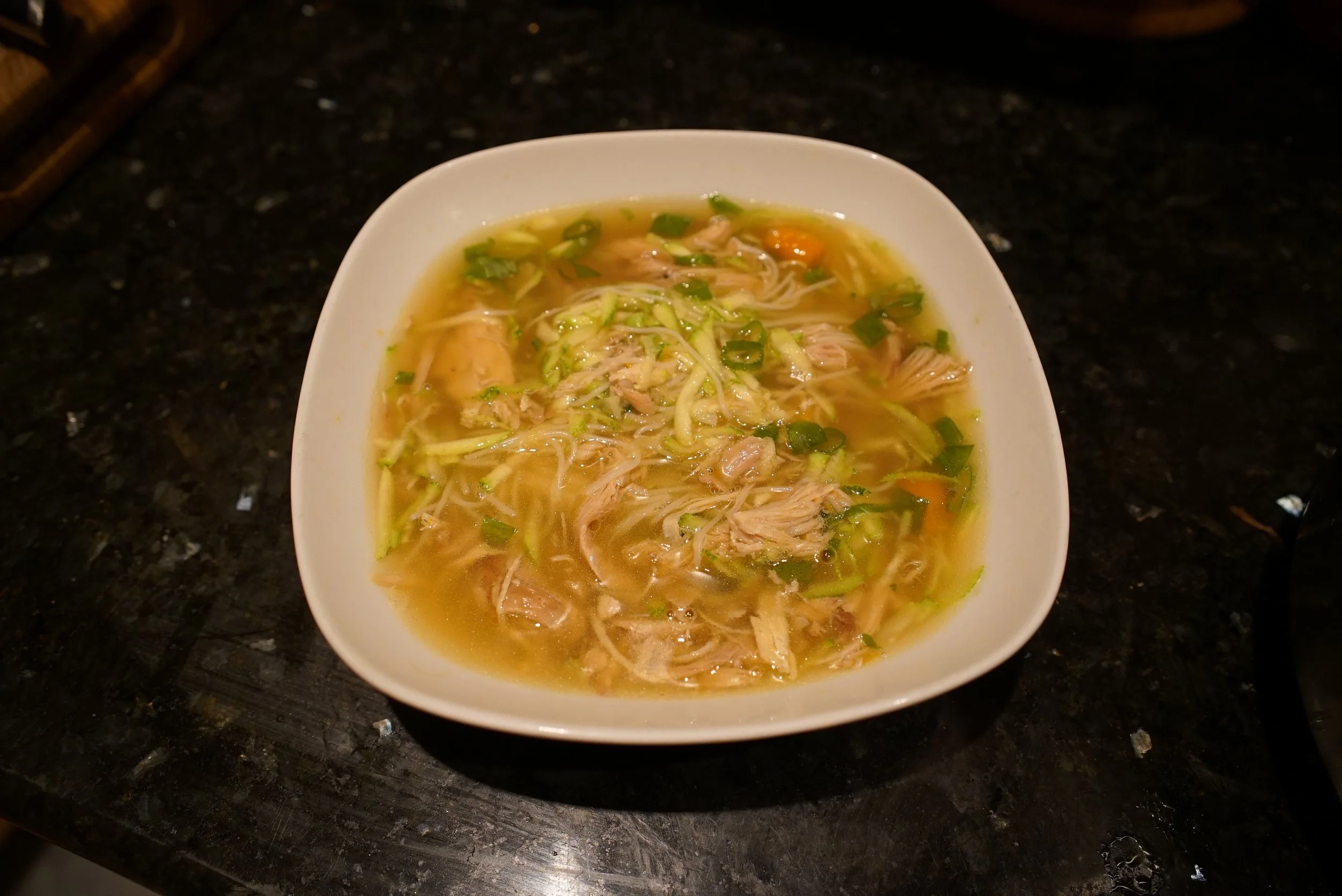
This is the chicken bone broth I make every week, or at least a few times per month. It takes one whole chicken or a leftover carcass, a handful of aromatics, and four hours in the Instant Pot. The stovetop version works the same way with a longer cook that requires a bit more supervision. You could also make this in a slow cooker. The result is a savory broth that sets to a firm gel in the fridge, ready for soup or a mug on its own.
Key takeaways
- Instant Pot: high pressure for 4 hours. Stovetop: a bare simmer for 5 hours or longer.
- Chicken feet are optional and add extra gelatin.
- Fish sauce and coconut aminos add savory depth.
- Remove the garlic and ginger before serving.
- Broth keeps 5 days in the fridge and 6 months in the freezer.
This recipe is shared for general food and cooking education. I am a certified clinical herbalist, not a physician, and nothing here is a diagnosis or treatment for any condition. Nutrient content in homemade broth varies by batch. If you manage a medical condition or take medication, talk with your own provider about changes to your diet.
Ingredients
Evidence: kitchen practice. Quantities are what I use; adjust to taste.
This fills a 6-quart or 8-quart Instant Pot. For a stockpot, use the same amounts and add water to cover.
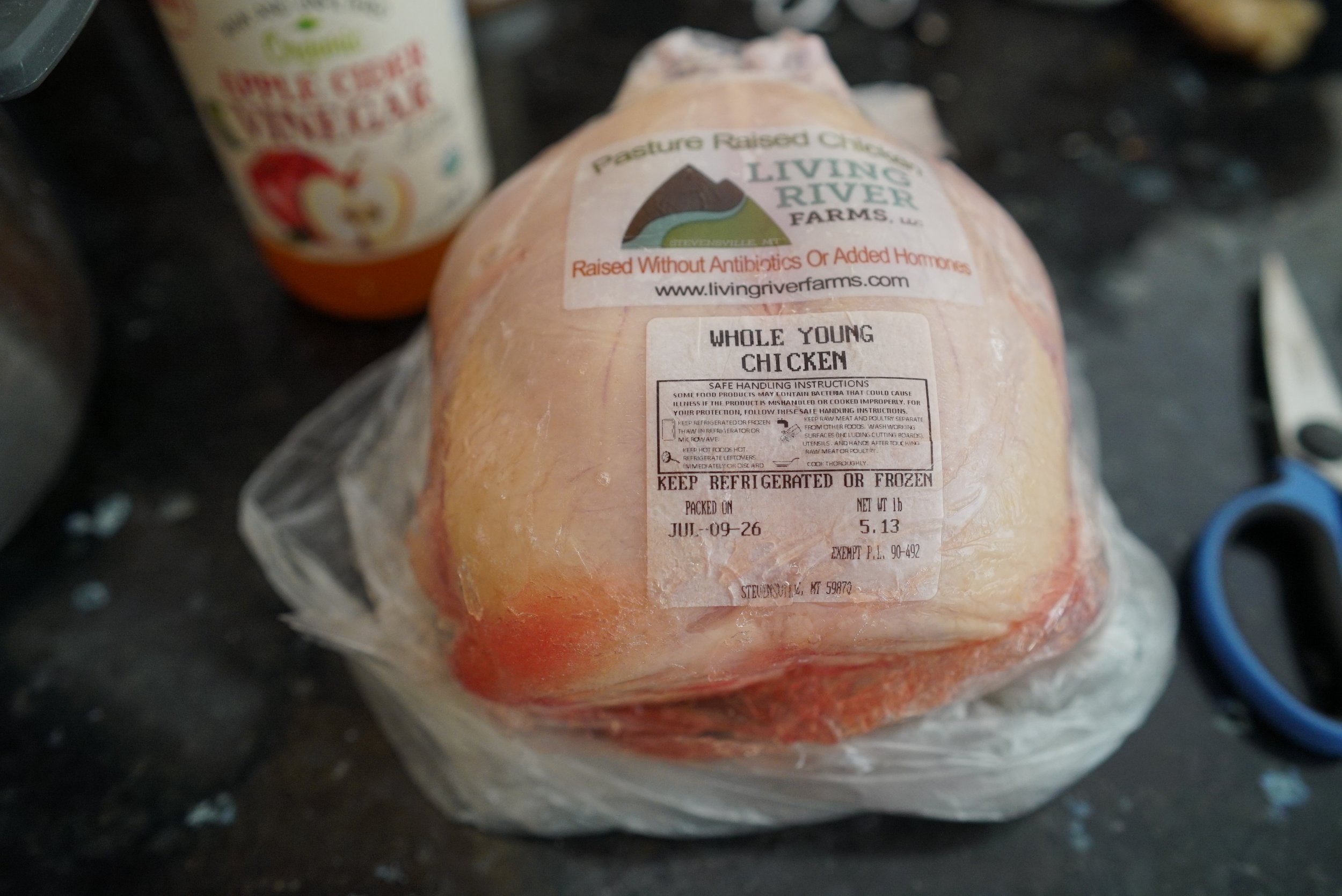
- 1 whole chicken (4-5lbs), or 1 chicken carcass
- 5 chicken feet (optional, for extra gelatin)
- 3 to 6 whole garlic cloves, peeled
- 1 thumb-sized piece of fresh ginger, sliced thin
- 1 to 2 tablespoons apple cider vinegar
- 1 sprig fresh rosemary, or 2 tablespoons dried
- 1 sprig fresh thyme, or 2 teaspoons dried
- 2 to 3 bay leaves
- 1/2 teaspoon black pepper
- 3 celery stalks, chopped
- 3 carrots, chopped
- 1 tablespoon salt, plus more to taste at the end
- 3 tablespoons coconut aminos
- 2 tablespoons fish sauce
- Filtered water, added last to fill the pot with 1 to 2 inches of headspace
Instant Pot chicken bone broth
Evidence: kitchen practice. This is my standard weekly method.
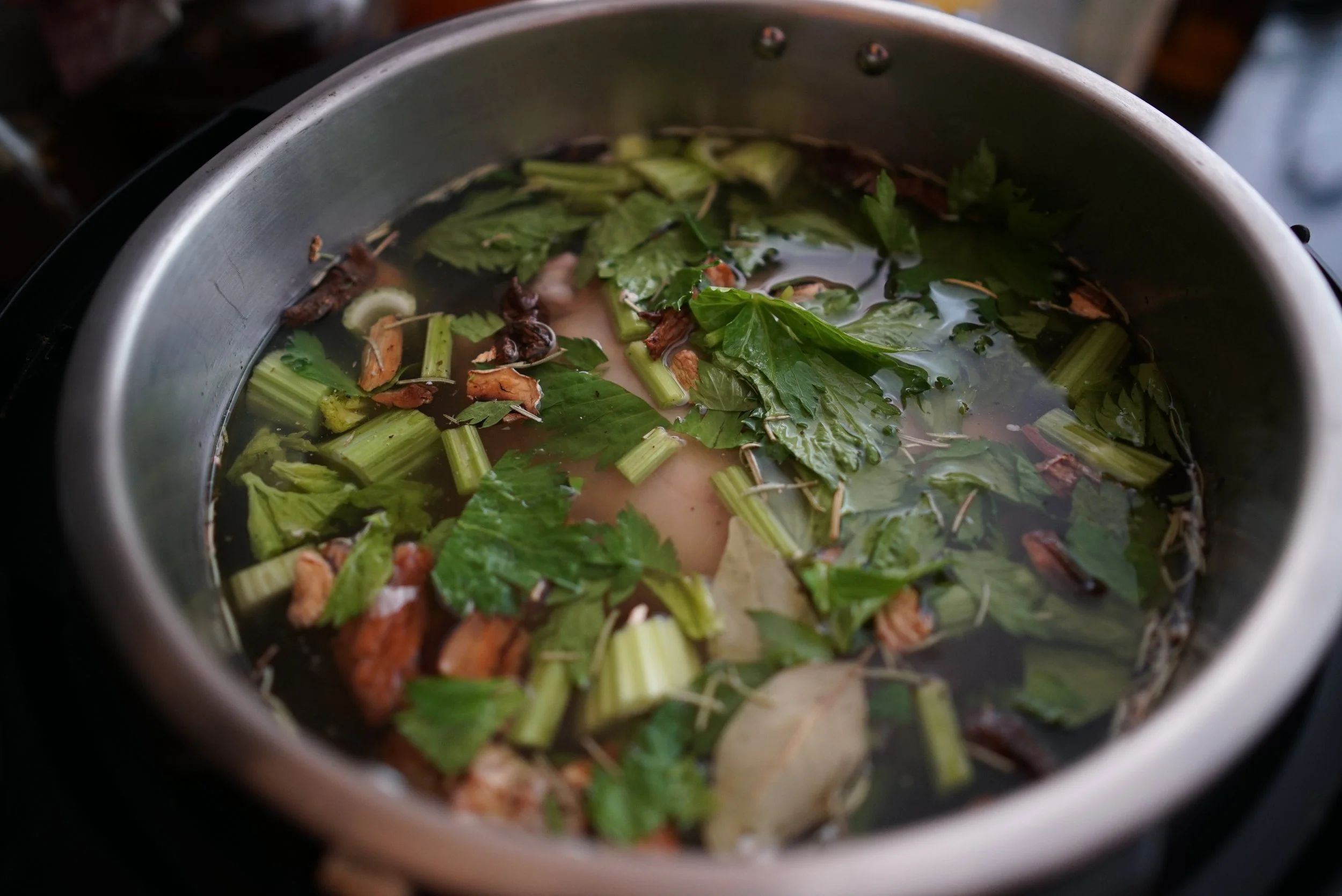
Put the chicken, feet, garlic, ginger, herbs, bay leaves, pepper, celery, carrots, salt, coconut aminos, fish sauce, and vinegar in the pot. Add filtered water until the pot is full, leaving 1 to 2 inches below the max line so the pressure valve stays clear.
Lock the lid and set the valve to sealing. Pressure cook on high for 4 hours, which is the maximum most Instant Pot models allow on a single cycle. When the timer ends, let the pressure release naturally, because a quick release with this much liquid will spit hot broth through the valve.
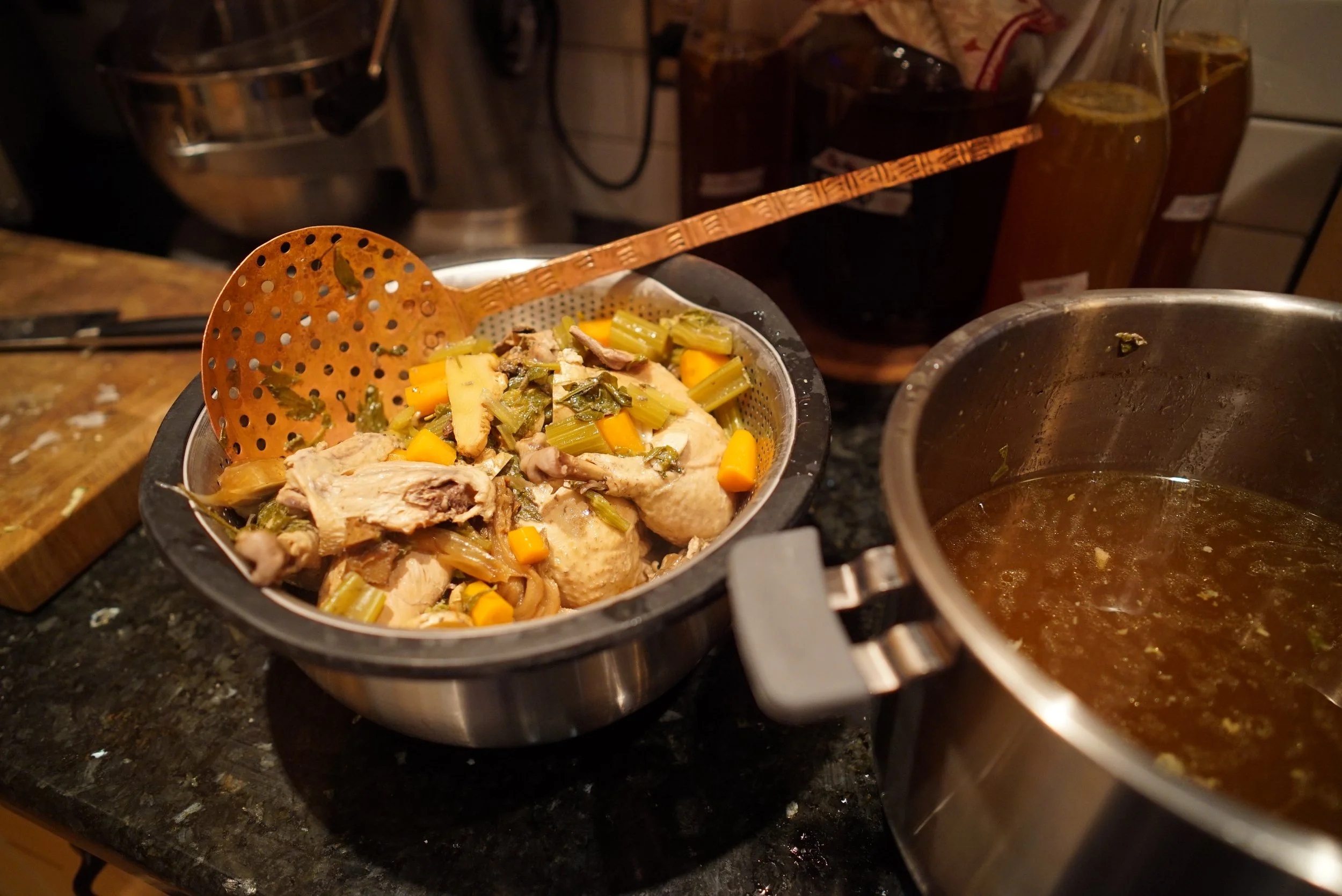
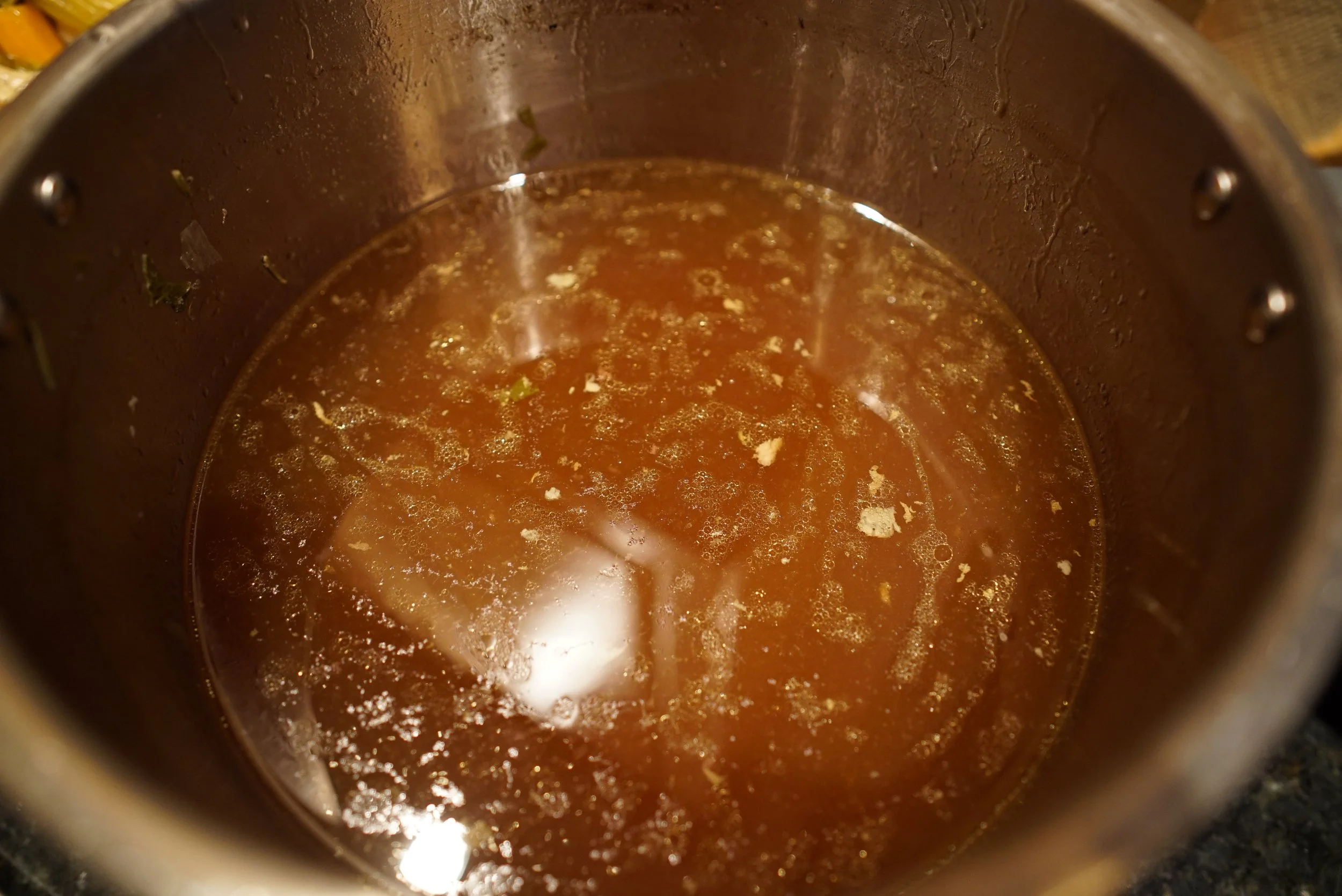
Open the lid and lift out the large pieces with tongs. If you started with a whole chicken, the meat will fall off the bones, so pull it for soup or salads and discard the bones. Strain the broth through a fine mesh sieve into a large bowl. Pick out and discard the garlic cloves and ginger slices, since both keep releasing flavor as the broth sits and can turn it bitter. Taste and add salt as needed.
Stovetop method
Evidence: kitchen practice. Same ingredients, longer cook.
Add everything to a large stockpot and cover with filtered water by 2 inches. Bring to a boil, then drop the heat to the lowest setting that keeps a few small bubbles rising, around 190°F (88°C). Cover and cook for at least 5 hours. Eight hours gives a firmer gel if you have the time. Check every hour or two and top up with water if the bones start to show. Strain and finish the same way as the Instant Pot version.
A hard boil turns the broth cloudy and flat, so hold it at a bare simmer for the full cook.
Why each ingredient is in the pot
Evidence: mixed. Flavor notes are kitchen practice; the vinegar and gelatin notes cite published measurements.
Chicken feet
Feet are mostly skin, tendon, and cartilage, which is where the gelatin comes from. Five feet added to a whole chicken produce a broth that sets solid when chilled. Ask for them at a butcher counter or an Asian grocery. Rinse them and trim the nails with kitchen shears if they still have them.
Apple cider vinegar
A small amount of acid helps draw minerals from the bones. In a controlled test, acidified broth released roughly 15 to 17 times more calcium and magnesium than plain water, though the total in either version stayed low, under 5% of a day's calcium per serving.[1] One to two tablespoons is enough, and the vinegar flavor cooks off.
Garlic and ginger
Both flavor the broth during the cook and both keep going after it. Left in, they turn the finished broth sharp and bitter within a day, so remove them when you strain.
Coconut aminos and fish sauce
These two supply glutamate and a savory backbone that plain salt cannot. Fish sauce at 2 tablespoons in a full pot does not taste of fish once cooked; it deepens the savory flavor. Coconut aminos add a mild sweetness that rounds out the vinegar. If you avoid soy, this pairing replaces tamari.
Rosemary, thyme, and bay
Fresh sprigs go in whole so the stems can be lifted out. Dried herbs get strained. Rosemary is strong, so if you prefer a neutral broth for Asian dishes, halve it or leave it out.
Optional: roasting the carcass first
If you are using a leftover carcass from a roast chicken, the bones are already browned. If the bones are raw, you can roast them at 400°F (205°C) for 30 minutes before they go in the pot to deepen the color and flavor. I skip it most weeks because a raw whole chicken makes a lighter broth that works better for everyday cooking.
The gel test
Evidence: kitchen practice.
Chill a cup of strained broth for a few hours. A firm, wobbly set means the collagen converted to gelatin. If it stays liquid, the pot had too much water for the amount of bone, or the cook was too short. Next time add feet, use less water, or extend the stovetop cook. Broth that stays liquid is still worth using; the gel only shows how concentrated the batch turned out.
Homemade broth varies from batch to batch. A 2019 analysis of home and commercial bone broths found wide swings in glycine, proline, and hydroxyproline between preparations, and lower amounts overall than a 20-gram collagen supplement dose.[2] Cook it for the flavor and the meals it goes into rather than for a set dose of any nutrient.
Cooling and storage
Evidence: standard food-handling practice.
Cool the broth fast, since a full pot left on the counter stays in the warm range for hours. Set the bowl in a sink of cold water and stir, or divide it into shallow containers, then refrigerate within 2 hours of cooking. Once cold, the fat rises and hardens on top. Lift it off and save it for cooking, or leave it on as a seal.
Refrigerated broth keeps about 5 days. For the freezer, portion it into wide-mouth jars with 1 inch of headspace, silicone trays, or freezer bags laid flat. Frozen broth is best within 6 months. Reheat to a simmer before using.
What the research says about bone broth
Evidence: limited. Two lab analyses and one physiologist's writing are cited; no controlled human trials on homemade broth exist.
Two lab analyses cover most of what has been measured in homemade broth. Broth is a poor mineral source, with calcium and magnesium per serving staying low even with vinegar and a long cook.[1] Its protein is mostly gelatin, and the amount varies by recipe, bone type, and water ratio.[2]
The reason I keep it in the weekly rotation comes from Ray Peat's writing on gelatin. He described gelatin as roughly one-third glycine with no tryptophan and almost no cysteine, and argued that eating it alongside muscle meat balances the amino acid load of a meat-heavy diet.[3] He wrote this from his reading of the physiology; no trial has tested it. The Ray Peat food list covers where gelatin and broth sit in his broader framework, and the Ray Peat resource hub links to his original articles.
The same 2017 study that measured minerals also tested for lead and cadmium and found the amounts in broth were minimal under normal cooking, including with vinegar added.[1]
Frequently asked questions
Evidence: kitchen practice unless a source is cited.
Can I use a rotisserie chicken carcass?
Yes. Strip the meat first and use the bones, skin, and any drippings. Rotisserie birds are already salted and seasoned, so start with half the salt and adjust at the end.
Why did my broth not gel?
Too much water for the amount of bone, or too short a cook. Add chicken feet, fill the pot less, or simmer longer on the stovetop.
Does the Instant Pot make broth that gels like a long stovetop simmer?
Yes. Four hours at high pressure gives a firm gel from a whole chicken with feet. Without feet it sets softer.
Can I skip the fish sauce?
You can. The broth will taste flatter and honestly less good. Replace it with an extra tablespoon of coconut aminos and a little more salt at the end. If you've never used fish sauce before, it may seem like a weird thing to add, but I PROMISE it is one of the biggest flavor boosting ingredients, and after it's cooked it won't taste or smell fishy. It's non-negotiable when I make it. Caution though, for those with fish allergies since it is made from anchovies.
Is there a lot of calcium in bone broth?
No. Lab measurements put calcium and magnesium per serving below 5% of a day's need, even with vinegar in the pot.[1] The value of broth is in its gelatin and flavor.
Can I reuse the bones for a second batch?
A second cook from the same bones gives a weaker, lighter broth. I like using it as a cooking liquid for rice instead of water. For a broth that gels, you'll wnat to use fresh bones.
Sources
Every citation was checked against its live PubMed record or original publication before delivery.
- Hsu DJ, Lee CW, Tsai WC, Chien YC. Essential and toxic metals in animal bone broths. Food & Nutrition Research. 2017;61(1):1347478. doi:10.1080/16546628.2017.1347478. Authors are affiliated with two Taiwanese public universities; no industry funding is declared. ↩
- Alcock RD, Shaw GC, Burke LM. Bone broth unlikely to provide reliable concentrations of collagen precursors compared with supplemental sources of collagen used in collagen research. International Journal of Sport Nutrition and Exercise Metabolism. 2019;29(3):265-272. PMID 29893587. Authors are affiliated with the Australian Institute of Sport and Australian Catholic University. ↩
- Peat R. Gelatin, stress, longevity. raypeat.com. raypeat.com/articles/articles/gelatin.shtml. Independent physiologist's essay; not a peer-reviewed study. ↩