Cold Plunging for Women: Why I Don't Recommend It Regularly
Are cold plunges good for women? Occasionally, in warm weather, when you feel like it, they are fine. As a daily health practice, I do not recommend them. The research on women shows a stress response that never fades, a thyroid shift after each exposure, and no recovery benefit in the one trial done in women. Here is what the studies say and why I keep cold plunges occasional.
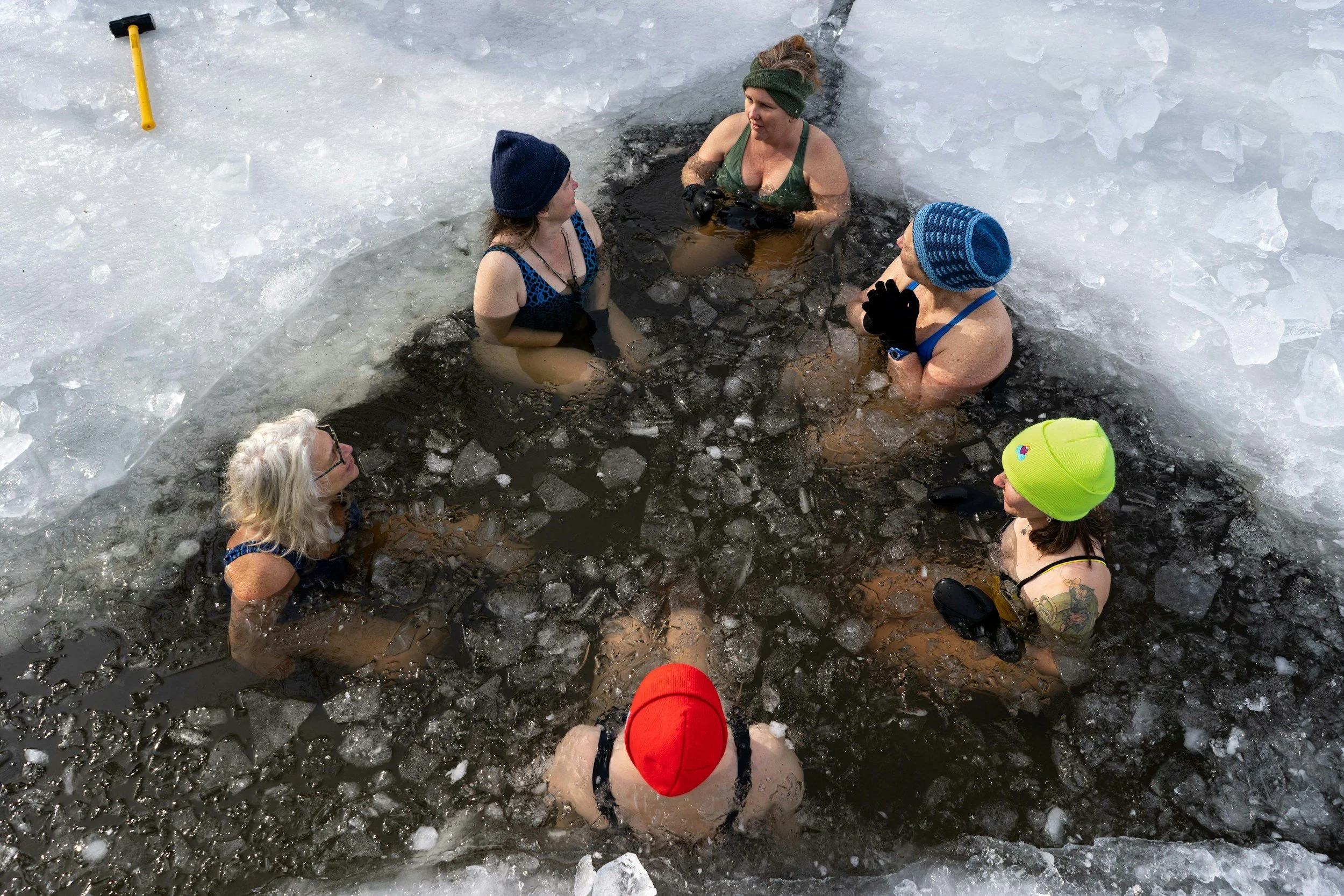
Cold plunging has moved from athlete recovery rooms into the daily routine of a lot of women I talk to. The promise is that a few minutes in 39°F (4°C) water every morning builds resilience, burns fat, and steadies mood. BUT Most of the research behind that promise was done on men! When you read the studies that included women, or were done only in women, the picture changes. This article walks through that research, and includes what the thyroid writers I trust most said about deliberate cold.
Key takeaways
- One hour in 57°F (14°C) water raised noradrenaline 530% in men. Cortisol did not rise. Cold water stresses the nervous system, not the adrenal glands.1
- In women exposed three times a week for 12 weeks, the noradrenaline surge was the same at week 12 as at week 1. The body did not get used to it.2
- In 117 young adults, women started shivering at a warmer temperature than men, and two hours of mild cold lowered free T3 in women but not in men.4
- Women's skin blood vessels tighten harder in cold, and estrogen and progesterone strengthen that response.5,6
- A 15-minute winter swim raised TSH and lowered free T3 and free T4 in experienced swimmers.10
- Ray Peat was asked about cold showers and ice baths several times. He did not think they were beneficial, and said that for someone with low thyroid function they can make things worse.13,14
- An occasional jump into a cold river on a hot day is a different thing from a scheduled daily ice bath. My position is about the second one.
This article is for education only. It does not diagnose, treat, or prevent any condition. I am a certified clinical herbalist, not a physician. Do not start or stop any medication, hormone therapy, or medical treatment based on what you read here. Cold water immersion carries documented cardiovascular risk, including for people with heart conditions, high blood pressure, or Raynaud's. Responses vary widely between individuals. If you are pregnant, breastfeeding, on thyroid medication, or managing a heart condition, talk with your own clinician before any cold exposure practice. If you are in crisis, contact your local emergency line.
New to thyroid talk? Start here
The thyroid is a small gland in the front of the neck. Its job is to set how fast your cells make energy and heat. When it is working well, you feel warm, steady, and clear-headed. When it runs low, the common signs are feeling cold, tired, foggy, and gaining weight without a change in eating.
The gland makes a hormone called T4, which the body converts into T3, the active form. The pituitary gland in the brain sends a signal called TSH to tell the thyroid to make more. "Free" T3 and T4 are the portions circulating unattached to carrier proteins, so they are the amounts your cells can use. When you see "TSH rose and free T3 fell" in this article, it means the brain asked for more and the body ended up with less.
Low thyroid function is common in women and often goes unrecognized because the standard TSH test alone misses a lot of cases. If you want a fuller picture of your own thyroid, my article on the cholesterol and thyroid connection lists which markers to ask for.
What cold water does in the first minute
Evidence: strong for the acute response. Human immersion trials with hormone sampling.
Cold water triggers a reflex the moment it hits the skin. Heart rate and blood pressure jump, breathing turns fast and shallow, and the blood vessels in the skin and limbs close down to keep warm blood near the heart and brain. The clearest measurement of the hormone side comes from a Czech study in which young men sat neck-deep for an hour in water at 90°F (32°C), 68°F (20°C), and 57°F (14°C). At 57°F (14°C), metabolic rate rose 350%. Noradrenaline rose 530% and dopamine rose 250%. Cortisol did not increase at any temperature.1
That last detail matters, because the claim that cold plunges raise cortisol is everywhere online and the immersion data does not support it. What cold water does is drive a large surge of noradrenaline, the main hormone of the fight-or-flight branch of the nervous system. The study authors concluded that the cold responses came from the sympathetic nervous system rather than from adrenal hormones.1
Noradrenaline and cortisol: what is the difference?
Both are stress hormones, but they do different jobs. Noradrenaline (also called norepinephrine) comes from the nervous system and the adrenal glands and acts within seconds. It raises heart rate, tightens blood vessels, sharpens focus, and shifts the body into alert mode. It is the reason a cold plunge feels bracing.
Cortisol comes from the outer part of the adrenal glands and acts over minutes to hours. It raises blood sugar, dampens inflammation, and reshapes energy use during a longer stress. Most wellness writing about cold assumes cortisol is the hormone involved. The immersion studies measured both, and only noradrenaline moved.
The question for anyone doing this daily is whether the body adapts. A Finnish trial had healthy women do either 20 seconds in 32°F to 36°F (0°C to 2°C) water or two minutes in -166°F (-110°C) air, three times a week for 12 weeks. The noradrenaline response after each exposure was, in the authors' words, remarkably similar across the full 12 weeks, and cortisol did not climb.2 Each session produced the same surge as the first one. That was with a 20-second dip, not the three to five minutes most plunge protocols call for.
Cold plunge for women vs men: where the response differs
Evidence: moderate. Controlled physiology studies, several small; the largest mixed-sex study had 117 participants.
The idea that women simply handle cold worse than men does not hold up cleanly. When researchers put women in 64°F (18°C) water for up to 90 minutes and compared them with men from an earlier identical protocol, women's core temperature fell at about half the rate of men's. Once the analysis accounted for body fat and body size, the difference disappeared.3 Much of what looks like a sex difference in cooling is a body composition difference.
The hormone response is where the sexes part ways. The largest controlled comparison put 58 men and 59 women, all young and lean, between water-cooled mattresses for two hours at the coldest temperature each person could tolerate without shivering. Women began shivering at 69°F (20.6°C) against 67°F (19.6°C) for men, so their exposure ran warmer. Even so, free T3 fell 3.3% in women and did not fall in men. Leptin dropped 30% in women against 14% in men, and blood sugar fell further in women. The authors concluded that the metabolic and hormonal changes were more pronounced in women.4
What is leptin, and why does the drop matter?
Leptin is a hormone released by body fat. Its main job is to tell the brain how much stored energy you have. When leptin is high, the brain reads the body as well fed. When leptin falls, the brain reads the body as running short, and it responds by raising appetite and, if the drop is sustained, by pulling back on functions that cost energy. Ovulation is one of those functions. A steeper leptin drop in women after cold is a stronger "energy is short" message reaching the part of the brain that decides whether to run a menstrual cycle.
Three more differences hold up. The first is in the skin's blood vessels. Estrogen and progesterone both strengthen the tightening response to cold, and women's small vessels react to local cooling differently from men's and change across the menstrual cycle.5,6,7 Women are also far more likely to have Raynaud's, a condition of exaggerated vessel spasm in cold, and that risk drops after menopause unless estrogen is replaced.6
The second is cooling speed when the body is already warm. Researchers reviewing cold-water treatment of heat stroke found that overheated women cool faster than overheated men, and noted that the cooling guidelines in use were built from male data and applied to women without being checked.8 A woman going from a workout or a sauna into cold water may drop her temperature faster than the protocols assume.
The third is the brain. In a 2024 study of 22 men and 19 women, women's reaction time on spatial, memory, and attention tasks slowed during cold-air exposure at 50°F (10°C), while men's performance held steady or improved.9 The authors noted that sex differences in cold research remain under-studied, and nearly every paper cited on this page says the same.
Why a woman's cycle responds to stress load
Evidence: strong for the mechanism, limited for cold specifically. No human study has linked cold plunging to menstrual disruption or shown the opposite.
Women carry a system men do not: a control center in the brain that decides, cycle by cycle, whether conditions are safe enough to ovulate. When stress activates the adrenal axis, the signals that drive ovulation slow down, estrogen drops, and the cycle stops. Endocrinologists call this functional hypothalamic amenorrhea, and the Endocrine Society's guideline describes it as the body's adaptive response to chronic energy shortage, in which it diverts resources to the systems needed for survival.17 The known triggers are psychological stress, undereating, overtraining, or any combination.17,18 Women with the condition show higher 24-hour cortisol than women with other causes of missed ovulation, along with low T3.18,19
The reproductive axis in plain terms
The hypothalamus, a small region at the base of the brain, releases a hormone called GnRH in pulses. Those pulses tell the pituitary to release LH and FSH, which tell the ovaries to grow a follicle, make estrogen, and release an egg. Endocrinologists call this chain the hypothalamic-pituitary-ovarian axis, or the reproductive axis for short.
The hypothalamus is also where stress signals and energy signals like leptin arrive. When it reads the body as under threat or under-fueled, it slows the GnRH pulses and the whole chain below goes quiet. Periods get longer, lighter, or stop. This is the body protecting itself from a pregnancy it does not think it can afford. The same system does not exist in men, which is why the cost of overshooting on stress is different for women.
Cold immersion is not on that trigger list, and I want to be clear about that. Nobody has run the human study. What is documented is that the reproductive axis responds to total stress load rather than to any single input, that energy shortage makes it more sensitive to added stressors, and that falling leptin is one of the signals it listens to.17 The mattress study found leptin dropping twice as far in women as in men after two hours of mild cold.4 A daily practice that produces a large noradrenaline surge, a jump in metabolic rate, a leptin drop, and a short-term fall in free thyroid hormone, on top of morning workouts, fasting windows, and a full workload, adds to that load. For a man, the cost of overdoing it is fatigue. For a woman in her reproductive years, the documented cost of sustained stress load is a suppressed cycle, low estrogen, and the bone and heart effects that follow.18 That difference is the main reason I hold the position I do.
What the animal studies show
Evidence: limited. Rodent data only, small groups, with a design flaw described below. Rodent reproduction does not map cleanly onto women.
The only controlled long-term cold immersion work on female reproduction is in mice and rats. In a 2025 study, female mice were immersed to the neck in 39°F (4°C) water for 6 minutes a day for 21 days. Compared with controls, they gained weight, their FSH, LH, estradiol, and AMH all rose, inflammatory markers climbed in the abdominal fluid, and the ovaries and uterus showed raised inflammation with gene activity shifted toward inflammatory pathways. The authors concluded that cold may set up an inflammatory environment in the reproductive organs and disrupt sex hormones.20 They also cited earlier rat work in which two weeks of cold raised LH, disrupted the estrous cycle, and thinned the uterine lining.20
Two cautions. The study used five mice per group, and the control mice were not dipped in warm water, toweled, and blow-dried the way the cold group was, so handling stress is mixed in with the cold. Part of the funding came from a Chinese military logistics research program. The sharpest criticism of the design came from the co-founder of an ice-bath company, who argued the hormone pattern could be read as strong ovarian signaling rather than damage.21 The same writer, whose company sells tubs starting above $16,000, also stated plainly that chronic cold exposure, like chronic overexercise and chronic fasting, will destroy female fertility, and that he recommends brief exposure only.21 So the disagreement is about where brief ends and chronic begins. A daily practice sits closer to chronic than the marketing suggests.
Cold plunge benefits for women: what holds up in the studies
Evidence: mixed. One randomized trial in women, one large self-report survey.
The benefit that does hold up is the one you can feel. The noradrenaline and dopamine surge measured in the immersion studies is a real lift in alertness and mood, and it lasts for a while after you get out.1 The benefits that sell plunge tubs go further than that, and the women-specific evidence for them is thin.
The only randomized trial of cold-water immersion done entirely in women was published in 2025. Thirty women did a muscle-damaging jump workout and then recovered with cold water, hot water, or nothing. Neither immersion sped up recovery of strength, soreness, swelling, or muscle-damage markers compared with doing nothing.23 The recovery benefit that sells most plunge tubs came from male athletes and did not appear when tested in women.
On the other side, a 2024 UK survey of more than 1,100 regular cold-water swimmers found that many women reported fewer menstrual and perimenopausal symptoms, especially anxiety, mood swings, and irritability.24 This was self-reported by women who already swim in cold water and, in many cases, swim to manage those symptoms. It tells you how a self-selected group of swimmers feels. It cannot tell you what the practice did to their hormones, and it says nothing about the women who tried cold swimming, felt worse, and stopped.
What the cold advocates say about women
Evidence: secondary sources with commercial interests, included for balance and disclosed.
The most widely read voice arguing for a women-specific approach is exercise physiologist Stacy Sims, who sells courses on heat and cold exposure. Her position is that ice-bath temperatures are counterproductive for women and that the useful range is around 57°F to 59°F (14°C to 15°C) for two to five minutes, three or four times a week, with near-freezing water left to men.22 She blames a cortisol spike, which the immersion studies do not show; the measured surge is noradrenaline.1,2 Still, a prominent cold advocate reading the same sex-difference research lands on "not that cold, and not daily" for women, and the ice-bath manufacturer cited above also describes women's exposure as brief by necessity.21 Where those writers and I differ is whether a milder version is worth adding at all. Nobody in this discussion is arguing that the 39°F (4°C) daily protocol is a good idea for women.
Are cold plunges bad for women? My position
Evidence: practitioner opinion and personal experience, built on the mechanism studies above rather than on long-term outcome data, which does not yet exist.
I would not add cold plunging to a woman's routine as a health practice, and I would not do it myself on a schedule. The research does not show that daily plunging harms women's hormones. It also does not show that the practice is safe long term, because no one has run the study that would answer that question. What it does show is a stress response that stays the same size every time, a short-term thyroid shift after each exposure, a leptin drop twice as steep in women as in men, a vessel response that women's own hormones strengthen, and a reproductive system known to shut down when total stress load runs high. The main documented effect of cold plunging in women is a repeated stress surge, and in my view, repeating that surge on the reproductive system year after year is unlikely to end well. Reproductive health is one of the clearest measures of overall health a woman has, whether or not she ever intends to have children.
Part of this comes from my own experience. When I lived in Oregon I belonged to a wellness club with a sauna, a red light room, and a whole-body cryotherapy chamber, the same -166°F (-110°C) air exposure used in the Finnish women's trial. I went into the chamber every week for several months, already hypothyroid at the time, believing it was making me healthier. What I felt was colder, more tired, and worse than when I started, which matches Peat's description of people who took up cold and measured 95°F (35°C) hours later. I went from the chamber into the sauna to rewarm, and often did red light afterward. The sauna helped. The red light was a good addition. The cryo, as far as I can tell looking back, made the low thyroid I already had worse. I stopped the cold and kept the heat.
The men in the studies had more muscle to make heat, no cycle to protect, and a stress system that pays a lower price for being pushed. Women who feel steadier after cold water are describing something real, and the noradrenaline and dopamine data explain the feeling. What no study can yet tell us is what it costs to repeat that five mornings a week for a year.
The occasional plunge is a different thing
Evidence: practitioner opinion.
Jumping into a cold river on a hot July afternoon is not what this article is about. Your body is warm, the exposure is short, the water is usually well above ice-bath temperature, and you get out when you want to. If it feels good, do it. My concern is the scheduled version: a tub of 39°F (4°C) water at 6 a.m. in January, timed on a phone, done because a protocol said so and kept up because stopping feels like failure.
If you do plunge now and then, pay attention to what follows. Signs I would take seriously are a longer or missed cycle, new spotting, cold hands and feet that last for hours afterward, a waking temperature that drifts down over weeks, waking at 3 a.m., and dread of the next session that outweighs the lift from the last one. These are the outputs of the stress and thyroid systems described above, and they show up before any lab test would. Barnes and Peat both used the waking temperature as their first measurement, and it costs nothing to take. Tracking your cycle alongside any new practice is the simplest way to catch a change early; I wrote about doing that without handing your data to an app. If stress is the thing you are trying to manage, the herbs in my adaptogen guide work on the same system without the cold.
How to take a waking temperature
Keep a thermometer by the bed. Before you sit up, talk, or drink anything, take your temperature. Oral is fine; Barnes used underarm, held for ten minutes. Write it down along with the day of your cycle, because temperature runs about half a degree higher in the second half of the cycle. Do this for two weeks to learn your normal.
Barnes considered a waking underarm reading below 97.8°F (36.6°C) a sign of low thyroid. Peat looked for the temperature to rise about half a degree by late morning after breakfast, and treated a reading that stayed flat all day as a sign the metabolism was not responding. If you try a cold plunge, take a reading two hours and six hours afterward. If your temperature is still down hours later, your body has told you what it thinks of the practice.
Frequently asked questions
Are cold plunges good for women?
Occasionally, when your body is warm and you want to, they are fine. As a daily practice, the women-specific evidence does not support the benefits claimed for them, and the mechanism studies point to a repeated stress load on the thyroid and reproductive systems. That is why I keep them occasional.
Are cold plunges bad for women's hormones?
No study has shown harm, and no study has shown long-term safety, because no one has followed women through months of daily plunging. What the studies do show is a noradrenaline surge that does not fade with repetition, a short-term drop in free thyroid hormone after each exposure, and a leptin drop twice as steep in women as in men.2,4,10
Does cold plunging raise cortisol in women?
The immersion studies do not show a cortisol rise. One hour in 57°F (14°C) water left cortisol unchanged in men while noradrenaline rose 530%, and a 12-week trial in women found no cortisol increase across repeated exposures.1,2 The stress signal from cold runs through the nervous system.
What temperature should women cold plunge at?
The cold advocates who argue for a women-specific approach put the range at 57°F to 59°F (14°C to 15°C) rather than the 39°F (4°C) ice-bath standard, and even the ice-bath industry describes women's exposure as brief by necessity.21,22 My position is that the schedule matters more than the temperature. A cool river in summer is one thing; a timed ice bath every morning is another.
How long should women cold plunge?
The only multi-week trial in women used 20 seconds.2 The women-specific advocates suggest two to five minutes.22 No study has tested longer daily exposures in women over months. If you plunge occasionally, get out when you want to, not when a timer says so.
Can you cold plunge on your period?
No study has looked at this. Cold tightens blood vessels, and some women report lighter flow during immersion and a return afterward. Cramping and cold sensitivity are often higher in the first days of a period, which is a reason to listen more closely rather than push through.
Can you cold plunge while pregnant or breastfeeding?
There is no controlled safety data for either. Cold immersion raises heart rate and blood pressure and drives a large stress-hormone surge, and pregnancy already changes how the body handles both.1 This is a question for your own midwife or clinician, not for an article.
Can cold plunging affect fertility?
No human study has tested it. Fertility depends on a reproductive axis that is documented to shut down under sustained stress load, cold is a stressor, and the one animal study found inflammation in the ovaries and uterus after three weeks of daily immersion.17,20 Even an ice-bath manufacturer's co-founder writes that chronic cold exposure will damage female fertility.21 That is the reasoning behind my caution, not proof of harm.
Is there a cold plunge study on women?
Two matter most. A 2025 randomized trial in 30 women found no recovery benefit from cold immersion, and a 2020 study of 117 young adults found larger hormone shifts in women than in men after two hours of mild cold.4,23 A 12-week Finnish trial in women measured the stress-hormone and thyroid response to repeated exposures.2,11
Does cold water affect thyroid hormones?
A 15-minute ice-water swim raised TSH and lowered free T3 and free T4 in experienced swimmers, and the free T4 drop appeared only with cold water, not cold air.10 Two hours of mild cold lowered free T3 in women but not in men.4 In women doing 20-second dips three times a week for 12 weeks, TSH rose after exposures but stayed within the normal range.11
Doesn't cold stimulate the thyroid?
In animals with a healthy gland, yes. McGavack's 1951 textbook reports rats nearly doubling thyroxin output at 34°F (1°C) compared with room temperature, a response driven by the pituitary.25 That describes a demand the gland can meet. In the human ice-swim study, TSH rose while free T3 and T4 fell, which is what the same demand looks like when the gland cannot fully keep up.10 Peat's point was that a thyroid already running low does not respond to cold by making more; the person just gets cold.13
What did Ray Peat say about cold plunges?
Asked directly in 2020, he said he did not think cold showers or baths were beneficial, that they momentarily activate the stress hormones, and that for someone whose thyroid is already low they will just make that person cold and feel sick. He reported measuring oral temperatures of 95°F to 96°F (35°C to 35.6°C) hours afterward in people who had taken it up.13
Is cryotherapy the same as cold plunging?
Whole-body cryotherapy uses -166°F (-110°C) air for two to three minutes instead of water. The Finnish trials tested both in women and found the same repeated noradrenaline response and the same thyroid pattern.2,11 My own experience with weekly cryotherapy while hypothyroid is described above.
Cold plunge for women vs men: what is the difference?
Once body fat and body size are accounted for, cooling rates are similar.3 Women shiver at a warmer temperature, show larger hormone shifts to the same cold, tighten skin vessels harder, cool faster when already overheated, and showed slower attention and memory in cold air when men did not.4,6,8,9 Men also have no cycle to protect, which changes the cost of overdoing it.
Is an occasional cold swim a problem?
This article is about a scheduled daily practice in near-freezing water. A short swim in a cold river on a warm day, when your body is warm and you leave when you want to, is a different exposure. If it feels good, enjoy it.
Sources
- Šrámek P, Šimečková M, Janský L, Šavlíková J, Vybíral S. Human physiological responses to immersion into water of different temperatures. Eur J Appl Physiol. 2000;81(5):436-442. doi:10.1007/s004210050065. Male subjects only.
- Leppäluoto J, Westerlund T, Huttunen P, et al. Effects of long-term whole-body cold exposures on plasma concentrations of ACTH, beta-endorphin, cortisol, catecholamines and cytokines in healthy females. Scand J Clin Lab Invest. 2008;68(2):145-153. doi:10.1080/00365510701516350. PMID 18382932.
- Tikuisis P, Jacobs I, Moroz D, Vallerand AL, Martineau L. Comparison of thermoregulatory responses between men and women immersed in cold water. J Appl Physiol. 2000;89(4):1403-1411. doi:10.1152/jappl.2000.89.4.1403. Defence research funded (Canada).
- Mengel LA, Seidl H, Brandl B, et al. Gender differences in the response to short-term cold exposure in young adults. J Clin Endocrinol Metab. 2020;105(5):e1938-e1948. doi:10.1210/clinem/dgaa110. PMID 32144431. Funded by the ZIEL-Institute for Food and Health and the Else Kröner-Fresenius Stiftung; authors declared nothing to disclose.
- Cankar K, Music M, Finderle Z. Cutaneous microvascular response during local cold exposure: the effect of female sex hormones and cold perception. Microvasc Res. 2016;108:34-40. doi:10.1016/j.mvr.2016.07.006.
- Greenfield AM, Alba BK, Giersch GEW, Seeley AD. Influences of ovarian hormones on physiological responses to cold in women. Temperature. 2021. doi:10.1080/23328940.2021.1953688. Authors affiliated with the US Army Research Institute of Environmental Medicine.
- Sex differences during a cold-stress test in normobaric and hypobaric hypoxia: a randomized controlled crossover study. Front Physiol. 2022;13:998665. doi:10.3389/fphys.2022.998665.
- Hutchins KP, et al. Treating exertional heat stroke: limited understanding of the female response to cold water immersion. Front Physiol. 2022. PMC9732943.
- Posada-Quintero HF, et al. Sex differences in autonomic functions and cognitive performance during cold-air exposure and cold-water partial immersion. Front Physiol. 2024;15:1463784. doi:10.3389/fphys.2024.1463784. Task battery adapted from a US Defense assessment tool.
- Kovaničová Z, et al. Cold exposure distinctively modulates parathyroid and thyroid hormones in cold-acclimatized and non-acclimatized humans. Endocrinology. 2020;161(7):bqaa051. doi:10.1210/endocr/bqaa051.
- Smolander J, Leppäluoto J, Westerlund T, et al. Effects of repeated whole-body cold exposures on serum concentrations of growth hormone, thyrotropin, prolactin and thyroid hormones in healthy women. Cryobiology. 2009;58(3):275-278. doi:10.1016/j.cryobiol.2009.02.001. Six women per group.
- Peat R. TSH, temperature, pulse rate, and other indicators in hypothyroidism. raypeat.com.
- Peat R. Listener Q&A on weight loss, prolactin, and cold therapy. Jodellefit interview, November 10, 2020. Transcript in the Ray Peat archive.
- Peat R. Interview, One Radio Network with Patrick Timpone, January 20, 2020. Transcript in the Ray Peat archive.
- Peat R. Interview, KMUD Herb Doctors, "Current trends: nitric oxide," October 16, 2015. Transcript in the Ray Peat archive.
- Barnes BO, Galton L. Hypothyroidism: The Unsuspected Illness. New York: Thomas Y. Crowell; 1976.
- Gordon CM, Ackerman KE, Berga SL, et al. Functional hypothalamic amenorrhea: an Endocrine Society clinical practice guideline. J Clin Endocrinol Metab. 2017;102(5):1413-1439. doi:10.1210/jc.2017-00131. Specialty society guideline; individual author industry disclosures are listed in the publication.
- Meczekalski B, Katulski K, Czyzyk A, Podfigurna-Stopa A, Maciejewska-Jeske M. Functional hypothalamic amenorrhea and its influence on women's health. J Endocrinol Invest. 2014;37(11):1049-1056. doi:10.1007/s40618-014-0169-3.
- Berga SL, Daniels TL, Giles DE. Women with functional hypothalamic amenorrhea but not other forms of anovulation display amplified cortisol concentrations. Fertil Steril. 1997;67(6):1024-1030. PMID 9176439.
- Sun H, Zhao Q, Liang X, et al. Effects of cold environment exposure on female reproductive health and its regulatory mechanisms. Front Genet. 2025;16:1570053. doi:10.3389/fgene.2025.1570053. PMC12014596. Mouse study, five animals per group. Funded by the National Natural Science Foundation of China, Shanghai Natural Science Foundation, a postgraduate grant, and a Chinese military logistics research project.
- Seager TP. Ice bath for female fertility. Morozko Forge company journal, January 17, 2026 (updated April 9, 2026). morozkoforge.com. Author co-founded the ice-bath company that publishes the page; commercial source, cited for its stated position only.
- Sims S. Cold plunging for women: why colder isn't always better. November 5, 2025. drstacysims.com. Author sells heat and cold exposure courses; commercial source, cited for her stated position only.
- Wellauer V, Clijsen R, Bianchi G, Riggi E, Hohenauer E. No acceleration of recovery from exercise-induced muscle damage after cold or hot water immersion in women: a randomised controlled trial. PLoS One. 2025;20(5):e0322416. doi:10.1371/journal.pone.0322416. No specific funding; authors declared no competing interests. Registered NCT04902924.
- Pound M, Massey H, Roseneil S, et al. How do women feel cold water swimming affects their menstrual and perimenopausal symptoms? Post Reprod Health. 2024;30(1):11-27. doi:10.1177/20533691241227100. Online self-report survey of current cold-water swimmers.
- McGavack TH, Winfield JM, Mersheimer WL. The Thyroid. St. Louis: C.V. Mosby; 1951. Chapter XI, "The Follicle and Its Cyclic Activity," section 5, Temperature, pp. 110-111, citing Dempsey and Astwood (1943), Cramer (1928), Rabkina (1947), Uotila (1939), and Purves and Griesbach (1946). Facsimile reprint, Kessinger Publishing.