Tamarind May Help Your Body Flush Out Fluoride (Study Shows 37% Increase)
Tamarind May Help Your Body Flush Out Fluoride, According to Research
Key Takeaways
- A 2002 clinical study published in the European Journal of Clinical Nutrition found that consuming just 10 grams of tamarind per day increased urinary fluoride excretion by 37%.
- Fluoride accumulates in bones, the thyroid gland, and the pineal gland over time, and a 2024 government review by the National Toxicology Program linked higher fluoride exposure to lower IQ in children.
- A follow-up study in 2004 found that tamarind may also help mobilize fluoride already stored in bone tissue, not just newly ingested fluoride.
- Tamarind is widely available at international grocery stores, especially Indian, Mexican, Thai, and Caribbean markets, and can also be found at many health food stores and online retailers.
If you have ever wondered whether there is a natural way to support your body in eliminating fluoride, tamarind deserves your attention. This tropical fruit, long prized in Ayurvedic and traditional medicine systems, has been the subject of several clinical studies showing it can meaningfully increase how much fluoride your body excretes through urine.
What the Study Found
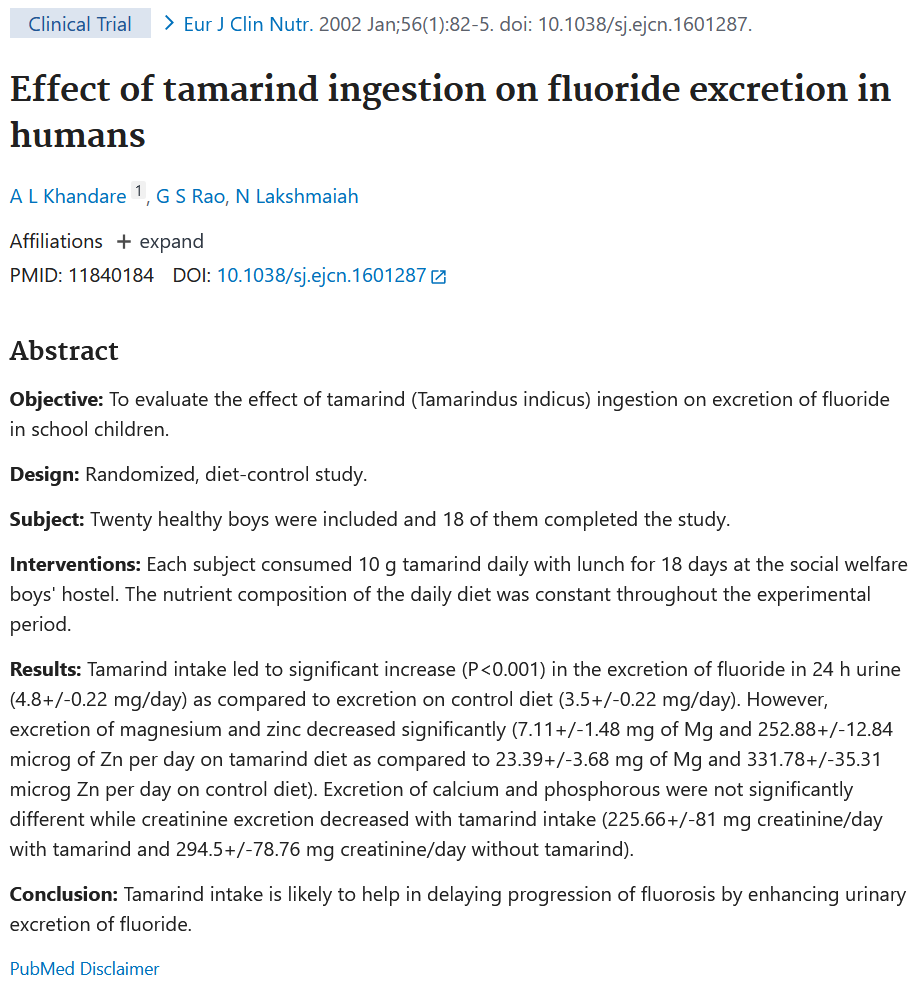
A randomized, diet-controlled clinical study conducted by researchers at the National Institute of Nutrition in Hyderabad, India was published in 2002 in the European Journal of Clinical Nutrition. The research team, led by A.L. Khandare, set out to evaluate whether consuming tamarind could increase fluoride excretion in humans.
The study included 20 healthy boys, 18 of whom completed the trial. Each subject consumed 10 grams of tamarind daily with lunch for 18 days while eating a nutritionally consistent diet throughout the experimental period.
The results were striking. Fluoride excretion through urine rose from an average of 3.5 mg per day on the control diet to 4.8 mg per day during tamarind supplementation. That represents a 37% increase in the amount of fluoride leaving the body. The increase was statistically significant at a confidence level of P<0.001.
The researchers concluded that tamarind intake is likely to help delay the progression of fluorosis by enhancing the urinary excretion of fluoride.
A follow-up study published in 2004 in the journal Nutrition by the same research team took the findings a step further. This time, 30 subjects from a fluoride-endemic area were given defluoridated water for two weeks to lower their baseline fluoride levels. After that, one group received tamarind supplementation while the control group continued with defluoridated water alone. The tamarind group showed a significant increase in fluoride excretion compared to controls, suggesting that tamarind may help mobilize fluoride already deposited in bone tissue, not just fluoride consumed in the diet.
Study Reference: Khandare AL, Rao GS, Lakshmaiah N. Effect of tamarind ingestion on fluoride excretion in humans. Eur J Clin Nutr. 2002 Jan;56(1):82-85. Available at: https://pubmed.ncbi.nlm.nih.gov/11840184/
Why Fluoride Exposure Is a Growing Health Concern
Fluoride is added to the municipal water supply in approximately two-thirds of U.S. communities. It is also present in many toothpastes, mouthwashes, processed foods, beverages, and some pharmaceuticals. While fluoride has long been promoted for its role in preventing tooth decay, a growing body of scientific evidence suggests that chronic fluoride exposure may carry significant health risks, particularly for the brain, thyroid, and skeletal system.
Neurotoxicity and Reduced IQ in Children
In August 2024, the National Toxicology Program (NTP), a division of the U.S. Department of Health and Human Services, published the results of a systematic review that had been eight years in the making. The NTP concluded with moderate confidence that higher fluoride exposure is consistently associated with lower IQ in children. The review examined 72 epidemiological studies, and 18 out of 19 high-quality studies found an inverse relationship between fluoride exposure and IQ.
A corresponding meta-analysis published in JAMA Pediatrics in January 2025 quantified the impact further, finding that for every 1 mg/L increase in urinary fluoride, there was an average decrease of 1.63 IQ points in children. The editors of JAMA Pediatrics noted that the cognitive effects of fluoride were comparable to those of lead exposure.
Pineal Gland Calcification
The pineal gland is a small endocrine gland in the brain responsible for producing melatonin, the hormone that regulates your sleep-wake cycle. Research published by Jennifer Luke at the University of Surrey found that the pineal gland accumulates more fluoride than any other soft tissue in the body. The mean fluoride concentration found in calcified pineal tissue was equivalent to that found in severely fluorosed bone. Because the pineal gland sits outside the blood-brain barrier, it is especially vulnerable to fluoride accumulation, which may contribute to calcification of the gland and subsequent disruption of melatonin production.
Thyroid Disruption
Fluoride has a long and well-documented history of interaction with thyroid function. In fact, fluoride compounds were used in the mid-20th century as antithyroid medication to treat hyperthyroidism. Chronic fluoride exposure has been associated with reduced thyroid hormone levels and increased risk of hypothyroidism, particularly in populations with iodine deficiency.
Skeletal Fluorosis
When fluoride accumulates in bone tissue over many years, it can lead to a condition known as skeletal fluorosis. Early stages may mimic symptoms of arthritis, including joint pain and stiffness. Advanced cases can cause significant damage to bones and joints. This condition is most common in regions with naturally high fluoride levels in drinking water, but long-term, low-level exposure from multiple sources can also contribute to fluoride buildup in the skeleton.
How Tamarind May Work
The exact mechanism by which tamarind enhances fluoride excretion is not fully understood, but researchers have proposed several possibilities. Tamarind appears to increase urinary pH, which may promote the excretion of fluoride through the kidneys rather than allowing it to be reabsorbed. Some researchers have also pointed to the role of tamarind's influence on carbonic anhydrase, a kidney enzyme involved in acid-base balance that may affect how fluoride is handled by the body.
Animal studies have expanded on the human research. A 2011 study published in Research in Veterinary Science found that tamarind fruit extract reduced fluoride concentrations in both blood and bone in rats while increasing urinary excretion. A 2018 study published in Fluoride journal found that tamarind seed coat extract protected human lung cells from fluoride-induced oxidative stress, mitochondrial dysfunction, and cell death.
Where to Buy Tamarind
Tamarind is not always easy to find at conventional grocery stores, but it is widely available if you know where to look.
International grocery stores are the most reliable source. Indian, Mexican, Thai, Vietnamese, and Caribbean markets almost always carry tamarind in various forms, including whole pods, compressed blocks of pulp, paste, and concentrate. Whole pods and blocks of pulp are the least processed options and are generally preferable for those looking for a whole-food approach.
Many health food stores and co-ops also carry tamarind paste or concentrate, though selection varies by location. Online retailers including Amazon carry tamarind in all its forms and can be a convenient option if you do not have an international market nearby.
When shopping for tamarind, look for products with no added sugar, preservatives, or artificial ingredients. Pure tamarind pulp or whole pods are the best choices. A small amount goes a long way. The study that demonstrated the 37% increase in fluoride excretion used just 10 grams per day, which is roughly two teaspoons of tamarind paste.
Tamarind has a distinctive sour and slightly sweet flavor. It is commonly used in chutneys, curries, soups, sauces, agua fresca, and candies. It can also be dissolved in warm water and consumed as a simple drink. Personally, I usually eat it plain, after cracking the pods and removing seeds.
A Note on Expectations
While the clinical research on tamarind and fluoride excretion is promising, it is important to understand that no single food is going to completely remove all accumulated fluoride from your body overnight. The studies suggest that regular, consistent consumption of tamarind can meaningfully increase how much fluoride your body eliminates through urine and may even help mobilize fluoride stored in bone tissue over time.
If you are concerned about fluoride exposure, tamarind can be one part of a broader strategy that may also include filtering your drinking water with a system rated for fluoride removal (such as reverse osmosis, activated alumina, or bone char filters), choosing fluoride-free dental products, and being mindful of processed foods and beverages that may contain added fluoride.
FAQ
What is tamarind and where does it come from?
Tamarind (Tamarindus indica) is a tropical fruit that grows in a pod on the tamarind tree, which is native to Africa and widely cultivated throughout South Asia, Southeast Asia, Mexico, and the Caribbean. The edible pulp inside the pod has a distinctive tangy, sour-sweet flavor and has been used for centuries in cooking and traditional medicine systems including Ayurveda.
How much tamarind do I need to eat to help with fluoride excretion?
The clinical study that demonstrated a 37% increase in fluoride excretion used just 10 grams of tamarind per day, which is approximately two teaspoons of tamarind paste or pulp. This amount was consumed daily with lunch for 18 days during the study period.
Can tamarind remove fluoride that is already stored in my bones?
A 2004 follow-up study by the same research team found evidence that tamarind supplementation helped mobilize fluoride that was already deposited in bone tissue, increasing its excretion through urine even after subjects had been switched to defluoridated water. This suggests that tamarind may have benefits beyond simply helping the body eliminate newly consumed fluoride.
Is fluoride in drinking water really harmful?
The National Toxicology Program, a division of the U.S. Department of Health and Human Services, published a systematic review in August 2024 concluding with moderate confidence that higher fluoride exposure is consistently associated with lower IQ in children. A meta-analysis published in JAMA Pediatrics in January 2025 found that IQ decreases were measurable even at exposure levels below 1.5 mg/L, which is relevant to communities with fluoridated water. In September 2024, a federal court ruled that water fluoridation at the U.S. recommended level poses an unreasonable risk of reducing IQ in children.
Does fluoride really calcify the pineal gland?
Research by Jennifer Luke at the University of Surrey found that the human pineal gland accumulates extremely high concentrations of fluoride, with levels comparable to or exceeding those found in severely fluorosed bone. The pineal gland sits outside the blood-brain barrier, making it especially susceptible to fluoride accumulation. Studies have found a strong positive correlation between calcium and fluoride concentrations in the pineal gland, and researchers have noted that this accumulation may disrupt melatonin production.
What is the best way to reduce fluoride exposure at home?
The most effective ways to reduce fluoride exposure include installing a water filter rated for fluoride removal (reverse osmosis, activated alumina, or bone char are the most effective types), using fluoride-free toothpaste and mouthwash, and being aware that fluoride can also be present in processed foods and beverages made with fluoridated water, certain teas, and some medications.
What forms of tamarind are available for purchase?
Tamarind is available in several forms, including whole pods, compressed blocks of pulp, paste, concentrate, and powder. Whole pods and pulp blocks are the least processed and most closely resemble what was used in the clinical research. Tamarind paste is convenient for cooking and mixing into drinks. It is most commonly found at Indian, Mexican, Thai, and Caribbean grocery stores, as well as some health food stores and online retailers.
Are there any side effects of eating tamarind?
The clinical study noted that tamarind consumption was associated with decreased urinary excretion of magnesium and zinc. If you plan to consume tamarind regularly, it may be wise to ensure you are getting adequate magnesium and zinc through your diet or supplementation. Tamarind is also naturally high in tartaric acid, so people with acid reflux or sensitive stomachs may want to start with smaller amounts. As always, consult with a qualified healthcare practitioner if you have specific health concerns.