Where to Buy Oysters: Sourcing, Harvest Tags, Cadmium & Spoilage
As an Amazon Associate, Ivy Herbal earns from qualifying purchases. This article contains an affiliate link, marked where it appears.
A dozen raw oysters at a restaurant runs about $42 in most US cities. The same dozen bought live from a farm or a busy fish market costs a third of that, and you control how long they sat, how cold they were kept, and where they came from. This guide covers where to buy oysters, how to read the harvest tag, which growing regions carry more cadmium, how to tell when an oyster has spoiled, and what the label on a tin of smoked oysters is telling you.
Key takeaways
- Buy live oysters from a certified dealer or direct from the farm. Ask to see the harvest tag and check the harvest date.
- Eat them the same day or the next. Store cup side down in an open bowl on ice, never sealed and never in fresh water.
- A live oyster stays shut. An open shell that does not close when tapped is dead and goes in the trash.
- Pacific oysters from the northern Pacific coast accumulate cadmium from the water. Smaller oysters harvested in spring and summer carry less.
- On a smoked oyster label, "Natural Smoke" listed as an ingredient means smoke flavoring was added. Check country of origin and the packing oil.
This article is for educational purposes and does not provide medical advice. Raw shellfish carries a risk of foodborne illness. Eating oysters raw is a personal decision; anyone who is pregnant, over 65, immunocompromised, or living with liver disease should discuss it with a qualified practitioner.
Why buy oysters instead of ordering them
Evidence: USDA nutrient database, published writing by Ray Peat
Oysters are one of the most mineral-dense foods sold in a grocery store. USDA FoodData Central lists wild eastern oysters at 39 mg of zinc and 4.5 mg of copper per 100 grams raw.1 Pacific oysters test lower for zinc, around 17 mg per 100 grams, and higher for vitamin B12. Both species carry iodine and selenium.
Ray Peat, whose bioenergetic framework informs much of the food guidance on this site, listed oysters among the low-fat seafoods that "can provide useful trace minerals, without much risk" when eaten occasionally.2 He also wrote that oysters and shrimp supply copper, which he considered important for keeping iron from accumulating in tissue.3 In Nutrition for Women he preferred what he called biological purification of zinc, as in oysters, over refined zinc supplements, because cadmium is difficult to separate from zinc industrially.4 His argument for eating oysters rested on clean water, which is why sourcing gets the rest of this article.
Restaurant oysters solve the shucking problem and nothing else. You cannot see the tag, you do not know the harvest date, and you pay for the room. Buying live oysters and learning to shuck them takes one evening of practice and brings the cost down to about $1.75 per oyster from most farms.
Where to buy oysters: a source tier list
Evidence: state shellfish licensing records, farm shipping policies
Every commercial oyster sold in the US must pass through a dealer certified under the National Shellfish Sanitation Program. Oregon's Department of Agriculture summarizes the rule: shellfish crossing state lines must come from a dealer on the Interstate Certified Shellfish Shippers List, and every container must be tagged with the dealer's certification number, the harvest area, and the harvest date.5 If a seller cannot show you a tag, they are not a certified source.
Tier 1: direct from the farm, shipped live
These farms harvest to order and ship overnight with a harvest tag in the box, which gives you the shortest possible gap between water and plate.
- Hama Hama Oyster Company, Lilliwaup, Washington. Sixth-generation family farm on Hood Canal. Harvests daily, ships FedEx overnight to the continental US with a harvest tag in every order, and packs enough ice for two days in case of delay.6 Beach-grown oysters with rougher shells and a crisp, cucumber-rind finish.
- Taylor Shellfish Farms, Shelton, Washington. Five generations of Puget Sound shellfish farming. Ships live oysters, clams, mussels, and geoduck nationwide from its online store.7
- Island Creek Oysters, Duxbury, Massachusetts. Bottom-grown East Coast oysters with high salinity and a buttery finish. Ships nationally and offers mixed boxes that pair its own oysters with Hama Hama Pacifics.8
Tier 2: farm stores, oyster farm near you, and serious fish markets
If you live within driving distance of a coast, the farm store beats mail order. Hama Hama's farm store has sold shellfish off the tide flats since the 1970s,9 and most working oyster farms in Washington, Maine, Virginia, and the Gulf sell retail at the dock. Inland, look for the fish market with the longest line and the fastest turnover. A counter that sells through its oysters every day is a counter whose oysters are never old.
Tier 3: grocery seafood counters
Acceptable when the counter keeps the harvest tag on display and the oysters sit on ice with the cup side down. Ask the harvest date before buying, and if the staff cannot find the tag, buy something else.
Avoid
- Oysters displayed at room temperature or sitting in melted water.
- Pre-shucked oysters in jars with no pack date or a date more than a few days old.
- Any seller who cannot produce a dealer tag.
- Canned oysters with no country of origin on the label.
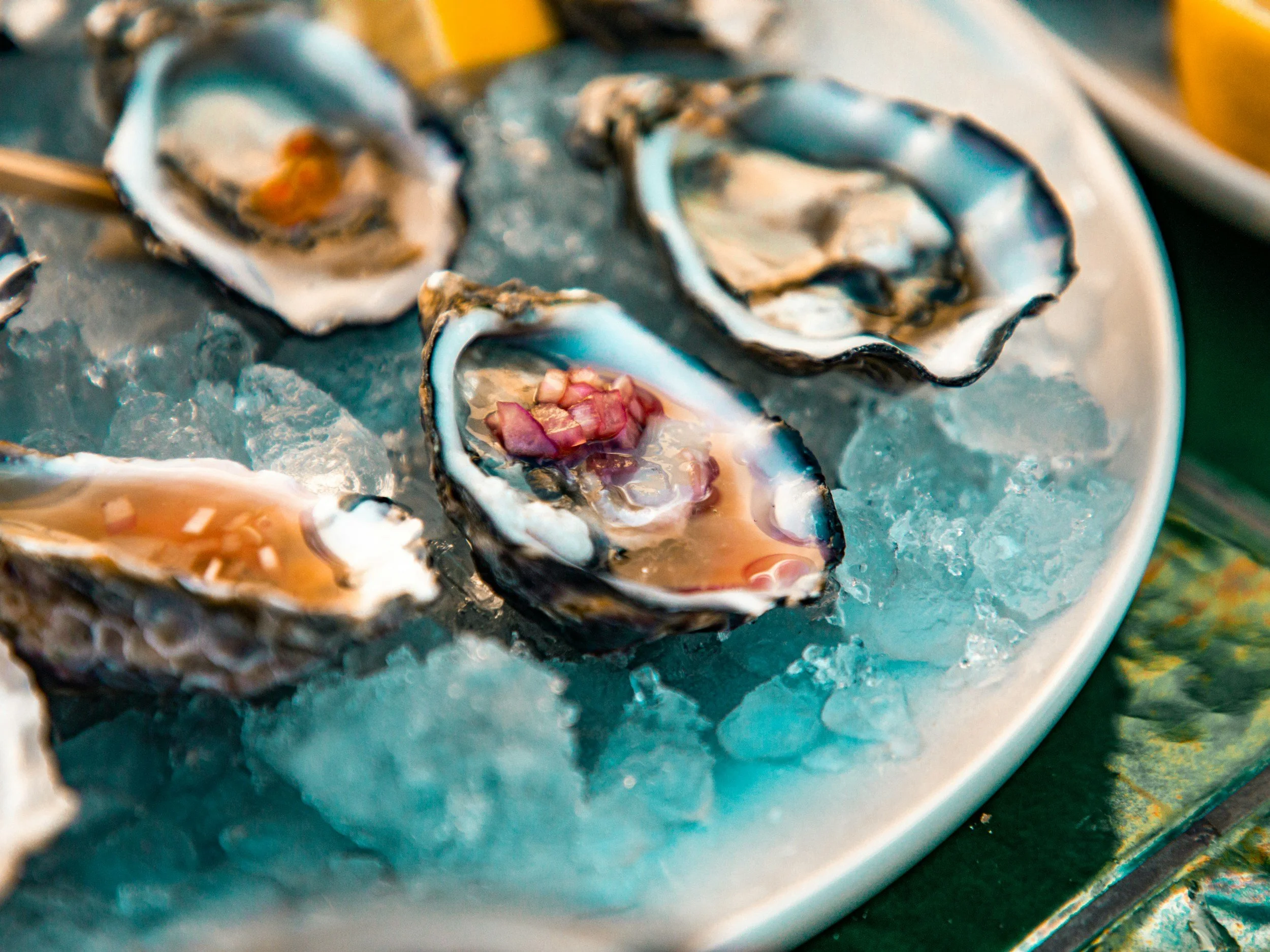
How to read an oyster harvest tag
Evidence: state shellfish regulations and dealer certification requirements
The tag stapled to every bag of live oysters is the only proof of where they came from. Under the shellfish sanitation program every state has adopted, the tag lists the dealer's name and certification number, the harvest area, the harvest date, and the species. Retailers must keep the tag until the container is empty and then file it for 90 days so an illness can be traced back to a growing area.5
Two things on the tag matter to you as a buyer. The harvest date tells you how long the oyster has been out of the water; count your storage window from that date, not from the day you bought them. The harvest area tells you which bay the oyster came from, which is what you need for the cadmium section below.
Wild vs farmed oysters
Evidence: farm and dealer descriptions of growing methods
Farmed oysters make up nearly all oysters sold in the US. They are not fed or medicated. They eat the same plankton a wild oyster eats from the same water, and flavor comes from the bay rather than from the growing method.
The differences are physical. Farmed oysters raised off the bottom get tumbled by tides or by hand, which produces a deep cup and a clean hinge at a uniform size, so they shuck easily and hold their liquor. Wild oysters grow on the bay floor, come out in irregular shapes and sizes, and tend to run larger with a firmer adductor muscle. Gulf Coast growers steer wild oysters toward grilling and frying and farmed oysters toward the half shell for that reason.10
Bottom-grown farmed oysters like Island Creek's and beach-grown farmed oysters like Hama Hama's sit between the two. They are cultivated but shaped by the bottom, with rockier shells and more variation than a cage-grown oyster.
For sourcing purposes, farmed wins on traceability. A farm knows its own harvest area, its own harvest date, and its own water. Wild harvest depends on the individual harvester's records.
Choosing oysters lower in cadmium
Evidence: field studies of Pacific oysters in British Columbia
Oysters concentrate cadmium from seawater. Pacific oysters grown on the coast of British Columbia have tested at or above 2 micrograms per gram wet weight, high enough that some international markets stopped accepting them. A year-long study at two Vancouver Island farms found that dissolved cadmium in the water, not particles or food, was the main source, and that the metal concentrated in the gut tissue.11
A three-year grow-out study across the BC coast found cadmium concentration was higher in winter than in summer, and the total cadmium per oyster rose from south to north, with three sites showing point sources not present elsewhere.12 Fisheries and Oceans Canada's summary of this work recommends choosing sites with lower dissolved cadmium and harvesting in spring and summer when concentrations bottom out.13
What that means at the counter:
- Prefer spring and summer harvest dates for Pacific oysters from Washington and British Columbia.
- Choose smaller oysters. Total cadmium per animal scales with tissue mass, and the gut is where it collects.
- Ask the farm which bay the oysters came from. Farms on the same coast can differ by site.
- Do not assume an imported canned oyster of unknown origin has been tested for metals.
This research covers Pacific oysters in the Pacific Northwest. Comparable published data for eastern and Gulf oysters was not available for this article, so no ranking between coasts is made here.
How to tell if oysters have gone bad
Evidence: farm handling guidance and standard shucking practice
A raw oyster is a live animal. The shell stays clamped shut while it is alive and opens when it dies, which gives you a test before you pick up a knife.
- Tap test. A live oyster is shut tight or closes when tapped. A gaping shell that stays open is dead and should be thrown out.
- Weight. A live oyster feels heavy for its size because it is full of seawater. A light one has dried out.
- Smell. Open the shell and smell it. A fresh oyster smells like clean salt water and nothing else. Any fishy, sour, sulfur, or ammonia note means discard.
- Liquor. The cup should be brimming with clear brine. Cloudy liquor, a dry cup, or shrunken meat means discard.
- Taste. A sound oyster tastes of brine and sweetness. Anything sour or metallic gets spit out.
These checks apply whether you shuck at home or buy oysters shucked to order at a raw bar. Smell every one regardless of who opened it.
Jarred shucked oysters have a shorter margin. The liquid should be clear to slightly milky with no strong smell. Use them for cooking within the date on the container.
How long do oysters last in the fridge
Evidence: farm storage instructions
Count from the harvest date on the tag, not from the purchase date. The shortest gap is the safest, and the flavor drops off well before the oyster dies. Buying and eating the same day or the next is the standard to hold yourself to.
Storage rules from the farms that ship live oysters:6
- Keep them cold, below 40°F.
- Place them cup side down in an open bowl or on a tray so the liquor stays in the shell.
- Cover with a damp cloth. Do not seal them in a bag or lidded container; they need air.
- Ice is fine, but do not let them sit in the meltwater. Fresh water kills oysters.
- Rinse under cold running water before shucking to remove grit and mud from the shell.
Shucked oysters, whether from a jar or your own knife, should go straight into a covered container in the coldest part of the fridge and be used within two days.
Smoked oysters: real wood smoke vs smoke flavoring
Evidence: federal flavor labeling rules and manufacturers' own ingredient panels
Most canned smoked oysters in a US grocery store are imported, packed in seed oil, and flavored rather than smoked. The label tells you which is which if you know where to look.
Under 21 CFR 101.22, smoke flavoring added to a food must appear in the ingredient list. "Natural smoke flavor" or "natural smoke" means condensed wood smoke, sold as liquid smoke, was added as an ingredient. "Artificial smoke flavor" means a synthetic version.14 Oysters that were hung over burning wood do not list smoke as an ingredient, because smoke applied that way is a process rather than an additive. An ingredient panel that reads only oysters and salt in oil points to direct smoking; one that includes "natural smoke" points to flavoring, either instead of or in addition to a smokehouse.
Two things to check after the smoke question. First, the packing oil. Cottonseed oil and sunflower oil are both high in polyunsaturated fat, and neither belongs in a tin you will eat weekly if you follow the fat guidance elsewhere on this site. Drain and rinse the oysters, or find a brand packed in olive oil. Second, country of origin. It is required on the label, usually near the bottom of the can.
Smoked oyster brand tiers
As an Amazon Associate, Ivy Herbal may earn a small commission from qualifying purchases at no additional cost to you. Links marked "(affiliate link)" below are shipped and/or sold from Amazon.com.
- Tier 1: Ekone Oyster Company (Bay Center, Washington). Owned by the Taylor family of Taylor Shellfish. Pacific oysters grown on long lines in Willapa Bay, steamed, brined in small batches, racked, and smoked over maple chips at the company's own cannery.15 Packed in organic sunflower oil with salt, organic sugar, garlic and onion powder, and citric acid. The ingredient panel also lists "Natural Smoke," so smoke flavoring is added on top of the smokehouse.16 If that distinction matters to you, ask the company directly. On origin and traceability, nothing else on a US shelf compares. Available direct from Taylor Shellfish or on Amazon as Ekone Original Smoked Oysters (affiliate link).
- Tier 2: Crown Prince Natural in olive oil. Crown Prince's Natural line is a different product from its standard tin. The company's page for it lists oysters raised in South Korean coastal waters, smoked over oak, and packed in Turkish olive oil, with an ingredient panel of oysters and olive oil.21 No smoke flavoring appears on the panel and the oil question is solved. The growing water is still one you cannot check yourself. This is the reasonable pantry tin when Ekone is out of reach: Crown Prince Natural Smoked Oysters in Olive Oil (affiliate link). Small West Coast canneries that name their bay belong in this tier as well; judge them by the same panel.
- Tier 3: Crown Prince standard tins and other mass-market imports. Crown Prince's product page for its standard line lists smoked oysters, cottonseed oil, and sea salt, labeled Product of China, from the Yellow Sea. The company describes itself as one of the largest importers of smoked oysters in the world.17 Retail listings for the cottonseed oil tin carry a California Proposition 65 reproductive harm warning,18 and Costco's listing for the 3.75-ounce Chinese olive oil tin names lead and cadmium in its warning.22 The Natural line and the standard line share a brand name and little else, so read the can size and the country of origin before you buy.
At grocery retail, a 3-ounce tin of Ekone costs roughly three times a standard tin of Crown Prince. The difference buys a named bay and an oil you can identify.
Cooking oysters at home
Evidence: USDA nutrient database, farm cooking guidance
Cooked oysters are the answer for anyone who wants the minerals without the raw-shellfish decision. Heat does not remove zinc or copper. USDA data lists cooked eastern oysters higher in zinc per serving than raw because water cooks off.19
Larger oysters suit cooking. Hama Hama sells its bigger sizes as "grillers" and points buyers toward shucked oysters in a jar for frying and casseroles.20 Wild Gulf oysters, with their size and firm texture, hold up on a grill or in a fryer better than a small cup oyster does.
- Grilled. Set unshucked oysters cup side down on a hot grill. They open as they cook. Add butter and garlic once the shell pops.
- Roasted. Same method in a 450°F oven on a bed of rock salt.
- Steamed. A few minutes over boiling water until the shells open.
- Pan-fried. Shucked oysters dredged in flour or cornmeal, fried in tallow or butter for a minute per side.
Shells that open during cooking were alive going in. Any shell that stays shut after the rest have opened should be tossed rather than pried.
Footnotes
- USDA FoodData Central. Mollusks, oyster, eastern, wild, raw. FDC ID 171978. ↩
- Peat, R. Unsaturated Vegetable Oils: Toxic. raypeat.com. ↩
- Peat, R. Iron's Dangers. raypeat.com. ↩
- Peat, R. Nutrition for Women. Passage on zinc, cadmium, and biological purification, as collected at Ray Peat on Zinc. ↩
- Oregon Department of Agriculture. Commercial Shellfish Licensing. Tagging, retention, and dealer certification requirements. ↩
- Hama Hama Oyster Company. Hama Hama Oysters. Shipping, packing, and storage details. ↩
- Taylor Shellfish Farms. Online store. ↩
- Island Creek Oysters. East Coast - West Coast Half & Half. ↩
- Hama Hama Oyster Company. Home page. Farm store history. ↩
- Great Days Outdoors. Wild Oysters Vs Farmed Oysters. Interview with an Alabama oyster grower. ↩
- Lekhi P, Cassis D, Pearce CM, Ebell N, Maldonado MT, Orians KJ. Role of dissolved and particulate cadmium in the accumulation of cadmium in cultured oysters (Crassostrea gigas). Sci Total Environ. 2008;393(2-3):309-325. doi:10.1016/j.scitotenv.2007.12.004. ↩
- Spatial and temporal variations in cadmium concentrations and burdens in the Pacific oyster (Crassostrea gigas) sampled from the Pacific north-west. PMID 19406438. ↩
- Fisheries and Oceans Canada. Cadmium in Deepwater-Cultured Pacific Oysters. ACRDP fact sheet. ↩
- Lexology. Where there is smoke, there is fire, or is there? Summary of 21 CFR 101.22 smoke flavor labeling. ↩
- Taylor Shellfish Farms. Original Ekone Smoked Oysters. Process description. ↩
- Good Eggs. Ekone Smoked Oysters, 3 oz. Ingredient panel as listed by the retailer. ↩
- Crown Prince, Inc. Smoked Oysters. Ingredient panel and country of origin for the standard line. ↩
- Albertsons. Crown Prince Oysters Smoked Fancy Whole in Cottonseed Oil, 3.75 oz. Retail listing with Proposition 65 warning. ↩
- USDA National Agricultural Library. Zinc content of selected foods per common measure. ↩
- Hama Hama Oyster Company. Fresh Pacific Northwest Oysters. Size and cooking guidance. ↩
- Crown Prince Natural. Oysters. Growing waters, smoking method, and packing oil for the Natural line. ↩
- Costco. Crown Prince Smoked Oysters in Olive Oil, Fancy Whole, 3.75 oz, 6-count. Retail listing with Proposition 65 warning naming lead and cadmium. ↩