
Elderberry Syrup Recipe and Herbal Monograph: Uses, Safety, Look-Alikes
Key Takeaways
- Elderberries must be cooked. Raw berries contain lectins and the plant carries cyanogenic glycosides in its stems, leaves, and seeds. Five to ten minutes at a boil deactivates the lectins, and a proper simmer covers it comfortably.
- Three toxic plants are mistaken for elder: pokeweed, devil's walking stick, and water hemlock. The identification section below covers how to separate them.
- Only the ripe berries and the flowers are used. Leaves, bark, root, green stems, and unripe fruit are not food and do not become safe with cooking.
- The clinical evidence is mixed and the funding matters. The trials showing a four-day benefit were paid for by the product manufacturer. The strongest independent trial found no benefit at all.
- Honey makes the syrup unsuitable for infants under twelve months because of botulism risk, which is the actual reason for the age-one rule.
- Refrigerated honey syrup keeps two to three months. Maple or sugar versions keep two to four weeks.
Elderberry syrup is the first herbal preparation most families make, and it deserves a fuller treatment than the recipe alone. The plant has a documented history in European household medicine going back four centuries, a genuine set of cautions that most recipes skip, and a clinical record that is more complicated than the marketing suggests.
This piece covers all of it: the botany, how to tell elder apart from the poisonous plants that grow beside it, what the tradition actually used it for, why cooking is not optional, who should avoid it, and a syrup recipe written for both dried and fresh berries with measurements in either grams or cups.
Elderberry: A Herbal Monograph
| Botanical name | Sambucus nigra L. (European or black elder); Sambucus nigra subsp. canadensis (American elder) |
|---|---|
| Family | Adoxaceae, formerly classified in Caprifoliaceae |
| Common names | Elder, black elder, elderberry, European elder, common elder, boor tree, pipe tree |
| Parts used | Ripe berries and flowers only |
| Parts never used | Leaves, bark, root, green stems, unripe berries |
| Taste | Berries sweet-tart and mildly astringent; flowers faintly sweet and aromatic |
| Energetics | Berries cooling and moistening. Flowers cooling and relaxing, classed as a relaxing diaphoretic in Western practice. |
| Actions | Berries: antioxidant, immunomodulating, antiviral in laboratory models, mildly laxative in quantity. Flowers: diaphoretic, mild diuretic, anticatarrhal. |
| Harvest | Flowers in late spring through early summer, on a dry day. Berries mid-August through mid-September, when clusters darken fully and begin to droop under their own weight. |
Botanical description
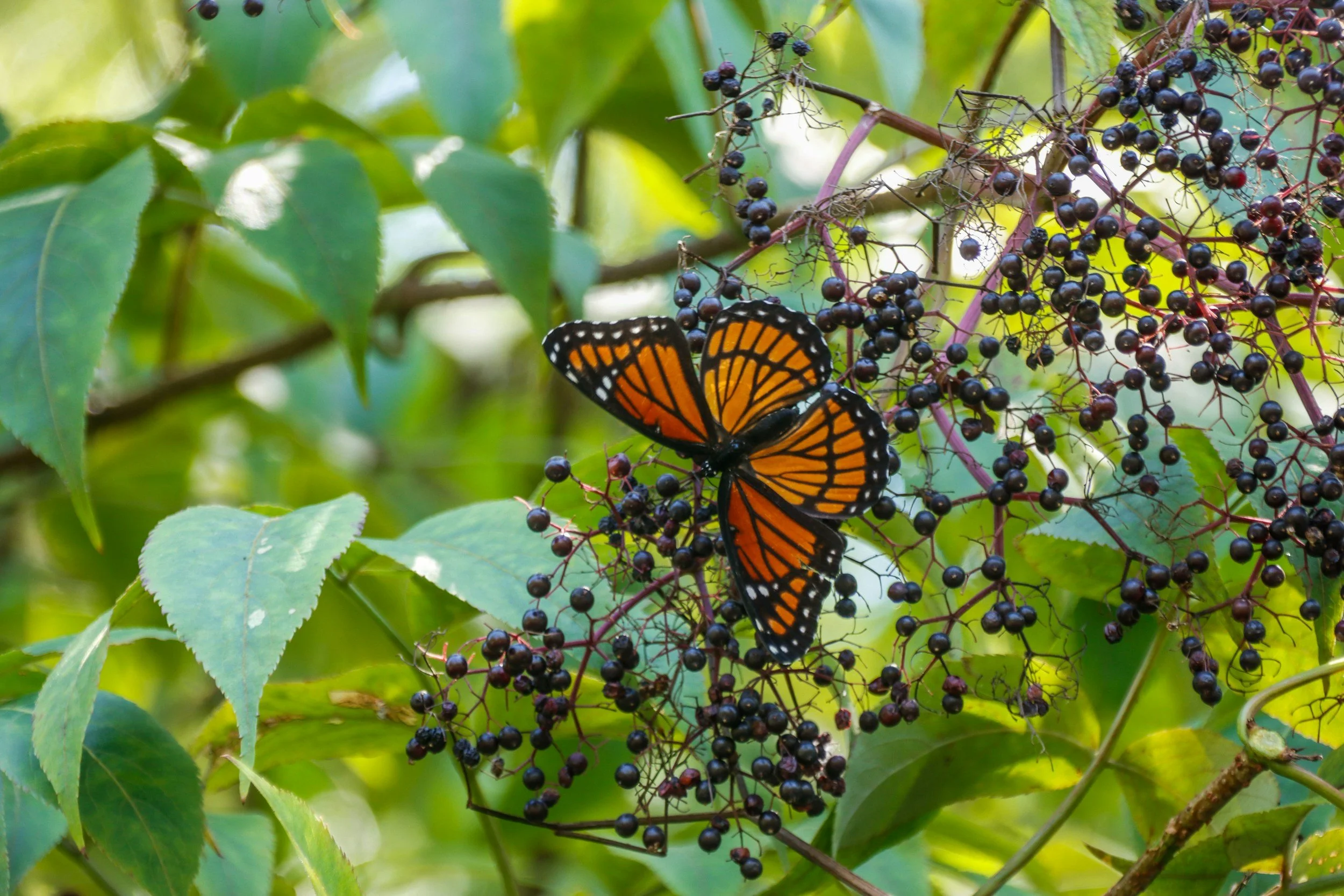
Elder is a deciduous shrub or small multi-stemmed tree, commonly six to twenty feet tall, with woody bark-covered stems marked by raised corky lenticels. Cut a stem and you will find a wide core of soft white pith, which is the feature that gave the plant its old name of pipe tree and its use for whistles and popguns.
The leaves are pinnately compound and arranged in opposite pairs along the stem, each leaf carrying five to eleven serrated leaflets. Look at the serrations closely, because the vein pattern is a reliable identification check: on elder the secondary veins run toward the tips of the teeth or fade before reaching the margin, rather than terminating in the notches between them.
Flowers appear in broad flat-topped or slightly domed clusters called cymes, cream to off-white, small and five-petaled, with a heavy sweet scent on warm days. The fruit that follows is a small dark purple to black drupe, roughly the size of a BB, borne in those same flat-topped clusters which bend downward as the berries fill.
Constituents
The berries are unusually rich in anthocyanins, principally cyanidin-3-glucoside and cyanidin-3-sambubioside, which account for the deep pigment and most of the measured antioxidant activity. Alongside these sit flavonols including quercetin, rutin, and kaempferol, phenolic acids such as chlorogenic acid, organic acids, and a modest amount of vitamin C.
Two other constituent groups matter for safety rather than benefit. Sambucus species contain lectins, some of which are type II ribosome-inactivating proteins, distributed through the bark, fruit, and seeds. The plant also produces the cyanogenic glycoside sambunigrin, concentrated in leaves, stems, seeds, and unripe fruit rather than in ripe berry pulp. Both groups are addressed by heat, which is covered in detail below.
Related species worth knowing
Red elder, Sambucus racemosa, is a true elder with red berries carried in conical or dome-shaped clusters rather than flat ones. It carries a higher toxin load than black elder and is not used for syrup by most practitioners.
Dwarf elder or danewort, Sambucus ebulus, is herbaceous rather than woody, dying back to the ground each winter, and it holds its berry clusters upright instead of letting them droop. Its fruits and leaves contain ebulin lectins and it is treated as toxic.
How to Identify Elder With Confidence
If you are not one hundred percent certain of the plant, do not consume it. There is no partial credit in plant identification, and no amount of cooking, straining, or processing makes a misidentified plant safe. Every point in the checklist below has to match. If a single one does not, or you find yourself talking yourself into it, walk away and buy dried berries from a supplier instead.
If you are buying dried berries from a reputable supplier you can skip ahead, but anyone harvesting should be able to run through a short checklist without hesitating. Elder should satisfy every one of these points, and a plant that fails any single one is not elder.
- Woody stems with bark. Elder is a shrub or small tree that persists through winter. Its stems are covered in bark and dotted with raised corky lenticels.
- Soft white pith inside the stem. Cut a branch crosswise and the center is filled with spongy tissue that is white, not brown or tan. Take the cut from older or second-year wood rather than the soft new growth at the tips, where the color is less definitive.
- Opposite compound leaves. Leaves sit in pairs directly across from one another, and each leaf is divided into five to eleven toothed leaflets.
- Flat-topped clusters. Both flowers and fruit are carried in broad, roughly flat cymes rather than long hanging strings or tall spikes.
- Vein pattern at the leaf margin. Secondary veins run toward the tips of the teeth or fade out before the edge, rather than ending in the notches between teeth.
- No thorns anywhere. Elder has none, on any part of the plant.
- Ripe fruit is dark purple to black and the loaded cluster droops under its own weight.
Poisonous Look-Alikes
Three plants account for nearly all elderberry misidentification, and they ripen in the same season and often the same ground. The differences are clear once you know what to check.
| Plant | What it is | How to tell it apart from elder |
|---|---|---|
| Pokeweed Phytolacca americana |
Herbaceous perennial to ten feet, all parts toxic. The most common source of confusion, since it grows in the same disturbed ground and ripens at the same time. | Smooth magenta or purple stem with no bark and no pith. Leaves are simple, alternate, and smooth-edged rather than compound, opposite, and toothed. Berries hang in long drooping strings called racemes rather than flat clusters. Dies to the ground each winter, so there is no woody framework. |
| Devil's walking stick Aralia spinosa |
Woody deciduous shrub of eastern North America, ten to twenty-five feet, with fruit that resembles elderberry closely from a distance. | Thorns. The main stem and the leaf nodes carry stout spines, and elder has none anywhere. The leaves are also enormous and doubly compound, and the fruit is carried on branching panicles rather than a flat cyme. |
| Water hemlock Cicuta species |
Among the most poisonous plants in North America. Confusion happens at the flowering stage, when its white umbels can pass for elderflower at a glance. | Herbaceous, not woody: green ridged stems, frequently purple-streaked or mottled, with no bark and no white pith. Leaves are triply compound with narrow leaflets arranged alternately. Leaf veins terminate in the notches between the teeth rather than at the tips. Grows in wet ground along ditches, marshes, and stream banks. It never produces dark berries. |
| Poison hemlock Conium maculatum |
A second deadly member of the carrot family that can be confused with elderflower at the blooming stage. | Smooth hairless stem blotched with purple, fern-like finely divided leaves, and an unpleasant musty smell when crushed. Herbaceous throughout, with no woody stem or pith. |
| Red elder Sambucus racemosa |
A true elder, but with a higher toxin load and a different fruit. | Berries are red, and the cluster is conical or pyramidal rather than flat. Fruits earlier in the season than black elder. The reliable secondary check is pith color: cut an older or second-year branch crosswise and red elder shows brown to orange-brown pith, where black elder is white. Young tip growth can read pale on both, so take the cut from mature wood. This works before the fruit has colored and settles cases where the cluster shape is ambiguous. |
| Dwarf elder Sambucus ebulus |
Also a true elder, containing ebulin lectins, and treated as toxic. | Herbaceous rather than woody, dying back to the ground each winter, and it holds its berry clusters upright instead of letting them droop. |
The single fastest field check is the stem. Elder is woody, bark-covered, and filled with soft white pith. Pokeweed, water hemlock, and poison hemlock are all herbaceous with green or purple stems and no pith. Devil's walking stick is woody but thorny. If the stem does not match, stop there.
Two further practices are worth building in. Strip the berries from their stems before cooking, since the green stems carry considerably more cyanogenic glycoside than the fruit does, and a cluster that comes into the pot whole brings all of it along. And harvest away from roadsides, sprayed field margins, and industrial ground, because elder takes up what is in the soil around it.
Need Something from The Shop?
Check out these handmade, holistic and/or herbal goodies!




How Elder Was Used Traditionally
Elder occupies an unusual position in European herbal practice, having been treated less as a specific remedy than as a whole household pharmacy standing in the hedgerow. In 1655 the German physician Martin Blochwich published Anatomia Sambuci, translated into English as The Anatomy of the Elder, an entire volume devoted to the medicinal uses of one plant. John Evelyn, writing in Sylva in 1664, described elder in terms suggesting a remedy against nearly every complaint, and that framing is the origin of the phrase about elder being the medicine chest of country people.
Within that broad reputation, two preparations did most of the work. The flowers were taken as a hot infusion during fever, classed as a relaxing diaphoretic because they encourage sweating while easing tension rather than stimulating, and they were traditionally combined with peppermint and yarrow for exactly that purpose. The berries were cooked down into a thick preparation called a rob, sweetened and kept through winter, and given for coughs, colds, and chest complaints.
Other uses ran alongside these. The flowers went into infused oils and washes for the skin, and the berries were made into wine, vinegar, and preserves as much for the table as for the medicine shelf. In Northern European folklore the plant carried its own protective figure, the Elder Mother or Hylde-Moer of Danish tradition, and permission was asked before cutting elder wood. Whatever one makes of the folklore, the practical effect was a habit of restraint in harvesting.
In North America, Sambucus nigra subsp. canadensis was used by many Indigenous nations, with recorded applications spanning the berries as food and the flowers in preparations for fever and inflammation. Practices differed considerably between nations, and the surviving ethnobotanical record is uneven, so treating it as a single tradition would flatten something that was not uniform.
Why Elderberries Have to Be Cooked
This is the part most recipes reduce to a one-line warning, and the mechanism is worth understanding because it tells you what the cooking step is actually accomplishing.
Two separate constituent groups are involved. The first is a family of lectins, some of which are type II ribosome-inactivating proteins found in the bark, fruit, and seeds of Sambucus. Laboratory work has shown these lectins resist digestion in simulated gastric and duodenal fluid in their native state, which means eating raw berries does not break them down the way ordinary dietary protein is broken down. The same work found that five to ten minutes in a boiling water bath rendered them fully susceptible to digestive enzymes, and that up to twenty minutes of heating cost less than ten percent of the anthocyanin content and antioxidant activity. Heat solves the problem without meaningfully costing you the compounds you wanted.
The second group is the cyanogenic glycosides, chiefly sambunigrin, which release hydrogen cyanide when enzymatically broken down. These sit mostly in the leaves, stems, seeds, and unripe fruit rather than in ripe berry pulp, and analysis of American elderberry has found no quantifiable cyanogenic glycoside in commercial juice. Content varies by plant part, by species, by ripeness, and by growing conditions, which is a reasonable argument for handling every batch the same conservative way rather than assuming your berries are the low end of the range.
The consequences of skipping the step are documented. In 1983 a group of people in California drank juice pressed from raw elderberries that included leaves and stems, and were hospitalized with nausea, vomiting, weakness, and dizziness. Two features of that incident are instructive: the material was raw, and it included the parts of the plant that carry the highest toxin load.
The practical rule. Use ripe berries only, strip them from their stems, and bring the pot to a genuine rolling boil before dropping it back to a simmer. A forty-five minute simmer clears the ten-minute threshold with a wide margin. Never make a tea or infusion from elder leaves, bark, stems, or root, because steeping is not cooking and those parts remain unsafe regardless.
Contraindications and Cautions
- Infants under twelve months. This is about the honey, not the elderberry. Raw honey can carry Clostridium botulinum spores, which an infant gut cannot handle. A honey-sweetened syrup is off the table until the first birthday.
- Pregnancy and breastfeeding. Cooked berries in culinary amounts are traditionally regarded as fine, but medicinal doses have not been studied adequately in either group. Clear it with your provider.
- Autoimmune conditions and immunosuppressant medication. Caution here is standard advice, based on the reasoning that an immunomodulating herb may work against a drug prescribed to suppress immune activity. Worth stating plainly: the 2021 systematic review found no evidence that elderberry overstimulates the immune system, so the concern remains theoretical rather than demonstrated. If you are on tacrolimus, ciclosporin, mycophenolate, or a biologic, or you have had a transplant, this is a conversation for your physician rather than a decision to make alone.
- Diabetes medication. Elder has been reported to have insulin-stimulating and glucose-lowering effects, so anyone on insulin or an oral hypoglycemic should monitor more closely when starting.
- Diuretics. Elder flower in particular is a mild diuretic, with a theoretical additive effect alongside prescription diuretics.
- Allergy. Elderberry contains the recognized allergen Sam n1, and reactions have been reported. Start with a small amount if you have a history of pollen or fruit allergy.
- Quantity. Elderberry is mildly laxative in volume, and loose stools are the usual sign of taking more than you need.
- Product adulteration. Testing of commercial elderberry products has repeatedly found adulteration and mislabeling, with cheaper fruit substituted for elderberry. Buy dried berries from suppliers who publish identity testing, or grow and dry your own.
Elderberry Syrup Recipe
The recipe works with dried or fresh berries. Fresh berries carry their own moisture, so the fresh version uses roughly twice the berries by volume and half the added water, and it finishes faster. Both versions yield about three cups of syrup.
Version A: Dried Berries
- 1 cup dried elderberries
- 4 cups filtered water
- 1 cup raw honey
Version B: Fresh Berries
- 2 cups fresh ripe elderberries, stripped from the stems
- 2 cups filtered water
- 1 cup raw honey
Optional Aromatics
- 2 tbsp fresh ginger, grated, or 1 tbsp dried ginger root
- 1 tsp ground cinnamon, or one cinnamon stick
- 1/2 tsp ground cloves, or four whole cloves
Method
- Combine the berries, water, and any aromatics in a non-reactive saucepan, meaning stainless steel or enamel rather than bare aluminum or cast iron, since the anthocyanins react with those metals.
- Bring the pot to a full rolling boil. This step is not decorative, because the boil is what deactivates the lectins, and it needs to be an actual boil rather than a hot simmer.
- Reduce to a low simmer and hold it, partially covered, for forty-five to sixty minutes with dried berries or thirty to forty-five minutes with fresh, until the liquid has reduced by roughly half.
- Mash the softened berries against the side of the pot with the back of a spoon to release the remaining pigment, then take the pot off the heat.
- Let the mixture cool until it is comfortable to handle, then strain through a fine mesh sieve or a double layer of cheesecloth, pressing or squeezing firmly. You should end up with about two cups of liquid. Compost the spent berries.
- Let the liquid cool below 110°F, or 43°C, before the honey goes in. Above that, heat degrades the enzymes and volatile compounds that made raw honey worth using. If you have no thermometer, the liquid should feel barely warm rather than hot on the back of your wrist.
- Stir in the honey until it has fully dissolved, then pour into a clean glass jar or bottle, label it with the date, and refrigerate.
Yield: about 3 cups, or 720 ml.
Dosing, Storage, and Shelf Life
Suggested amounts
- Adults: one tablespoon daily through cold and flu season, or one tablespoon every three to four hours at the onset of symptoms.
- Children over one: one teaspoon daily, or one teaspoon every three to four hours at onset.
- Infants under twelve months: not suitable, because of the honey.
One point of intellectual accuracy is worth making here. The clinical trials used standardized commercial extracts at defined concentrations, typically 15 ml four times daily. Homemade syrup is a different preparation of unknown potency, varying with your berries, your reduction, and your ratios, so the dosing above comes from traditional practice rather than from the trials.
Storage
- Honey version, refrigerated: two to three months. There is no preservative and no pH testing in a home kitchen, so treat the longer figures circulating online with skepticism.
- Maple syrup, coconut sugar, or cane sugar versions, refrigerated: two to four weeks. These lack honey's antimicrobial activity and spoil considerably faster.
- Freezer: pour into an ice cube tray, freeze, and transfer the cubes to a bag. They keep six months or more, and one cube is roughly a tablespoon.
- Discard at any sign of mold, an off or alcoholic smell, or a sharp change in taste. Mild fizzing in a raw honey syrup can indicate wild fermentation rather than spoilage, but it means the preparation is changing and is best used up quickly or refrigerated harder.
What the Research Actually Shows
Elderberry has more clinical research behind it than most traditional herbs, and the results conflict in a way that tracks closely with who paid for the study. Both of those facts belong in the same paragraph.
The positive trials
The two studies that built elderberry's modern reputation were run by Zakay-Rones and colleagues. The first, published in 1995, followed 27 people during an influenza B outbreak in Panama and reported symptom improvement within two days in the treated group against six days in the control. The second, published in 2004, enrolled 60 adults in Norway with laboratory-confirmed influenza and reported that symptoms were relieved on average four days earlier, with significantly less use of rescue medication.
Both trials tested Sambucol, and both were sponsored by the manufacturer of that product. That does not make the results false, and the methodology of the 2004 trial was reasonable for its size, but manufacturer sponsorship is a documented predictor of favorable outcomes across the supplement literature and it lowers the confidence any reader should place in these figures. It is worth adding that even in the positive 2004 trial, both groups fully recovered within the same total window of about eight days.
The 2019 meta-analysis by Hawkins and colleagues pooled four randomized trials covering 180 participants and reported a substantial reduction in upper respiratory symptom duration, with a larger effect for influenza than for colds generally. The authors declared no financial interest in the subject matter. The limitation is structural rather than personal: three of the four trials it pooled were the industry-funded ones, so the meta-analysis inherits their bias no matter how disinterested its authors were.
The negative trial
The most methodologically rigorous independent test of elderberry was published by Macknin and colleagues in 2020. It was an investigator-initiated, FDA-approved Investigational New Drug study run out of three Cleveland Clinic emergency rooms, double-blind and placebo-controlled, enrolling 87 patients over age four with laboratory-confirmed influenza and symptoms of under 48 hours. Funding came from the Wendel Family Foundation and Cleveland Clinic, with the study product supplied by a manufacturer that provided no financial support and had no role in design or analysis.
The finding was no evidence that elderberry shortened the duration or reduced the severity of influenza. A post hoc analysis suggested that elderberry taken without oseltamivir produced outcomes two days worse than placebo taken alone, a result the authors treated cautiously given it was not the primary analysis. Their own summary noted that the results contradicted the earlier studies and that further work was needed.
The systematic review
Wieland and colleagues applied Cochrane methods to the whole body of evidence in 2021, screening 1,187 records and including five randomized trials. Their conclusions were carefully hedged: elderberry probably does not reduce the risk of catching a cold, it may reduce the duration and severity of colds and the duration of influenza but the evidence is uncertain, and there is no evidence that it overstimulates the immune system. That last point is worth holding onto, since concerns about cytokine overproduction circulated widely during the COVID-19 period and this review looked for that signal specifically and did not find it.
Laboratory findings
Away from the clinic, the mechanistic work is more consistent. Extracts have shown dose-dependent inhibition of nitric oxide release and protection against induced cellular toxicity in cell culture, and reviews of the plant's bioactive profile describe a substantial range of polyphenolic and terpenoid compounds with antioxidant and anti-inflammatory activity in vitro. Cell-culture results describe what a compound does to cells in a dish, which is a starting point for research rather than a demonstration of what happens in a person.
A fair summary. Elderberry has four centuries of documented household use, an excellent safety record when prepared correctly, and a clinical record where the favorable results came mainly from manufacturer-funded studies and the best independent trial found nothing. It is a reasonable thing to keep in the fridge through the winter. It is not a proven antiviral, and anyone selling it as one is going past the evidence.
Frequently Asked Questions
Can you eat raw elderberries?
No. Raw berries contain lectins that resist digestion in their native state, and the stems, seeds, leaves, and unripe fruit carry cyanogenic glycosides. Raw consumption causes nausea, vomiting, weakness, and dizziness. Five to ten minutes at a boil deactivates the lectins, and cooking costs you under ten percent of the antioxidant content.
What plants look like elderberry but are poisonous?
Pokeweed, devil's walking stick, and water hemlock are the three main ones, with poison hemlock a fourth risk at the flowering stage. The fastest check is the stem: elder is woody with bark and soft white pith, pokeweed and both hemlocks are herbaceous with no pith, and devil's walking stick is covered in thorns.
Is elderberry syrup safe for children?
Properly cooked elderberry syrup is generally considered safe for children over twelve months. The age cutoff is set by the honey rather than the berries, since raw honey can carry botulism spores that an infant gut cannot handle. Check with your child's provider on amounts.
How long does homemade elderberry syrup last?
Two to three months refrigerated when sweetened with honey, and two to four weeks when sweetened with maple syrup or sugar. Freezing it in ice cube trays extends that to six months or more.
Can I use fresh elderberries instead of dried?
Yes. Use roughly twice the volume of berries and half the water, since fresh fruit brings its own moisture, and expect a shorter simmer of thirty to forty-five minutes. Strip the berries from their stems first, because the green stems carry more cyanogenic glycoside than the fruit.
Does elderberry cause a cytokine storm?
The 2021 systematic review looked specifically for evidence of immune overstimulation and did not find any. The concern circulated widely during the pandemic and remains theoretical rather than demonstrated. People on immunosuppressant medication should still clear it with their physician.
Does elderberry work for the flu?
The evidence is split and the funding pattern is worth knowing. Trials reporting a four-day benefit were sponsored by the extract manufacturer, and the strongest independent trial, run at Cleveland Clinic in 2020, found no benefit. A Cochrane-methods review concluded it may shorten influenza duration but rated the evidence uncertain.
Why can't I make tea from elder leaves or bark?
Those parts carry the highest concentrations of cyanogenic glycosides and lectins, and steeping in hot water does not neutralize them the way boiling the berries does. Only the ripe berries and the flowers are used.
Sources
- Vaher M, et al. Lectin digestibility and stability of elderberry antioxidants to heat treatment in vitro. Molecules. 2017. PubMed
- Appenteng MK, et al. Cyanogenic glycoside analysis in American elderberry. Molecules. 2021. PMC
- Wieland LS, Piechotta V, Feinberg T, et al. Elderberry for prevention and treatment of viral respiratory illnesses: a systematic review. BMC Complement Med Ther. 2021;21(1):112. PMC
- Macknin M, Wolski K, Negrey J, Mace S. Elderberry extract outpatient influenza treatment for emergency room patients ages 5 and above: a randomized, double-blind, placebo-controlled trial. J Gen Intern Med. 2020;35(11):3271-3277. PubMed
- Hawkins J, Baker C, Cherry L, Dunne E. Black elderberry (Sambucus nigra) supplementation effectively treats upper respiratory symptoms: a meta-analysis of randomized, controlled clinical trials. Complement Ther Med. 2019;42:361-365. PubMed
- Zakay-Rones Z, Thom E, Wollan T, Wadstein J. Randomized study of the efficacy and safety of oral elderberry extract in the treatment of influenza A and B virus infections. J Int Med Res. 2004;32(2):132-140. Manufacturer-sponsored. PubMed
- Ferreira SS, Martins-Gomes C, Nunes FM, Silva AM. Elderberry (Sambucus nigra L.) extracts promote anti-inflammatory and cellular antioxidant activity. Food Chem X. 2022;15:100437. PubMed
- Liu D, He XQ, Wu DT, et al. Elderberry (Sambucus nigra L.): bioactive compounds, health functions, and applications. J Agric Food Chem. 2022;70(14):4202-4220. PubMed
- Jiménez P, et al. Effects of short-term heating on total polyphenols, anthocyanins, antioxidant activity and lectins of different parts of dwarf elder (Sambucus ebulus L.). Plant Foods Hum Nutr. 2014. Springer
- American elderberry: commercial production guide, including illustrated look-alike identification. Alabama Cooperative Extension System. ACES
- Blochwich M. Anatomia Sambuci, 1655. English translation, The Anatomy of the Elder, 1670.
- Evelyn J. Sylva, or A Discourse of Forest-Trees, 1664.
- Tierra M. Planetary Herbology. Lotus Press, 1988.
- Tierra L. Healing with the Herbs of Life. Crossing Press, 2003.
If you want to go further with this plant, my articles archive covers more of the winter apothecary, and there is additional material in the free resources collection.

A 37-page lye soap handbook built around one recipe: 90% beef tallow, 10% castor oil, 5% superfat. Exact grams measurements for each ingredient, the chemistry behind saponification, troubleshooting, adding color and scent naturally, and a printable batch log.