
Instant Pot Rotisserie Chicken Recipe (Plus What's in Store-Bought)
Key Takeaways
- The Costco rotisserie chicken ingredient label reads: whole chicken, water, and seasoning (salt, sodium phosphate, modified food starch, potato dextrin, carrageenan, sugar, dextrose, spice extractives).
- That seasoning is injected into the muscle as a solution before roasting, not rubbed on the outside.
- Carrageenan is a common trigger for bloating, cramping, and gut irritation. The degraded form of the same seaweed extract is classified by IARC as a possible human carcinogen.
- Phosphate additives are absorbed almost completely, while phosphorus bound in whole food is not. Higher serum phosphate tracks with cardiovascular risk even in people with normal kidney function.
- Sodium is not the problem. Commodity salt of undisclosed origin injected into a bird you did not season is a different question from salting your own food generously.
- Costco packs the chicken hot into a soft plastic bag. A 2024 study found leachate from heated takeout plastic altered gut microbiota and damaged heart tissue in rats.
- A whole chicken cooks in an Instant Pot at roughly 6 minutes per pound under high pressure, followed by 10 to 15 minutes of natural release. Verify 165°F in the thigh before serving.
This article is for educational purposes only and is not medical advice, diagnosis, or treatment. Nothing here has been evaluated by the FDA. Speak with a qualified healthcare provider before changing your diet, supplements, or any prescribed treatment.
This post contains Amazon affiliate links. As an Amazon Associate I earn from qualifying purchases, at no additional cost to you.
The Costco rotisserie chicken is the most famous prepared food in America. Five dollars, three to four pounds, sold below cost to get you through the door, and Costco moves well over a hundred million of them a year. It is a strong deal on protein, and the carcass makes broth, which is most of the reason it stays in so many weeknight rotations.
The ingredient label is where it gets more complicated. The bird is injected with a solution before roasting, and that solution contains sodium phosphate, carrageenan, modified food starch, potato dextrin, sugar, dextrose, salt, and a category called spice extractives that Costco has never disclosed. Then it goes into a plastic bag while it is still hot.
This article covers what each of those ingredients is doing, what the research says about the two that carry real evidence against them, how Costco compares to other retailers, and how to make a better version at home in about ten minutes of active work.
Where the Bird Comes From
Costco raises and processes its own chickens at a vertically integrated plant in Fremont, Nebraska, which is how the price holds at $4.99 while everything else in the deli climbs. Reporting on the facility puts the savings at roughly 35 cents per bird. These are conventional broilers, housed indoors at density and fed a corn and soy ration for six to seven weeks.
That ration shapes the fat in the meat, because chickens are monogastric and deposit dietary fatty acids into their tissue largely unchanged. Pasture access improves the picture, though the improvement is often overstated online. Independent work shows that access to forage produces a measurable shift toward omega-3 fatty acids and a lower omega-6 to omega-3 ratio. Feed composition drives that shift more than outdoor access on its own, so a bird on pasture still eating a corn and soy ration will look closer to a conventional bird than to one raised on corn-free and soy-free feed. Many of the striking ratio figures circulating online come from farm marketing pages rather than independent testing, so treat specific numbers with caution.
Chicken fat also stays relatively high in polyunsaturated fat regardless of how the bird was raised. That is a structural feature of poultry, not a farming failure. If you are working to lower dietary PUFA, chicken skin and dark meat are worth accounting for, and ruminant fat is the more reliable lever.
What you control cleanly is the additive load. A whole raw chicken has one ingredient. Whatever else ends up in it, you put there.
Instant Pot Rotisserie Chicken Recipe
Total time runs about 50 minutes for a 4 pound bird, including come-to-pressure and natural release. Active time is closer to ten minutes.
Ingredients
- 1 whole chicken, skin on, 4 to 5 pounds
- 2 tablespoons of a heat-stable cooking fat such as butter, ghee, tallow, or coconut oil
- 2 teaspoons unrefined salt, or more to taste
- 1 teaspoon black pepper
- 2 teaspoons paprika or smoked paprika
- 1 teaspoon garlic powder
- 1 teaspoon onion powder
- 1 cup water or chicken broth
- Optional: rosemary, thyme, or sage
Salt generously. A four pound bird can take two to three teaspoons without tasting salty, and under-seasoning is the most common reason a home version tastes flat next to a store-bought one.
On the fat: skip seed oils here. High heat and repeated oxygen exposure degrade polyunsaturated oils quickly, and the sauté step runs hot. My full breakdown of which fats hold up to heat is in the cooking oils guide.
Instructions
- Dry and season. Pat the chicken dry inside and out with a towel. Moisture on the skin prevents browning. Combine the salt, pepper, paprika, garlic powder, and onion powder, then rub the mixture over the entire surface and inside the cavity. Tuck herbs into the cavity if you are using them.
- Sear. Set the pot to Sauté on high and add the fat. When it shimmers, lower the chicken in breast side down and leave it alone for four to five minutes. Turn it and brown the back for another three. This step is optional but it improves both color and flavor considerably. Remove the chicken and set it aside.
- Deglaze and add liquid. Pour in the cup of water or broth and scrape the bottom of the pot with a wooden spoon until nothing is stuck. Skipping this is the most common cause of a burn notice.
- Position the bird. Set the trivet in the pot and place the chicken on top, breast side up. Stainless steel mason jar rings work if you do not have a trivet. The chicken needs to sit above the liquid, not in it.
- Pressure cook. Seal the lid, set the valve to sealing, and pressure cook on high for 6 minutes per pound. A 4 pound bird runs 24 minutes. Use the calculator below if the math is awkward.
- Natural release. When the timer ends, leave the pot alone for 10 to 15 minutes. The pressure drops on its own and the meat reabsorbs juice instead of losing it. Release any remaining pressure manually afterward.
- Check the temperature. Insert an instant-read thermometer into the thickest part of the thigh without touching bone. It should read 165°F. If it is short, seal the lid and pressure cook for another 3 to 5 minutes.
- Crisp the skin. Pressure cooking will not brown skin. Transfer the chicken to a sheet pan and broil on the top rack for 3 to 5 minutes until the skin is golden. Stay at the oven and watch it. It goes from pale to burnt in under a minute.
- Rest. Let it sit 10 minutes before carving.
How Long Should I Cook My Chicken?
Pressure cook for 24 minutes on high, then allow 10 to 15 minutes of natural pressure release.
Always confirm 165°F in the thickest part of the thigh before serving.
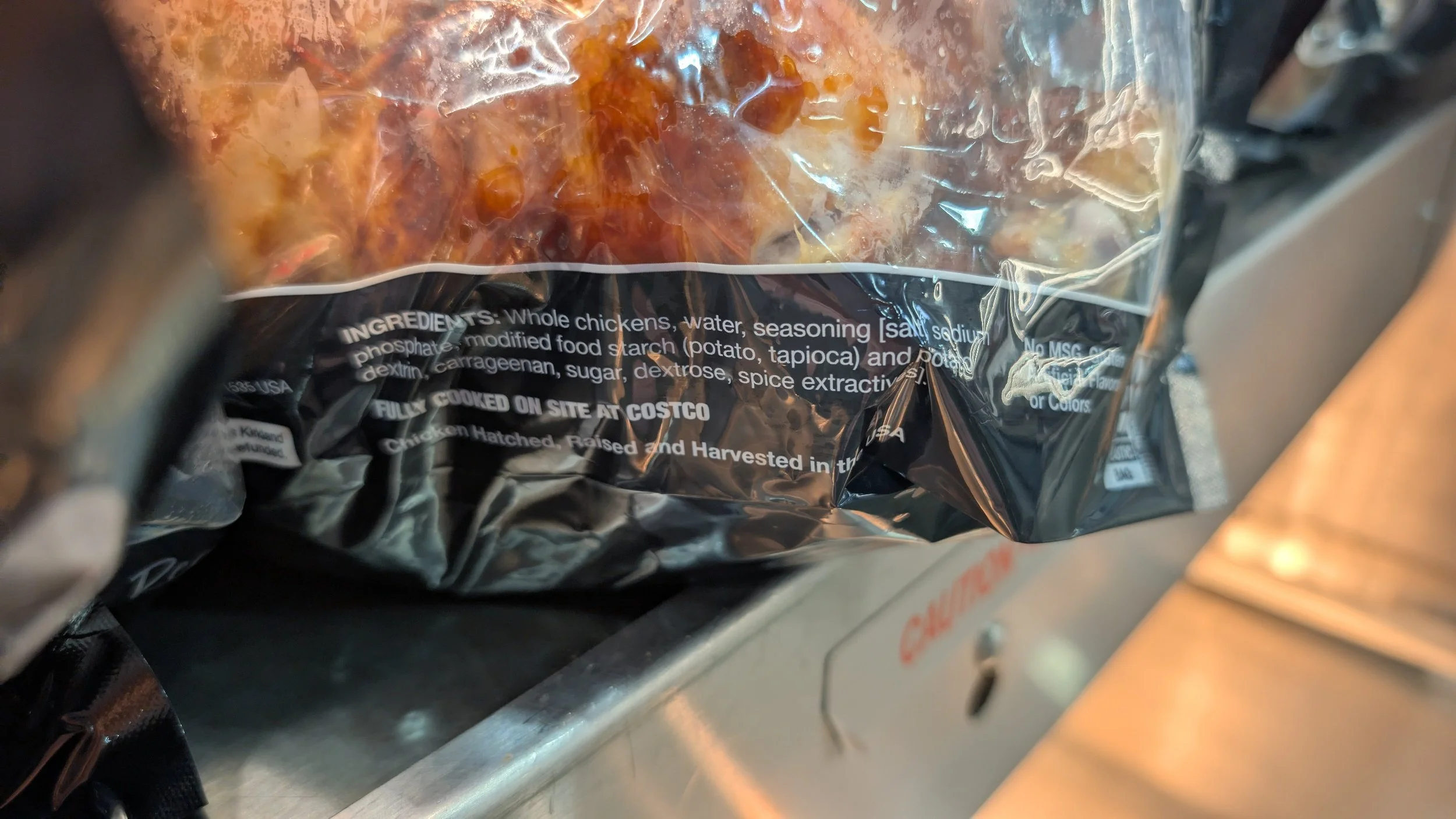
The Costco Rotisserie Chicken Ingredient Label
Here is the full label as it appears on the package, with what each item is doing. Jump to any ingredient for the detail.
Ingredients
Whole chicken, water, seasoning (salt, sodium phosphate, modified food starch, potato dextrin, carrageenan, sugar, dextrose, spice extractives)
| Ingredient | What it does |
|---|---|
| Salt | Flavor, moisture retention |
| Sodium phosphate | Raises pH so the muscle holds water |
| Modified food starch | Binder, keeps the solution in the meat |
| Potato dextrin | Binder, contributes surface gloss |
| Carrageenan | Seaweed-derived water binder |
| Sugar | Browning, balances the salt |
| Dextrose | Browning, simple sugar |
| Spice extractives | Undisclosed solvent-extracted spice concentrates |
The seasoning is injected into the muscle as a solution before roasting, not applied to the surface. Sodium runs about 460 mg per 3 ounce serving, roughly 2,400 mg across the whole bird.
What Each Ingredient Is Doing
Sodium Phosphate
Phosphate salts are the backbone of poultry injection solutions. They raise the pH of the meat and increase its water-holding capacity, which is why an injected bird stays juicy after sitting under a heat lamp for hours. It also means part of what you are buying by weight is water.
The health concern is bioavailability. Phosphorus bound in whole foods like meat, dairy, and legumes is absorbed at roughly 40 to 60 percent. Phosphate added as a salt is absorbed at close to 100 percent, so a small amount on the label translates into a disproportionate serum load. Analytical work on enhanced meat and poultry has repeatedly found substantially higher phosphorus in additive-containing products than in their unenhanced counterparts, which is why renal dietitians flag them by name.
Elevated serum phosphate is well established as a mortality and cardiovascular risk factor in chronic kidney disease. It also tracks with risk in people whose kidneys work normally. A community cohort of more than 57,000 adults found higher phosphate correlated with increased cardiovascular events across all levels of kidney function, not only in the CKD groups. A cross-sectional study in middle-aged Finnish adults found associations between food-additive phosphate intake and carotid intima-media thickness, an early marker of arterial change. These are observational findings and cannot establish causation on their own. They are enough to make a weekly source of highly absorbable phosphate worth reconsidering.
Sources: McGovern et al., PLoS ONE 2013 · Itkonen et al., Nutrition Journal 2013 · Jackson Heart Study, AJCN 2022
Carrageenan
Carrageenan is a sulfated polysaccharide extracted from red seaweed, used here as a water binder alongside the phosphate. It is the ingredient I hear about most from readers, and for good reason. Bloating, cramping, and general gut irritation after eating carrageenan-containing foods is a widely reported pattern, common enough that it is worth taking seriously even where the controlled data has not caught up.
The research picture has two layers. The degraded form of the same seaweed extract, called poligeenan, has been used for decades to induce intestinal inflammation and ulceration in laboratory animals, and it is classified by the International Agency for Research on Cancer as a possible human carcinogen. Poligeenan is not permitted as a food additive, and industry-affiliated reviews lean heavily on that distinction, arguing that food-grade carrageenan does not produce intestinal lesions in feeding studies conducted under good laboratory practice.
The second layer is where the distinction gets less reassuring. Independent researchers, principally Joanne Tobacman's group, argue that the inflammatory activity comes from carrageenan's molecular structure, specifically its alternating alpha-1,3 and beta-1,4 galactosidic bonds and its high degree of sulfation, and therefore occurs with both molecular weight ranges. Cell studies using food-grade carrageenan have shown activation of inflammatory transcription factors in intestinal epithelial tissue. A small randomized trial of a no-carrageenan diet in ulcerative colitis patients reported longer intervals to relapse. Industry published a critique of that trial and the authors published a reply, and both are worth reading if you want to see how the disagreement is conducted.
My position: the mechanistic case is unsettled, the human data is thin in both directions, and carrageenan contributes nothing nutritionally. It is in the chicken to hold water. When a large number of people report the same symptom after eating the same ingredient, that is a signal, and the absence of a definitive trial is not evidence that they are wrong. There is no cost to leaving it out.
Sources: Tobacman reply, Nutr Healthy Aging 2019 · Weiner, Crit Rev Toxicol 2002 (industry-affiliated)
Salt, and Why Sodium Is Not the Problem
A three ounce serving carries around 460 mg of sodium, which works out to roughly 2,400 mg across a whole bird. Most coverage of this chicken treats that number as the headline problem. I disagree, and I want to be specific about why.
Sodium is an essential nutrient. It regulates fluid balance, supports nerve conduction and muscle contraction, and is required for adrenal function and stomach acid production. The blanket advice to minimize it does not hold up well against the observational data. The PURE study, following more than 100,000 people across 17 countries, found the lowest rates of mortality and cardiovascular events at sodium intakes between roughly 3 and 5 grams per day, with risk rising at intakes below that range as well as above it. A 2018 Lancet analysis from the same group found sodium associated with cardiovascular events only in communities averaging above 5 grams per day. Graudal's meta-analysis reached a similar shape, with both low and excessive intake associated with higher mortality than usual intake. These findings are contested and the methodology has been challenged, particularly the use of spot urine estimates. They are strong enough that "eat less salt" is not the settled advice it is often presented as.
Most people I work with are under-salting rather than over-salting, and feeling it as fatigue, lightheadedness on standing, cramping, and poor sleep. If you eat mostly whole foods and cook at home, salting to taste is reasonable.
What nobody can tell you about this chicken is what salt is in it. Injection-grade commodity salt is purchased on price. Its source, its refining process, its anti-caking agents, and its contaminant testing are not disclosed anywhere on the package, and there is no mechanism by which a customer could find out. That is the actual objection. It is not the milligram count, it is that you are eating an unspecified industrial ingredient in an unspecified quantity, alongside phosphate salts you did not choose.
A note for accuracy, because this cuts against the way the argument is usually made online: third-party testing has generally found more heavy metal and microplastic contamination in unrefined salts than in refined ones. Pink Himalayan salt in particular has tested for measurable lead, arsenic, and aluminum, and one Australian analysis of 31 pink salt samples found a product exceeding the national lead limit. Refining removes contaminants along with the trace minerals. I use unrefined salt because I prefer minimally processed ingredients and because the flavor is better, and I buy brands that publish third-party testing. Choosing unrefined salt is not automatically choosing a cleaner salt.
Sources: Mente et al., Lancet 2018 · O'Donnell et al., NEJM 2014 · Lead Safe Mama, independent XRF and lab testing
Modified Food Starch, Potato Dextrin, Sugar, and Dextrose
Four of the eight seasoning ingredients are starches and sugars. Modified food starch and potato dextrin act as binders and help the injected solution stay in the meat. Potato dextrin also contributes to the glossy surface. Sugar and dextrose provide browning and a hint of sweetness that rounds out the salt.
The quantities per serving are small, and the carbohydrate count on the panel rounds to about half a gram. The point is not that a rotisserie chicken will spike your blood sugar. The point is that a product marketed as roasted chicken contains four separate carbohydrate additives, and none of them are there for your benefit. They are there to hold water, which is weight, which is margin.
Spice Extractives
This is the ingredient Costco has never explained, and it is the one I find most objectionable on principle. Spice extractives are concentrated oleoresins and essential oil fractions pulled from spices using solvents such as hexane, ethanol, or supercritical CO2. Which spices, which solvents, and what carrier or emulsifier system delivers them into the brine is not disclosed and is not required to be.
Related flavoring categories have the same structural problem. "Natural flavors" is a regulatory classification covering flavoring substances derived from plant, animal, or microbial sources, and a single listing can represent dozens of individual compounds plus the solvents, carriers, and preservatives used to deliver them. Those incidental additives do not have to be itemized. Propylene glycol as a solvent, BHA as an antioxidant, and polysorbate 80 as an emulsifier can all sit inside a two-word listing.
Polysorbate 80 is worth a specific note, because a claim circulates that dietary polysorbate 80 opens the blood-brain barrier. That comes from nanoparticle drug-delivery research, where the compound is applied as a particle coating specifically to achieve that effect, and it does not transfer to food doses. The stronger evidence concerns the gut. A double-blind controlled-feeding trial in healthy adults found that the emulsifier carboxymethylcellulose reduced gut microbial diversity, lowered short-chain fatty acid production, increased postprandial abdominal discomfort, and in two participants produced microbiota encroachment into the inner mucus layer. Ex vivo work on human microbiota found that carboxymethylcellulose and polysorbate 80 both produced lasting detrimental shifts in composition and function, while several other emulsifiers did not.
What bothers me about these categories is not any single compound. It is that they are designed so that you cannot know what you ate.
Sources: Chassaing et al., Gastroenterology 2022 · Naimi et al., Microbiome 2021
What Is Not on the Label
Two things worth crediting. Costco's rotisserie chicken contains no added MSG and no gluten-containing ingredients, both of which appear in competing products. It also does not carry the long preservative list found in some supermarket versions.
The reason I still make my own is that the eight ingredients it does have are eight more than a chicken needs, and two of them have real evidence attached.
The Hot Plastic Bag
This is not an ingredient, and I would still rank it above several items above it.
Costco moved its rotisserie chickens from rigid plastic clamshells to soft plastic bags in 2021, framed as a plastic reduction measure. By weight it is. From an exposure standpoint it is arguably worse, because the bag collapses onto the bird and holds direct contact across most of the surface while the chicken is still at serving temperature, and it traps steam against the film for the entire trip home.
Heat accelerates the migration of plasticizers and the shedding of microplastic particles into whatever the plastic is touching. A December 2024 study in Ecotoxicology and Environmental Safety examined this in two parts. A questionnaire study of 3,179 people found high-frequency plastic exposure associated with congestive heart failure at an odds ratio of 1.13, confidence interval 1.03 to 1.24. That is a modest association from self-reported exposure data and should be read as such. The animal arm is more striking. Rats drank leachate from disposable plastic takeout containers exposed to boiling water for one, five, or fifteen minutes, over three months. All exposure groups showed altered gut microbiota composition, inflammatory cell infiltration in the myocardium, mitochondrial swelling, and elevated serum markers of oxidative stress and inflammation. There was no dose-response gradient between the shortest and longest exposures, which the authors interpret as risk that does not depend on contact duration.
Related work by Marfella and colleagues in 2024 found micro- and nanoplastics in the carotid plaque of over 60 percent of surgically treated patients, and those patients had roughly a 4.5-fold higher rate of heart attack, stroke, or death over the following 34 months.
If you buy the chicken, get it out of the bag as soon as you walk in the door. If you cook it at home, the exposure does not exist.
Source: Wu et al., Ecotoxicology and Environmental Safety 2024, vol. 288
How Costco Compares to Other Store Rotisserie Chickens
Costco is not the worst option in this category, which is worth saying plainly. Reported sodium figures across major retailers run roughly as follows.
| Retailer | Sodium per 3 oz | Injected? |
|---|---|---|
| Kroger Simple Truth | About 40 mg | No |
| Costco Kirkland Signature | About 460 mg | Yes |
| Sam's Club Member's Mark | About 550 mg | Yes |
| Walmart | About 690 mg | Yes |
The sodium column is a proxy for whether the bird was injected, which is the distinction that matters. A 40 mg reading means salt, spices, and nothing else. Anything in the 400 to 700 range means a solution went in, and where there is a solution there are almost always phosphates.
Figures come from retailer nutrition panels as reported in consumer coverage and vary by cut and by region. Read the panel in front of you rather than relying on this table.
How to Buy a Better Rotisserie Chicken
Some weeks you are going to buy one. Here is how to sort the options quickly.
Read the ingredient panel, not the front of the package. "All natural" and "no artificial ingredients" are marketing terms with limited regulatory meaning. Rotisserie chickens are often labeled on a small sticker rather than a printed package, so check the deli case if the bird you are holding has none.
Look for a three-item list. The best case reads chicken, salt, spices. Kroger's Simple Truth line has been reported at 40 mg of sodium per serving against Costco's 460, which tells you it was never injected. Whole Foods and many regional natural grocers carry minimally processed options alongside conventional ones, and the difference in ingredient count is usually stark.
Watch for the word "enhanced" or a solution percentage. Labels reading "contains up to 15% solution" or "enhanced with chicken broth" indicate injection. Anything described as a solution, marinade, or broth injection is carrying phosphates.
Scan for the phosphate family. Sodium phosphate, sodium tripolyphosphate, potassium phosphate, and disodium phosphate all belong to the same category.
Scan for carrageenan specifically if you have had gut symptoms after eating one. It is the most common source of that complaint in this product category.
Get it out of the bag. Transfer the chicken to a plate or glass dish as soon as you are home rather than leaving it sealed in warm plastic through the drive and another twenty minutes on the counter.
Do Not Throw Away the Carcass
The frame from a single chicken makes about two quarts of broth, which is the part of this whole exercise that pays for itself.
Return the stripped carcass to the Instant Pot along with any skin, cartilage, and pan drippings. Add a roughly chopped onion, two carrots, two celery ribs, a bay leaf, and a tablespoon of apple cider vinegar, then cover with water to the two-thirds fill line. Pressure cook on high for 90 minutes and allow a full natural release.
Strain, cool, and refrigerate. A well-made broth from a good bird will gel in the refrigerator, which indicates intact collagen. It keeps five days refrigerated or six months frozen. Freeze in glass jars with headspace, or in silicone trays for smaller portions.
You can do this with a Costco carcass too, and it is worth doing. Bear in mind that the injection solution concentrates into the broth along with everything else, so a broth made from an enhanced bird will be considerably saltier and will carry the phosphate load. Taste before you salt it.
Storing the Cooked Chicken
Carve the meat off the bone within two hours of cooking or purchase and refrigerate it in a glass container. Whole cooked chicken cools slowly, and the interior can sit in the temperature danger zone for an uncomfortably long time if you refrigerate the bird intact.
Cooked chicken keeps three to four days refrigerated and about four months frozen. Freeze it in portions with a little broth to keep it from drying out on reheating.
Frequently Asked Questions
What are the ingredients in Costco rotisserie chicken?
Whole chicken, water, and seasoning, with the seasoning listed as salt, sodium phosphate, modified food starch, potato dextrin, carrageenan, sugar, dextrose, and spice extractives. Costco has never disclosed which spices the extractives are drawn from.
What is injected into Costco rotisserie chicken?
A saline solution built around salt and sodium phosphate, with carrageenan and modified starches as water binders and sugar and dextrose for browning. It goes into the muscle before roasting, which is why the seasoning is present throughout the meat rather than only on the skin.
Why does Costco rotisserie chicken upset my stomach?
Carrageenan is the most likely candidate. It is a seaweed-derived water binder, and digestive upset after eating carrageenan-containing foods is a common and widely reported reaction. Sodium phosphate and the starch additives can also contribute for sensitive people. The simplest way to find out is to eliminate carrageenan across your diet for a few weeks and see whether the symptoms resolve.
Does Costco rotisserie chicken have MSG?
No added MSG appears on the label, and Costco has confirmed this. Free glutamates can still be present in undisclosed spice extractives, though the label does not list yeast extract or hydrolyzed protein, which are the usual hidden sources.
Is Costco rotisserie chicken gluten free?
Costco has stated that it is. The modified food starch is potato and tapioca based rather than wheat based. If you have celiac disease, confirm with the deli, since formulations and regional suppliers can change.
How much sodium is in a Costco rotisserie chicken?
About 460 mg per 3 ounce serving, roughly 2,400 mg for the whole bird. That is high for a single product, though total sodium matters less than most coverage suggests, and the phosphate salts injected alongside it are the more meaningful concern.
Is Costco rotisserie chicken healthy?
It is a strong protein source at an unbeatable price and better than most convenience foods. It is also injected with a solution containing sodium phosphate, carrageenan, four carbohydrate additives, and undisclosed spice extractives, then packed hot into plastic. The phosphate and the carrageenan are the two items worth the most attention.
Why is Costco rotisserie chicken so cheap?
Costco sells it as a loss leader to drive foot traffic, and it raises and processes its own birds at a vertically integrated plant in Nebraska, which reportedly saves around 35 cents per chicken. The injection solution also adds water weight, so part of what you are buying by the pound is brine.
How many minutes per pound do you cook a whole chicken in an Instant Pot?
Six minutes per pound on high pressure, followed by 10 to 15 minutes of natural pressure release. A 4 pound chicken cooks for 24 minutes, a 5 pound chicken for 30. Confirm 165°F in the thickest part of the thigh before serving.
Can you cook a frozen chicken in an Instant Pot?
You can, but skip the sear and increase the time to roughly 9 minutes per pound. A frozen bird will not brown, the seasoning will not adhere well, and the cavity often stays undercooked. Thawing overnight in the refrigerator produces a much better result.
Why is my Instant Pot chicken skin soggy?
Pressure cooking is a moist heat method and cannot crisp skin. The broiler step is what fixes this. Pat the skin dry before broiling and give it 3 to 5 minutes on the top oven rack.
How long does cooked chicken last in the refrigerator?
Three to four days in a sealed container. Carve the meat off the bone within two hours rather than refrigerating the whole bird, which cools too slowly for safety.
Final Thoughts
The Costco rotisserie chicken is a strong deal and a reasonable emergency dinner. It is also eight seasoning ingredients injected into the muscle, two of which have real evidence against them, one of which the company has never explained, and a plastic bag pressed against several pounds of hot meat.
Making one at home takes ten minutes of attention and about forty minutes of waiting. You choose the bird, the salt, and the pot, and the carcass becomes two quarts of broth on the same day. If you keep buying them, read the panel, pick the shortest list on the shelf, and get it out of the bag as soon as you are through the door.









Cropped with a cozy, oversized, cropped fit and big pockets. One size fits most. Handmade by me from damaged and/or vintage quilts.